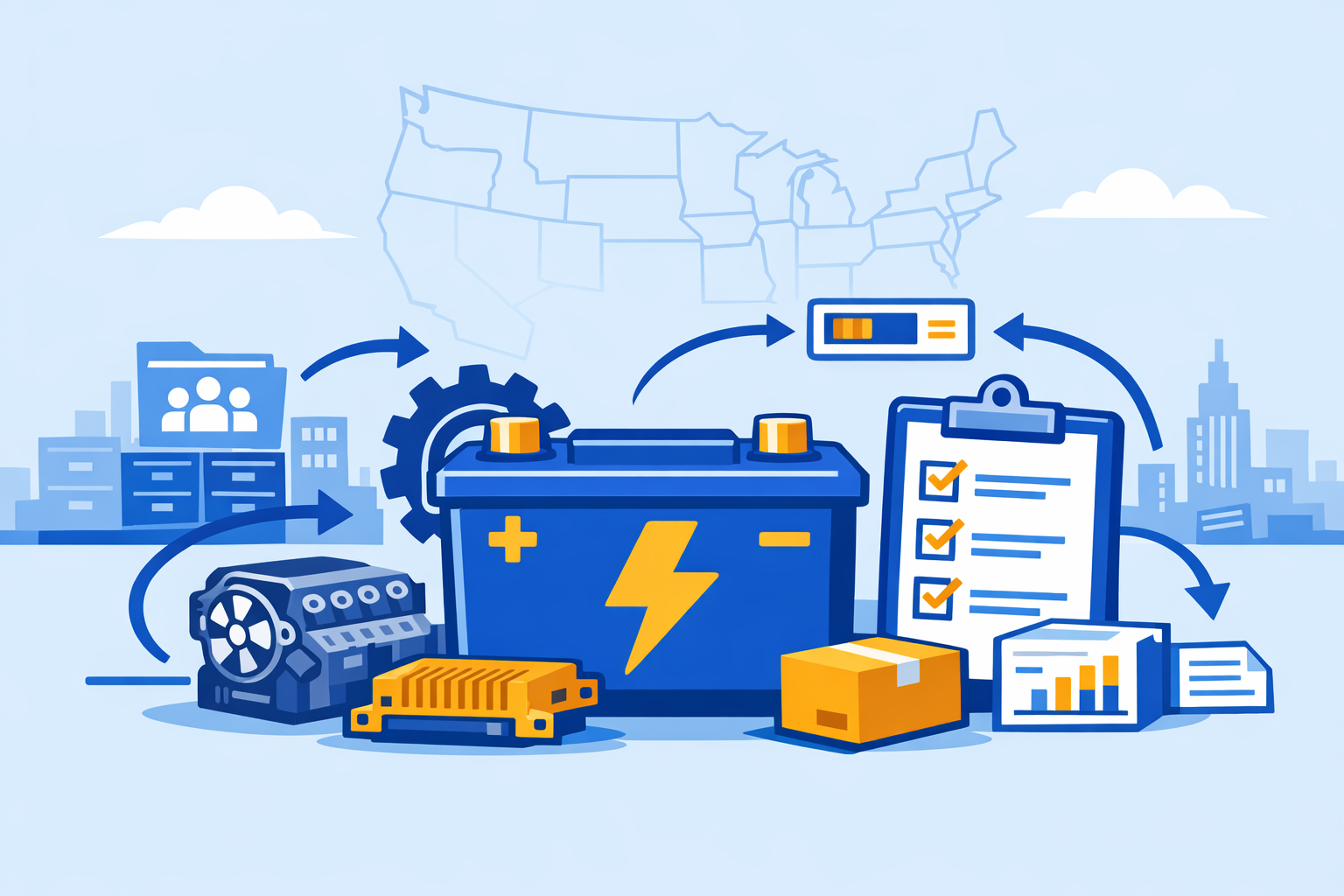
A growing number of U.S. states are advancing battery extended producer responsibility (EPR) laws with compliance deadlines concentrated in 2027 and 2028-and auto parts manufacturers are squarely in scope. For suppliers that produce or sell battery-containing components across multiple states, the regulatory window is narrowing faster than many anticipated.
The shift extends beyond consumer electronics. As electric vehicle adoption accelerates, state legislatures are broadening the definition of "covered batteries" to capture automotive components-from 12V modules to power packs and mobility device batteries. For the auto parts supply chain, this emerging framework represents one of the most consequential compliance obligations of the decade.
A Patchwork of State Laws, Converging on the Same Window
No single federal battery EPR law governs the U.S. market. Instead, individual states have enacted or are enacting separate statutes, each with its own definitions, timelines, and fee structures. The result is a regulatory mosaic that auto parts producers must navigate state by state.
California, Illinois, and New York have been highlighted by EPA officials as early adopters of battery stewardship programs[1], offering implementation models that other states are now following. Colorado, Oregon, Illinois, Nevada, New York, Vermont, and Washington all have new or recently enacted laws covering electronics and battery EPR.
The critical window for auto parts makers centers on 2027 and 2028, when a cluster of state deadlines converge:
| State | Key Law | Primary Deadline | Core Obligation | Disposal/Retail Ban |
|---|---|---|---|---|
| Wisconsin | Battery EPR Act | January 2027 | Join BSO; submit collection & management plan | TBD |
| Colorado | Battery Stewardship Act | August 2027 | Participate in approved stewardship plan | January 2030 |
| Connecticut | Battery Stewardship Act (2025) | January 2027 | Member of a Battery Stewardship Organization | July 2028 (retail) |
| Illinois | Battery Stewardship Act | January 2026 (active) | Approved stewardship plan required to sell in-state | January 2028 |
| Nebraska | Safe Battery Collection & Recycling Act | January 2028 | Join Battery Stewardship Organization | January 2028 |
| Washington | Battery Stewardship Program | July 2027 (portable) | Join BSO or file individual plan; appear on approved state list | January 2027 (portable) |
Sources: Product Stewardship Institute, Landbell Group, Call2Recycle / The Battery Network, National Law Review
Wisconsin's new law, effective January 2027, requires battery producers to join a stewardship organization and create a collection and management plan. The stewardship organization is responsible for collecting covered batteries on a "free, continuous, convenient, visible, and accessible basis" and using fees from battery producers to reimburse local governmental units for collection activities.
In Nebraska, the Governor signed the Safe Battery Collection and Recycling Act into law in May 2025. Starting in 2028, producers of covered portable and medium-format batteries must join a Battery Stewardship Organisation whose program-approved and monitored by the Nebraska Department of Environment and Energy-must include clear performance goals for consumer awareness, collection, and recycling efficiency.
In Colorado, starting August 1, 2027, producers must participate in and fund an organization with a submitted plan to sell or distribute covered batteries. As of July 1, 2029, retailers may only sell these products if the producer belongs to an organization with an approved plan. Retailers, producers, and organizations are also prohibited from charging point-of-sale fees to fund the program.
What Auto Parts Producers Are Actually Required to Do
Join a Battery Stewardship Organization
The central compliance obligation across all enacted laws is participation in an approved Battery Stewardship Organization (BSO). Extended producer responsibility, as defined by the OECD, assigns producers financial or physical responsibility for a product's entire lifecycle, including management or disposal of post-consumer products. In the United States, EPR is frequently implemented at the state level and covers multiple product categories, including batteries and e-waste.
BSOs collect fees from participating producers and use those funds to finance collection infrastructure, consumer education, and recycling operations. The Product Stewardship Institute advocates for EPR laws that level the playing field by requiring all battery producers to financially support recycling programs, relieving local governments and taxpayers of the burden of managing disconnected programs.
Fees vary by state. In Colorado, fees include a $50,000 plan submission fee, an $86,000 approval fee, and an annual administrative fee to cover oversight costs. Additional per-unit or weight-based assessments are anticipated as programs mature.
Update Labels and Packaging
Product labeling is another non-negotiable compliance area. Washington's Battery Stewardship Program requires product markings that are "permanent, clearly visible, and legible." By January 1, 2028, markings must include the producer's brand. By January 1, 2030, batteries must also carry the crossed-out wheeled bin symbol and information on battery chemistry, defined as the names, symbols, or codes recognized by ANSI, IEC, or SAE standards.
For auto parts manufacturers already managing complex packaging streams, these requirements signal a need to review and potentially redesign component labeling across product lines sold into covered states.
Report Sales and Recycling Data
Quarterly and annual reporting obligations are embedded in most enacted laws. Organizations must submit annual reports detailing implementation progress, with the first reports due as programs reach full operation. As states refine their rules, more granular data on end-of-life units, recycling pathways, and collection volumes is expected.
The Federal Backdrop: EPA Framework in Progress
While state laws are already moving forward, a voluntary federal framework is also in development. The Infrastructure Investment and Jobs Act requires the EPA and the U.S. Department of Energy to develop a national EPR framework for batteries addressing recycling goals, cost structures for mandatory recycling, reporting requirements, product design, collection models, and transportation of collected materials.
The U.S. EPA expects to publish its framework for battery EPR programs in summer 2026. The voluntary guide is intended for states implementing programs and draws on input from industry stakeholders.
The framework is not meant to serve as a model bill for states. Rather, it provides a high-level examination of design, collection, reporting, and regulatory considerations for battery EPR programs, alongside an overview of current practices and challenges from existing battery EPR states.
The EPA under the Trump administration has emphasized that the framework will advance a national goal to recover more critical minerals from domestic sources, as part of the federal government's effort to reduce reliance on imports and create U.S.-based jobs. This framing aligns battery stewardship with broader domestic supply chain security goals-a political dynamic likely to sustain regulatory momentum regardless of shifting priorities elsewhere.
Levers such as incentives or eco-modulated fees may encourage manufacturers to consider recyclability earlier in the design process, resulting in products that are easier to disassemble and enabling efficient battery removal at end of life.
Compliance Burden Is Disproportionate for Smaller Suppliers
While large OEMs and Tier 1 suppliers often maintain in-house sustainability and compliance teams, the multi-state EPR landscape creates an outsized burden for independent auto parts makers. Existing battery recycling regulations vary significantly across jurisdictions in legal enforcement, producer responsibility, waste classification, recycling targets, design standards, public engagement, and financial incentives-particularly given the complexities of global supply chains.
For suppliers operating across multiple states, maintaining separate reporting formats, fee structures, and labeling requirements represents a genuine operational challenge. Fragmented standards slow the cross-border movement of spent batteries and materials. Harmonized rules would make compliance costs more predictable and support wider capacity growth.
EPA hazardous-waste rules already impose handling fees of approximately $0.30-$0.80 per kilogram on battery-related waste streams in the United States. Across major markets, overall compliance can raise unit costs by roughly $0.50-$1.00 per kilogram.
The battery recovery market itself is growing rapidly. Analysts project the global battery recovery market will reach approximately $23.72 billion by 2035, at a compound annual growth rate of roughly 40.9%. For auto parts makers, early compliance investment may ultimately position them as preferred suppliers to OEMs seeking auditable recycling pathways.
Packaging and Labeling: The Hidden Compliance Layer
Beyond stewardship fees and reporting, the packaging implications of battery EPR are often underestimated. Several enacted laws explicitly require packaging designs that facilitate post-consumer separation and recycling-a requirement that intersects directly with existing state packaging EPR obligations auto OEMs and suppliers are already navigating. For context on how those packaging-specific EPR rules are evolving, see our earlier reporting on how auto OEMs are shifting recycled-content packaging strategies under 2026 EPR mandates.
Under the Colorado framework, collection points must be accessible statewide, including in rural and underserved communities. This requirement may indirectly affect how components are packaged and labeled to enable consumers and retailers to direct end-of-life products to appropriate collection infrastructure.
Suppliers that have already adapted packaging for consumer electronics recycling programs are best positioned to extend those practices into the automotive parts channel-particularly for 12V modules, hybrid battery packs, and e-mobility components that increasingly blur the line between consumer and automotive product categories.
Steps Auto Parts Makers Should Take Now
The 2027 window may appear distant, but regulatory timelines in this space are compressing. In Vermont, where the nation's first single-use household battery EPR law was enacted in 2014, battery collection increased by more than 180% in the first year of implementation. Early movers in battery stewardship have consistently outperformed laggards on both compliance cost and operational disruption.
The following steps outline a practical readiness pathway for auto parts producers:
1. Conduct an Internal Readiness Assessment Map all battery-containing products by state of sale, volume, and battery chemistry. Identify which products qualify as "covered batteries" or "battery-containing products" in each applicable jurisdiction. Document current end-of-life handling procedures and existing recycling partners.
2. Determine Producer Status in Each State Product manufacturers, brand owners, and distributors should evaluate whether they meet the definition of "producer." Obligated producers should create their own stewardship plan or register with a stewardship organization by the deadlines listed for each state. Each state applies slightly different criteria, requiring jurisdiction-by-jurisdiction review.
3. Register with a Battery Stewardship Organization Evaluate third-party BSOs for cost, reporting infrastructure, and multi-state coverage. Laws contain material fees that incentivize environmental performance, a stewardship plan, and opportunities to improve the plan as the program matures. Multi-state BSO membership can significantly reduce duplicative compliance overhead.
4. Update Product Labeling and Packaging Review labeling requirements by state and plan for phased updates. Washington's 2028 producer-brand marking requirement and 2030 chemistry labeling mandate should be factored into current product design cycles, not treated as a future problem.
5. Build Data Collection Infrastructure Establish scalable systems to track unit volumes by state, recycling pathway data, and collection metrics. Annual reporting is a standard element across all enacted laws, and quarterly disclosure obligations are under consideration in several states. Audit-ready data platforms will reduce duplication across multi-state filings.
6. Monitor Emerging Rulings and EPA Guidance Track final rule publications from state agencies. The U.S. EPA continues to develop a voluntary battery EPR framework to guide states working on extended producer responsibility programs, with the agency expecting to publish the framework in summer 2026 alongside a related Report to Congress.
Outlook: Toward a More Standardized Framework
Industry groups are pressing for standardized reporting templates and phased implementation windows to minimize supply chain friction. The EPA's forthcoming voluntary framework-informed by early-adopter states like California, Illinois, and New York-offers a meaningful opportunity to introduce consistency across the current mosaic of state rules.
The intent behind the federal framework has always been to develop guidance that helps states structure their design and implementation processes while offering some level of cross-jurisdictional consistency.[2] Whether that guidance arrives in time to influence the 2027 cohort of state deadlines remains to be seen.
For auto parts makers, the message is clear: the 2027-28 compliance window is not hypothetical. Multiple states including Wisconsin, Connecticut, Colorado, Nebraska, and Washington have enacted battery EPR laws with producer obligations taking effect between January 2027 and January 2028. Waiting for a federal standard before beginning compliance preparation is a risk few mid-size suppliers can afford.
Internal readiness assessments, BSO evaluation, and data infrastructure investment can be initiated now-and will pay dividends regardless of how individual state rules are finalized.
Frequently Asked Questions
Who qualifies as a "producer" under U.S. state battery EPR laws? Definitions vary by state but typically include the manufacturer of the covered battery or battery-containing product, the brand owner, or the first importer into the state. Auto parts suppliers should conduct a formal legal review of producer definitions in each state where they sell products.
Are large-format EV batteries covered under these new state laws? Most enacted state laws focus on portable and medium-format batteries. Large-format batteries-including full EV packs-are subject to separate assessment processes. Washington State's Department of Ecology, for example, was required to complete its assessment of large-format battery management by July 2027. However, labeling and marking requirements for large-format batteries begin taking effect in 2028 in Washington.
Do battery-containing products (not just standalone batteries) trigger compliance obligations? Yes. Most laws explicitly cover "battery-containing products," meaning auto components with embedded batteries-including certain 12V modules, hybrid power packs, and electronic control units with integrated batteries-may trigger producer obligations depending on how each state defines the covered product category.
What are the penalties for non-compliance? Consequences range from civil penalties and product bans to retailer liability. In Washington, noncompliance can lead to penalties, and the law creates a right of action for battery stewardship organizations to recover costs from a producer violating the law. Some states prohibit retailers from selling products from non-certified producers, effectively removing non-compliant suppliers from distribution channels.
Will the EPA's national framework preempt state laws? No. The EPA framework is not meant to serve as a model bill for states but rather a high-level examination of design, collection, reporting, and regulatory considerations. It is voluntary and advisory in nature. State laws already enacted will remain in effect, and additional states are expected to follow with their own legislation.