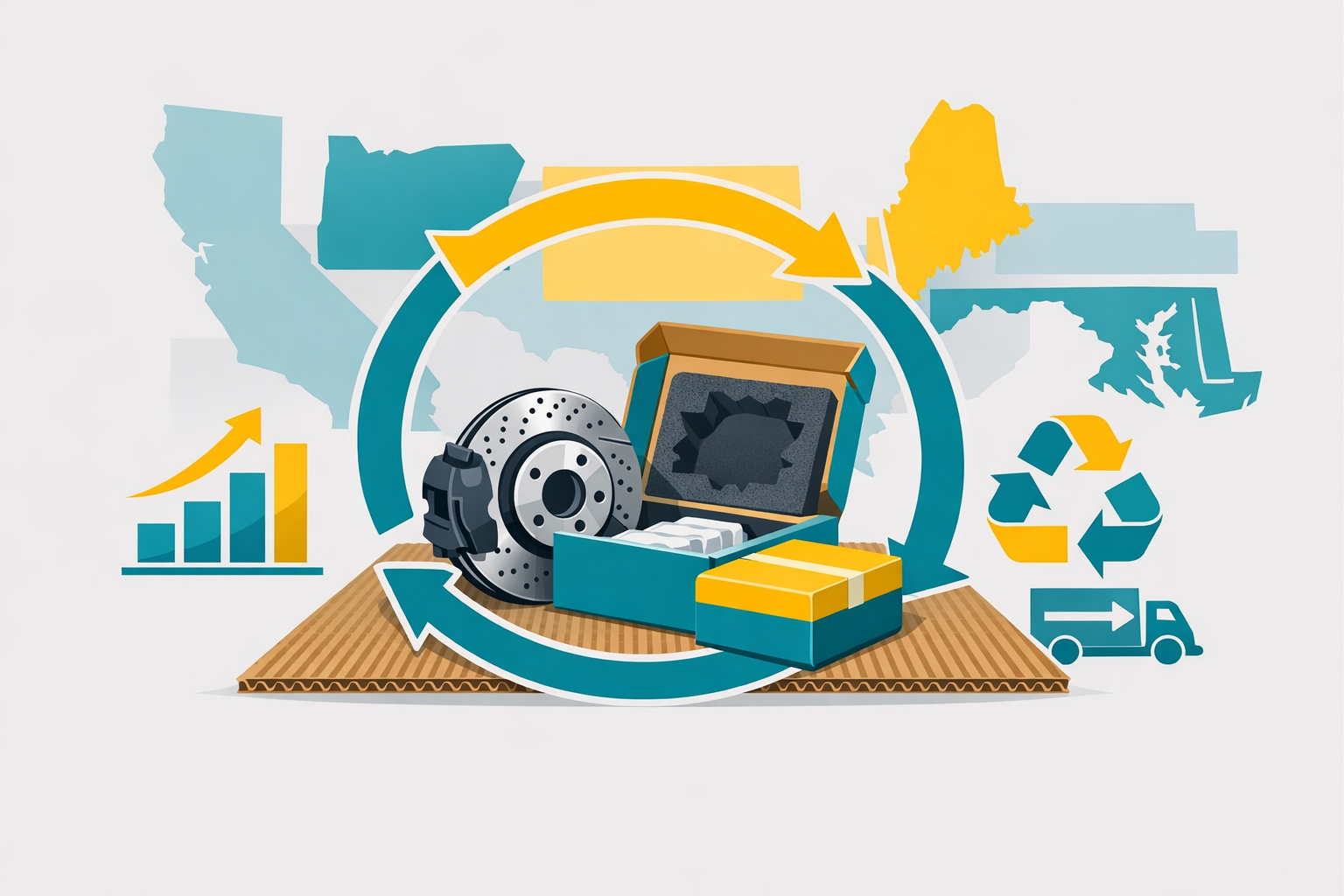
By 2027, automotive suppliers shipping packaged goods into California, Colorado, Maine, Oregon, and Maryland will face active financial obligations under state extended producer responsibility laws - and the compliance window is closing faster than many procurement teams realize.
State-enacted packaging EPR laws are rapidly reshaping obligations for companies that manufacture, distribute, or sell packaged products, shifting the financial and operational burden of packaging waste management from local governments and taxpayers to manufacturers, importers, and distributors. For an industry accustomed to managing packaging as a cost-of-goods line item, state-mandated take-back program fees represent a structural change in packaging economics.
Seven states currently have packaging EPR programs with key deadlines approaching. Implementation has accelerated, with several critical milestones converging in 2026 and 2027. Auto parts producers - from Tier 1 suppliers to aftermarket distributors - need a clear-eyed view of which states matter most, what the operational stakes are, and how to begin preparing today.
The Five-State Compliance Landscape
Not all seven EPR states carry equal urgency for the auto parts supply chain. The five states below represent the most critical compliance pressure points heading into 2027, based on program maturity, fee implementation timelines, and auto parts distribution volumes.
| State | Governing Law | Critical 2027 Milestone | Fee / Eco-Mod Approach | Auto Parts Relevance |
|---|---|---|---|---|
| California | SB 54 (2022) | PRO membership required by Jan 1, 2027; fee payments begin | Eco-modulated; based on recyclability & PCR content | High - large aftermarket & OEM distribution footprint |
| Colorado | HB 22-1355 (2022) | Annual fee cycle continues; eco-modulation schedule active | Tonnage-based fees with eco-mod credits | Mid - distribution hub for Midwest/West corridor |
| Maine | Stewardship Program (2021) | Full program goes operational; municipal reimbursements begin | Fees based on material type & tonnage supplied into state | Moderate - covers B2B packaging shipped into state |
| Oregon | SB 582 (2021) | Fee cycle matures; escalating recycling targets apply | LCA-linked eco-modulation; est. $0.076-$0.77 per lb | Moderate - enforcement penalties up to $25,000/day |
| Maryland | SB 901 (2025) | State publishes curbside recyclability list by Jul 1, 2027 | Multiple PROs permitted; eco-mod provisions included | Emerging - mid-Atlantic supply chains affected |
As of late 2025, seven states - Maine, Oregon, Colorado, California, Minnesota, Maryland, and Washington - had enacted comprehensive EPR packaging laws. Each state's approach shows general alignment on foundational elements despite unique procedural details.
At least two additional states introduced EPR legislation in 2026, and several others have existing proposals, signaling continued expansion of state-level programs. The patchwork is real - but it is converging.
What Auto Parts Producers Are Actually On the Hook For
Under EPR frameworks, producers bear responsibility for the entire lifecycle of packaging, from production through post-consumer disposal. In practice, this means several interlinked obligations:
Registration and PRO Membership
All seven states require producers to either join Producer Responsibility Organizations (PROs) - sometimes called Stewardship Organizations - or comply individually if the state pre-approves an individual compliance plan. To date, all U.S. states actively implementing EPR legislation have selected the Circular Action Alliance (CAA) as the designated PRO, creating a national through-line for compliance.
Eco-Modulated Fee Payments
Under EPR programs, materials - and their fees - are not created equal. These programs use eco-modulation to grade materials on a curve: the lower the environmental impact, the lower the fee. For auto parts packaging, this directly affects the economics of corrugated shippers, foam dunnage, multi-layer plastic wraps, and pallet stretch film - all common in automotive supply chains.
Brands using highly recyclable formats, higher post-consumer recycled content, or optimized packaging may pay lower fees. Packaging that disrupts recycling streams, contains toxic substances, or lacks recyclability may carry higher fees.
Data Reporting Requirements
Producers may be required to register with a state-approved PRO, submit detailed data reports on packaging quantities, pay eco-modulated fees, and maintain records for audit purposes. OEMs are expected to comply with EPR regulations and will need packaging information from their suppliers - meaning even suppliers not classified as direct "producers" may need to report packaging data to customers doing business in EPR-active states.
Business-to-Business Packaging Considerations
A critical nuance for auto parts suppliers: most B2B transactions are treated differently across state programs. States generally exempt packaging for certain transaction types, such as business-to-business shipments and packaging used for long-term product storage. Producers introducing de minimis amounts of packaging into a state may also qualify for exemptions. Suppliers should conduct a state-by-state assessment before assuming B2B exemptions apply uniformly.
The Design and Logistics Reckoning
EPR carries direct business implications for pricing, packaging design, and supply chain governance. Fee schedules and eco-modulation can shift unit economics, while reporting obligations require investments in data systems and board-level oversight. Early alignment of legal, sustainability, procurement, and finance functions can reduce compliance risk, lower total cost, and capture commercial advantage through more recyclable, lower-fee packaging.
For auto parts specifically, this translates into several concrete design and logistics challenges:
- Retooling protective packaging: Heavy-duty foam inserts and multi-layer plastic barriers commonly used for engine components, brake assemblies, and electronics are likely to carry higher eco-modulation penalties. Transitioning to corrugated alternatives or returnable/reusable dunnage requires qualification testing against damage rate benchmarks.
- Curbside recyclability thresholds: Maryland's program requires the state to develop a statewide list of covered materials determined to be recyclable or compostable through curbside programs by July 1, 2027 - a definition that will directly govern which auto parts packaging formats attract fee penalties.
- Logistics for take-back infrastructure: Carriers and third-party logistics providers moving auto parts in EPR-active states are beginning to factor recycling sortation and collection routing into lane planning. Suppliers coordinating return logistics for reusable dunnage or pallets will need contractual clarity on responsibility handoffs.
Brands should budget approximately 0.5-1% of annual sales for PRO fees, representing a 20%-40% increase in packaging spend. For high-volume auto parts distributors, that figure warrants integration into both procurement models and customer pricing structures before 2027 deadlines arrive.
Six Steps Auto Parts Producers Should Take Now
The following operational steps apply directly to packaging engineers, sustainability managers, procurement leads, and supply chain directors navigating multi-state EPR compliance.
Step 1 - Map all packaging categories by SKU and state. Conduct a full packaging audit across every SKU distributed into EPR-active states. Classify each packaging component by material type, weight, and recyclability. Consider starting with California, Colorado, and Oregon - the states with the earliest reporting deadlines.
Step 2 - Confirm "producer" status in each jurisdiction. Each state law differs in covered product types and producer definitions. Every company must review the producer definition under each state's packaging EPR law to determine whether it qualifies as a covered producer.
Step 3 - Register with CAA and submit supply data. The two most important steps any company can take now are to register with the designated PRO for each state and to collect packaging data for reporting according to state-specific criteria and deadlines.
Step 4 - Pilot EPR-enabled packaging redesign on selected SKUs. Identify two to five high-volume SKUs carrying high eco-modulation risk - typically multi-layer plastics or non-recyclable foam. Companies that shift away from high-fee materials can unlock significant savings to fuel further investments in R&D, material innovations, and packaging recovery.
Step 5 - Coordinate with recyclers to establish data-driven reporting. EPR will benefit plastics recyclers by increasing volumes recycled, reducing contamination, and driving infrastructure investment. Recyclers will carry responsibilities under these laws as well, including additional data reporting, site audits, and environmental standards. Early coordination with regional recyclers supports reporting accuracy and informs cost allocation models.
Step 6 - Integrate EPR fee forecasts into procurement and product pricing. Build fee forecasts into annual planning and create strategic packaging transformation plans by SKU to reduce fees and meet future compliance obligations. These tools can enable companies to generate SKU-level packaging reports for submission to local PROs.
For a broader view of how North American suppliers are aligning packaging specifications ahead of these mandates, see the related coverage on how auto suppliers are seeking unified packaging standards ahead of EPR rules.
Outlook: Patchwork Today, Convergence by 2027
With more state legislatures actively considering packaging EPR laws each year, absent federal action, companies should expect continued expansion of state-level programs. For auto parts producers, the five states profiled above represent the most immediate compliance obligations - but the trajectory points toward a broader multi-state reality within two to three years.
The suppliers best positioned for 2027 are those treating EPR not as a last-minute regulatory burden but as a signal to redesign packaging, tighten supply chain data infrastructure, and build recyclability into procurement strategy now. For organizations that engage early, there is an upside: a chance to control costs and capture a potential 6%-25% revenue uplift from increased sales volume, market share, new product offerings, and pricing premiums for sustainable goods.
The window to act ahead of enforcement is open. It will not remain open indefinitely.