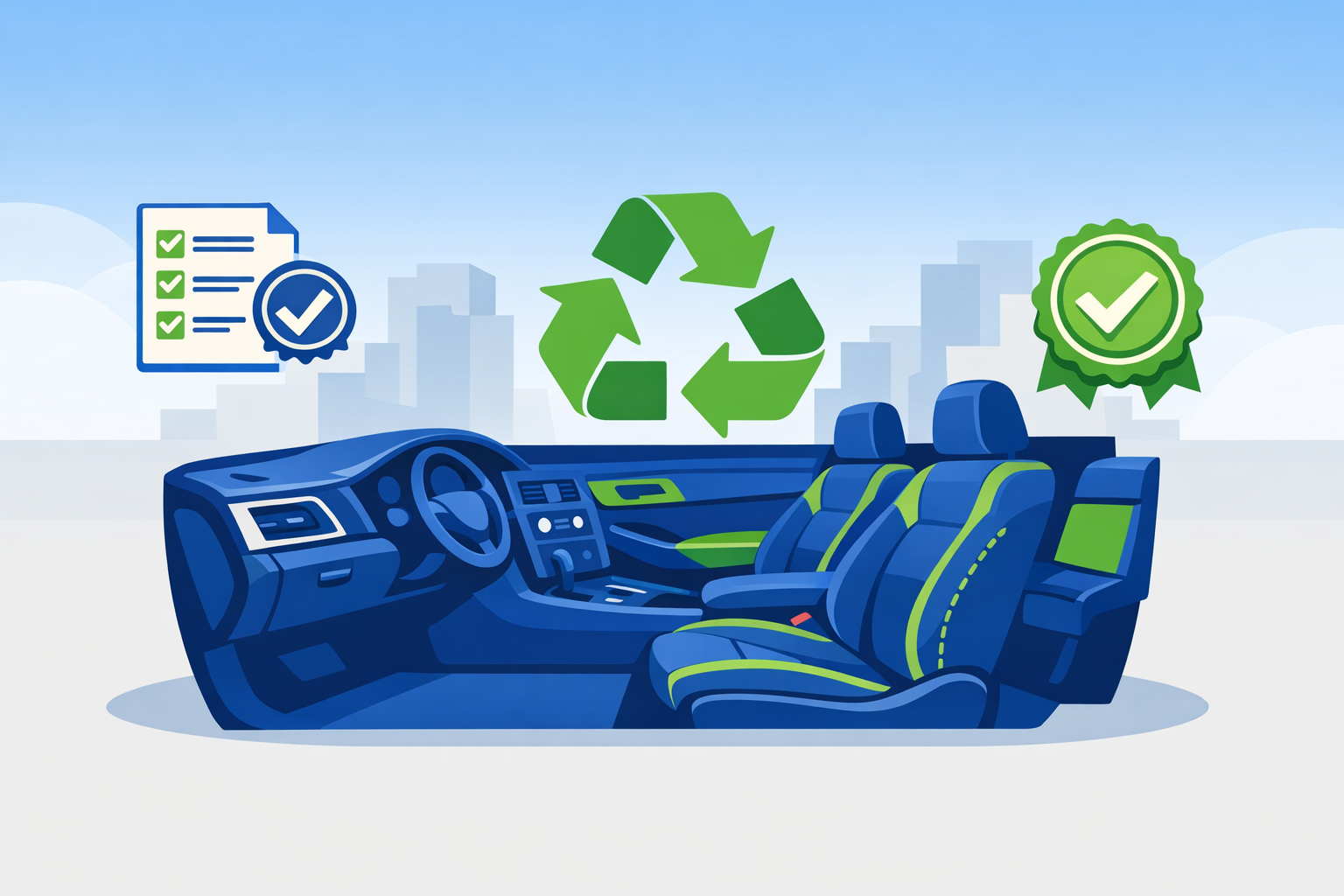
U.S. federal agencies and industry coalitions are advancing a coordinated effort to establish a unified national standard for recycled-plastic content in car interiors, with early guidance expected for automakers and Tier 1 suppliers. The initiative aims to replace a fragmented state-level compliance landscape with a single data-reporting and certification framework, potentially accelerating adoption of post-consumer recycled (PCR) materials across the domestic auto supply chain.
Background
The push for federal harmonization comes as automakers face widening divergence between domestic and international regulatory demands. In December 2025, the European Parliament and Council reached a provisional agreement on the EU's End-of-Life Vehicles (ELV) Regulation, a landmark circular economy measure. The EU agreement sets binding targets requiring plastics in new vehicles to contain a minimum of 15% recycled content within six years and 25% within ten years of the regulation entering into force. At least 20% of that recycled plastic must be sourced from closed-loop recycling-meaning material recovered from end-of-life vehicles.
In the United States, no equivalent federal mandate currently applies to vehicle materials. As of 2025, five states have enacted laws requiring certain containers and packages to meet minimum recycled-content standards, but these focus on packaging rather than durable vehicle components. While much of the legislative action has occurred at the state level, 2025 saw renewed interest in national coordination, creating compliance friction for automakers operating across multiple jurisdictions.
Major global markets including the European Union and Japan are advancing recycled-content requirements for vehicles, with mandatory thresholds expected within the next five to six years. To continue selling and exporting vehicles into these markets, U.S. automakers will need to meet these standards.
Details
Industry groups have identified the absence of a national framework as a structural obstacle for both OEMs and material suppliers. The American Chemistry Council has recommended that automotive OEMs include recycled-content standards as part of their material certification process and has called for federal and state-level initiatives to stimulate investment in national durable-plastics recycling infrastructure for collecting, separating, sorting, and processing end-of-life automotive plastics.
America's Plastic Makers, a coalition representing U.S. resin producers, has urged Congress to strengthen federal policy supporting end-of-life vehicle recycling, expand the use of recycled plastics-including materials produced through advanced recycling technologies-in new automobiles, and advance voluntary recycled-content standards aligned with emerging global requirements.
On the materials side, plastics comprise approximately 20% of a modern vehicle's weight, appearing in interior components such as dashboards, door panels, center consoles, and seat bases, which typically use ABS, PC/ABS blends, and modified polyolefins. For certain components-mono-material polypropylene interior parts, for example-the challenges of introducing recycled content are more straightforward, making these the primary target for automotive manufacturers.
A separate federal legislative proposal, the bipartisan Recycled Materials Attribution Act (RMAA), introduced in February 2026, would establish clear, consistent federal standards for recycled content and recycling claims by directing the Federal Trade Commission to update its Green Guides, last revised in 2012. The RMAA seeks to reduce consumer and business confusion by harmonizing inconsistent state rules and ensuring recycled-content claims are accurate, transparent, and verifiable under a uniform national framework.
Outlook
Falling behind risks losing access to key global markets and weakening U.S. competitiveness. Aligning U.S. recycled-content policy with global trends would help ensure American automakers can compete internationally, strengthen domestic manufacturing supply chains, and support long-term industrial competitiveness. For supply chain teams, early federal guidance on material provenance documentation and performance testing protocols is expected to shape procurement decisions and supplier qualification criteria well ahead of any formal mandate.