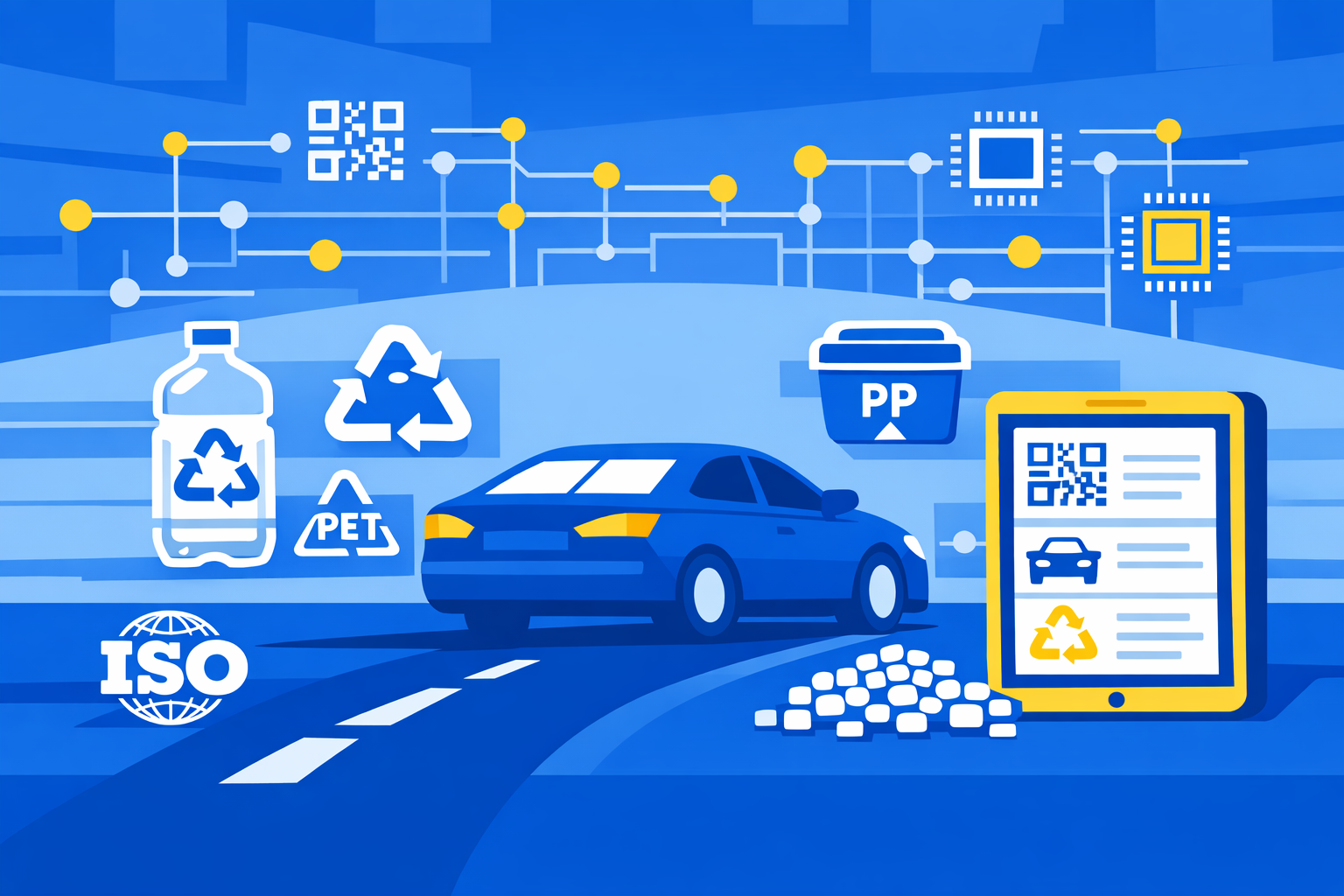
A coalition of U.S. states led by California has formalized a unified certification framework for recycled plastics used in automotive interiors, establishing common traceability and performance standards as end-of-life vehicle regulations tighten on both sides of the Atlantic. The framework, aligned with existing extended producer responsibility (EPR) legislation, aims to reduce material variability, streamline supplier qualification, and accelerate automaker adoption of post-consumer recycled (PCR) content in cabin components.
Background
The move builds on a growing state-level push to mandate recycled content in plastic products and enforce those claims through independent third-party verification. As of August 2025, five U.S. states had passed laws requiring post-consumer recycled content in plastic packaging, according to the Association of Plastic Recyclers (APR). California and Oregon are the most advanced, with both states citing the APR PCR Certification Program, or an equivalent scheme, as required for compliance with their respective EPR laws, according to the APR.
California's landmark Plastic Pollution Prevention and Packaging Producer Responsibility Act (SB 54) sets a first major compliance deadline of January 1, 2027, by which producers must join a Producer Responsibility Organization and reduce single-use plastic by 10%. Governor Gavin Newsom directed CalRecycle to restart the SB 54 rulemaking process in March 2025 over concerns about costs to businesses, though statutory timelines remain in effect, according to the Circular Action Alliance.
Automotive interiors represent a key target for PCR integration. Plastics comprise approximately 20% of a modern vehicle's weight, with interior components such as dashboards, door panels, center consoles, and seat bases commonly using ABS, PC/ABS blends, and modified polyolefins, according to Plastics Engineering. Recycling these multi-material assemblies has historically been complicated by adhesives, foams, and mixed-material constructions, according to the American Chemistry Council.
Details
The unified certification framework draws on existing third-party verification programs, including the APR's PCR Certification standard, which provides full chain-of-custody assessment to confirm that recycled content originates from post-consumer sources. The APR standard was developed in coordination with EU RecyClass to support global harmonization. Both Oregon and California reference this program, or an equivalent, for compliance purposes, with more states expected to follow, according to APR.
The certification push for automotive interiors comes as regulators globally escalate material traceability requirements. In the European Union, legislative measures that came into force in mid-2025 set legally binding recycled content requirements for plastics and introduced mandatory digital product passports, according to Plastics Engineering. Under the EU's provisional End-of-Life Vehicles Regulation, new vehicles will be required to contain a minimum 25% recycled plastic content, with at least 20% of that share sourced from end-of-life vehicles, phased in over a 10-year period following the regulation's entry into force.
In North America, the American Chemistry Council has called for automotive OEMs to incorporate recycled content standards directly into their material certification processes, with allowances for trace chemicals in durable goods that could open a regulatory pathway for automotive plastics recycling. IDTechEx research identifies material availability, variable material properties, and costs as the key challenges to scaling recycled plastic adoption in automotive manufacturing. Mono-material polypropylene interior components are currently regarded as the most accessible near-term target, given their more manageable recycling complexity, according to IDTechEx.
Industry suppliers are scaling up capacity in parallel. In February 2026, Republic Services announced the expansion of its polymer centers across multiple U.S. states, focused on producing high-purity recycled plastics to meet growing demand from companies seeking PCR content compliance. North American recyclers had the capacity to process approximately 1.7 billion additional pounds of plastic per year as of a May 2025 report-roughly one-third more than current throughput-though demand creation remains the central challenge.
Outlook
Automakers are expected to begin accelerated trials of certified post-consumer plastics in interior components and to renegotiate supplier contracts reflecting certification readiness as a qualification criterion. Suppliers and manufacturers have flagged early bottlenecks in certification throughput and testing facility capacity, particularly as audit demand ramps across multiple states simultaneously. The APR has indicated that its primary focus for 2026 will center on incentivizing the U.S. market to use domestically sourced recycled plastics, amid competition from cheaper imported recycled resin. Aligning state-level certification requirements with international standards such as EU RecyClass and ISO-based chain-of-custody programs is expected to reduce compliance fragmentation for global OEMs operating across North American and European markets.