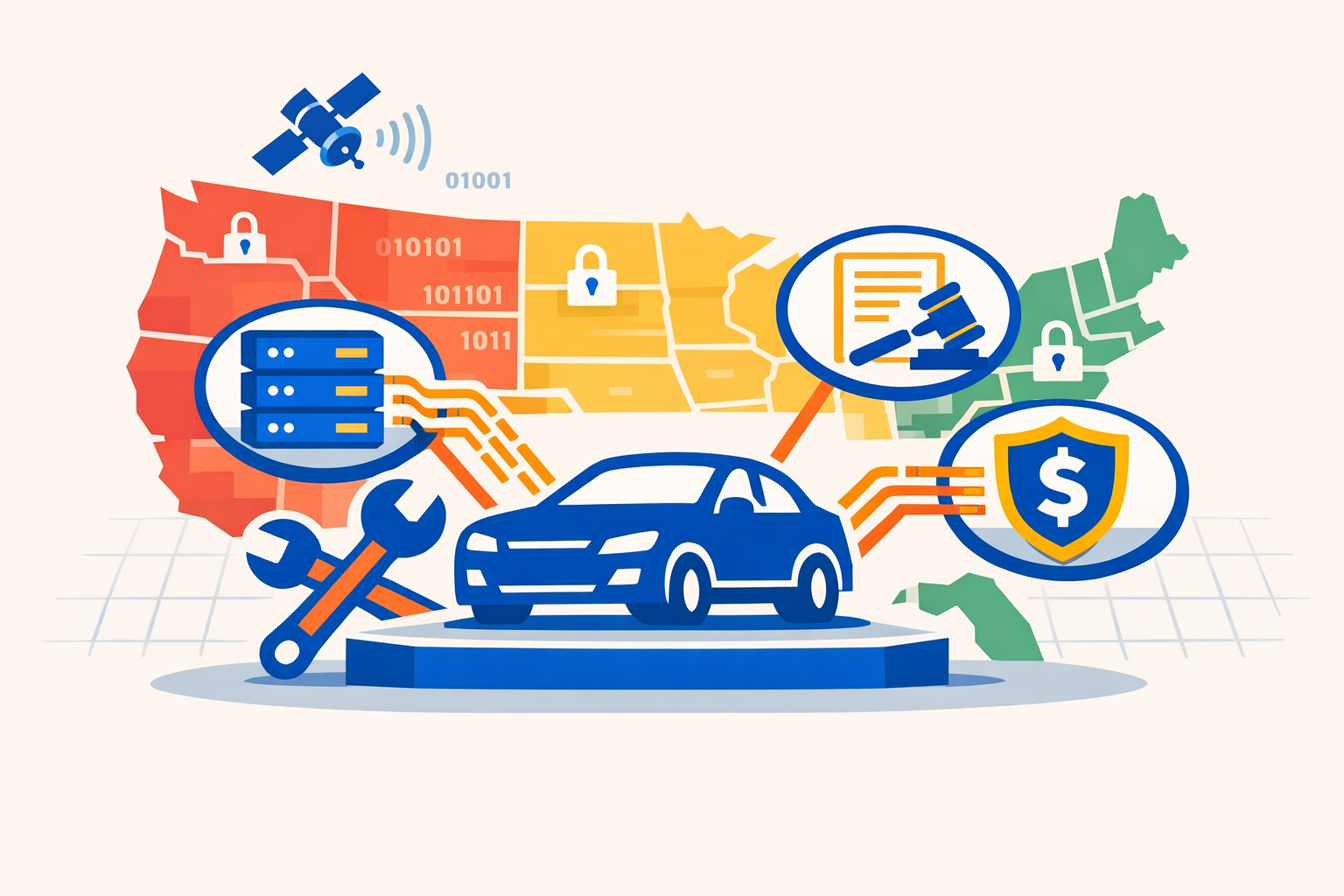
A fragmented patchwork of state-level laws governing vehicle data access and over-the-air (OTA) software transparency is forcing auto parts suppliers and independent repair shops to shoulder mounting compliance costs. As connected and electric vehicles proliferate, software-driven diagnostics have become central to everyday repairs - yet no uniform federal standard exists. Aftermarket operators now face different, and sometimes conflicting, requirements depending on where they operate.
Background
The right-to-repair debate in automotive is not new, but the rapid rise of software-defined vehicles (SDVs) and OTA update capability has raised the stakes significantly. Electric vehicles rely on software across nearly all core systems - motors, battery management, charging behavior, and safety functions - and OTA updates allow automakers to patch bugs, add features, and alter performance without a service visit. As this technology becomes standard, state mandates have specifically targeted vehicle telematics systems, which transmit diagnostic information wirelessly from the vehicle to manufacturers and dealers.[1]
Massachusetts set the baseline. In November 2020, voters approved Ballot Question 1 with 75% support, requiring manufacturers to provide independent repair facilities access to telematics and wireless mechanical data through a standardized platform. Maine followed in November 2023, with 84% voting in favor.
Meanwhile, broader right-to-repair legislation has been moving rapidly through other statehouses. In 2025, over 40 bills in at least 20 states were proposed or passed targeting a wide array of industries, including consumer electronics and agricultural machinery, with right-to-repair legislation. Enacted state laws vary in nearly all dimensions, including the scope of covered products, the mechanisms by which access is provided, and the protections afforded to original manufacturers.
Details
Maine's experience illustrates the implementation difficulties. Maine's Right to Repair law officially took effect January 5, 2025, but full implementation has stalled due to legal and regulatory disputes. The law requires creation of an independent entity to administer the data-access platform, but that entity has not yet been established.[2] Auto Innovators filed a lawsuit in January challenging Maine Attorney General Aaron Frey over enforcement, arguing the independent entity the law calls for does not exist. Five bills to repeal the law were subsequently introduced in the Maine legislature, which reconvened in January 2026 to finalize amendments to its telematics access law.[3]
The cost pressures on the aftermarket are concrete. An estimated 63% of repair shops struggle with routine fixes because automakers withhold data, and half send cars to dealerships - increasing costs by an estimated $3.1 billion annually. Independent shops employ nearly 5 million Americans and generate $500 billion a year.
State-level privacy regulation adds another compliance layer. Oregon updated its privacy law in 2025 to cover motor vehicle manufacturers and affiliates that control or process personal data obtained from a consumer's use of a motor vehicle. Oregon's requirement to honor universal opt-out requests took effect in January 2026, meaning all carmakers operating there must honor consumer requests to access, delete, and opt out of the sale of vehicle-generated data. In January 2025, the Texas Attorney General sued an insurer and its analytics affiliate for "unlawfully collecting, using, and selling over 45 million Americans' driving data to insurance companies."
On the federal side, the REPAIR Act - the Right to Equitable and Professional Auto Industry Repair Act - was reintroduced in the House in February 2025 and introduced in the Senate in April 2025. The bill would require manufacturers to make vehicle-generated data available to the vehicle's owner and designees through a standardized access platform and would give the Federal Trade Commission authority to require OEMs to provide consumers and independent workshops with data, critical repair information, and tools needed to repair motor vehicles. Supporters seek to attach the legislation to the Surface Transportation Reauthorization Act. Advocates argue federal action would prevent a fragmented state-by-state system and protect independent repairers.
The absence of a preemption clause remains a critical unresolved question. If the REPAIR Act includes such a clause, federal law will override conflicting state laws. If preemption is not included, OEMs and aftermarket suppliers face a dual compliance burden - adhering to both federal and state-specific requirements - a scenario that complicates planning and increases non-compliance risk.
Outlook
The REPAIR Act's fate will likely hinge on its inclusion or exclusion from the Surface Transportation Reauthorization Act, which Congress must pass by September 30. "The need for federal auto repair protections has never been stronger," said Ian Musselman, senior vice president of external affairs at LKQ Corporation. In the interim, aftermarket suppliers and repair operators should map their state-by-state exposure, monitor Maine's legislative amendments, and audit their data access and disclosure capabilities - particularly as the automotive OTA compliance market surpassed $4.8 billion in 2025 and is projected to reach $5.41 billion in 2026, reflecting how central software management has become to the industry's operational and regulatory baseline.