U.S. states are accelerating post-consumer recycled (PCR) certification programs for plastic materials as the European Union tightens traceability and recycled-content mandates for automotive interior components, creating a divergent compliance landscape that global automakers and their tier-one suppliers must navigate simultaneously.
As of mid-2025, five U.S. states had passed laws requiring post-consumer recycled content in plastic products, with seven states implementing Extended Producer Responsibility frameworks for packaging. As of mid-2025, five states had passed laws requiring post-consumer recycled content in plastic products, and seven had Extended Producer Responsibility (EPR) frameworks for packaging in place.[1] While these state programs primarily target packaging, the American Chemistry Council and the Association of Plastic Recyclers (APR) have both called for recycled-content standards to extend to durable goods, including automotive components. The American Chemistry Council has recommended that automotive OEMs incorporate recycled-content standards into their material certification processes.
Background
Automotive interiors are a significant target for recycled plastics policy. Plastics comprise approximately 20% of a modern vehicle's weight, with interior components such as dashboards, door panels, center consoles, and seat bases commonly produced from ABS, PC/ABS blends, and modified polyolefins. Recycling these components is complicated by their multi-material construction. Seats, doors, instrument panels, and headliners-which incorporate adhesives, webs, and foams-present particular recycling challenges.
On the EU side, a suite of updated legislative measures under the EU Circular Economy Action Plan came into force in mid-2025, setting legally binding requirements for recycled content in plastics, digital product passports, and design-for-recycling mandates for the automotive sector. in mid-2025, updated measures under the EU Circular Economy Action Plan and the Sustainable Products Initiative came into force, setting legally binding requirements for recycled content in plastics, digital product passports for traceability, and design-for-recycling mandates. Rules for recycled plastic content in vehicles are to be calculated and verified by end-2026, followed by a feasibility study for setting formal recycled-content targets in 2027. Under the EU's End-of-Life Vehicles (ELV) Regulation, rules for recycled plastic content are to be calculated and verified by end-2026, followed by a feasibility study for formal recycled-content targets in 2027.
Details
In the U.S., third-party PCR certification is increasingly embedded in state compliance frameworks. Both Oregon and California cite the APR's PCR Certification Program, or a similar scheme, for aspects of compliance with state laws, and more states are likely to adopt certification requirements to ensure accountability. The APR's updated PCR Certification standard, launched in November 2024, requires all new applicants from April 2025 onward to certify to the revised standard, with existing certified reclaimers expected to recertify to the new standard by their 2025 expiry dates. The updated APR program launched in November 2024; reclaimers certified after July 2024 must recertify to the new standard by their 2025 expiry date, and any organization seeking initial certification after April 1, 2025, must certify to the new standard. APR PCR Certification is a full chain-of-custody, third-party assessment verifying that recycled content originates from post-consumer sources. Companies select from approved certification bodies that audit against APR's PCR Standard, developed in coordination with EU RecyClass.
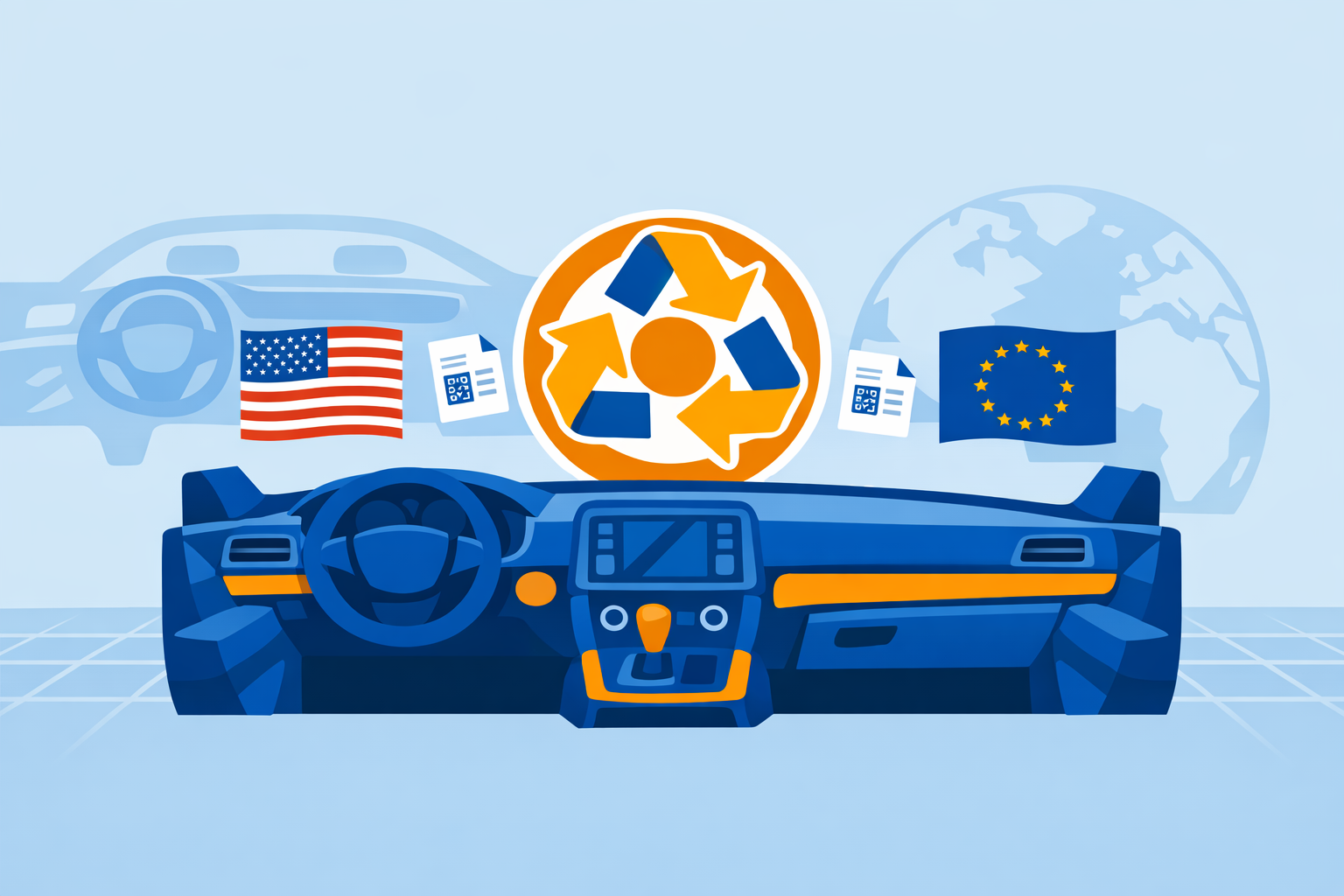
Despite this transatlantic coordination, structural differences remain. The EU approach is centralized and harmonized, with a single regulation applying across all member states. The U.S. system develops at the state level. Companies operating in both markets must manage two parallel systems-one unified and prescriptive, the other evolving and decentralized.
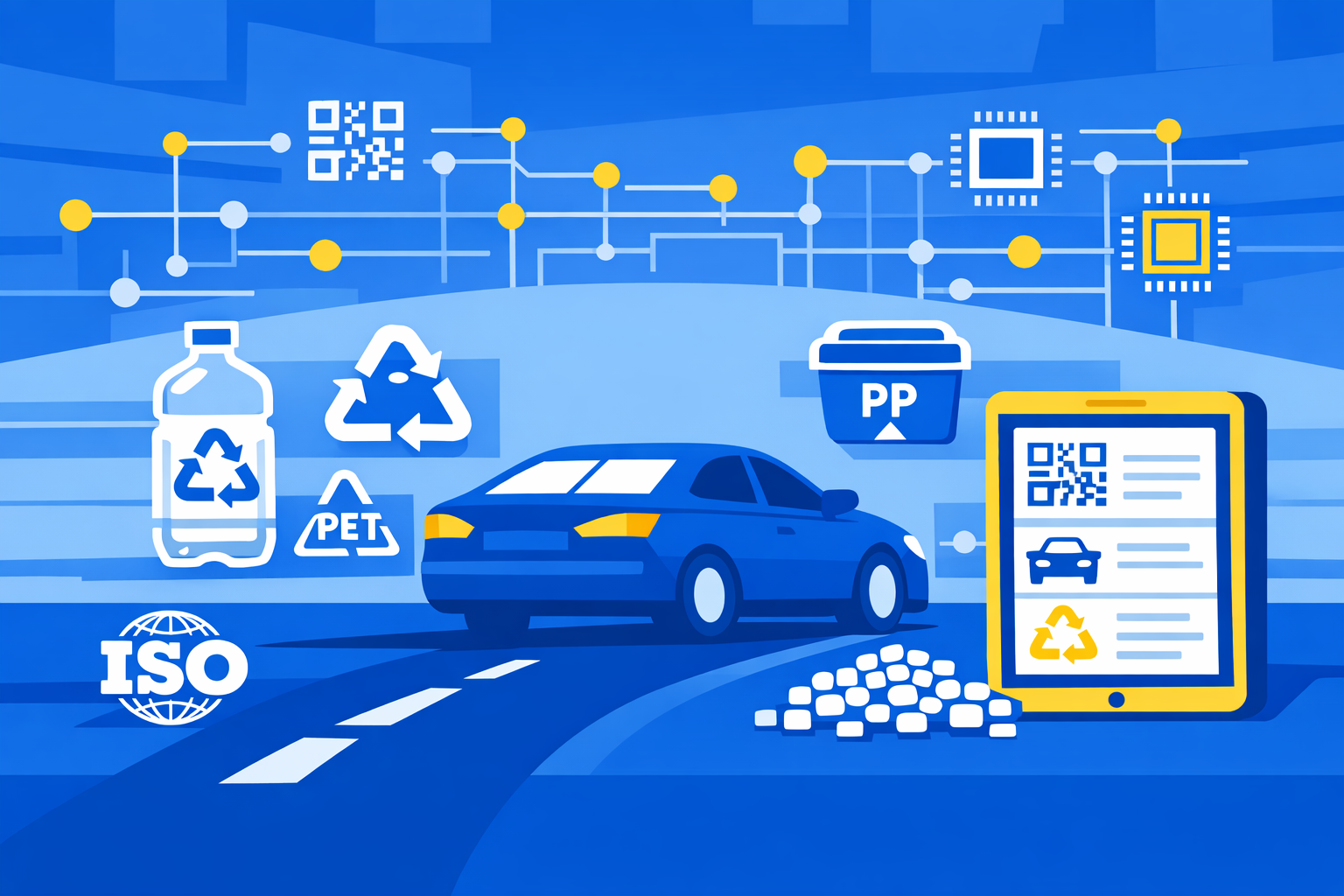
The EU's Digital Product Passport (DPP) framework imposes data-depth obligations that go well beyond any current U.S. state mandate for automotive materials. Starting in mid-2025, manufacturers selling into the EU must embed detailed material data into components through mandatory digital product passports, listing polymer types per ISO 1043, additives, fillers, joining methods, and end-of-life handling instructions-a level of traceability designed to support recycling automation and regulatory audits. Under the EU Ecodesign for Sustainable Products Regulation (ESPR, Regulation (EU) 2024/1781), mandatory Digital Product Passports are set to phase in from 2027 across multiple product groups, with batteries as the first mandatory category from February 2027. The ESPR has been in force since July 2024. In April 2025, the European Commission adopted its first ESPR Working Plan for 2025-2030; while DPPs are not yet mandatory for most products, the regulatory framework is now firmly in place.
Supply-chain friction is already visible at the supplier qualification level. EU requirements are driving development of data tools such as the automotive industry's International Material Data System (IMDS), and leveraging this investment to inform North American regulations could benefit the sector by driving greater consistency. Tier-one suppliers developing compounds for global OEM platforms must now manage dual qualification tracks: APR-certified PCR for state-level reporting in the U.S., and EN 15343- or DPP-compliant traceability documentation for EU market access. EN 15343, the European standard for plastics recycling traceability and recycled content, ensures that plastic manufacturers and packagers meet stringent traceability requirements often central to regulatory compliance across EU jurisdictions.
OEM commitments are amplifying demand pressure. Stellantis has announced plans to use 40% recycled content in vehicle plastics by 2030, partnering with European recyclers to source post-consumer polypropylene and polyamide compounds. Recycled plastics are forecast to play a major role in increasing sustainable content across vehicles, with a compound annual growth rate of 29.1% in recycled plastic content between 2025 and 2035, according to IDTechEx.
Outlook
The gap between U.S. state certification frameworks and EU DPP traceability requirements is expected to remain a source of operational complexity for global automotive supply chains through the end of the decade. Under the EU ELV Regulation, declaration of material formats is expected by 2030, with full enforcement anticipated from 2031. For suppliers, the priority is building unified data architectures that serve both APR chain-of-custody requirements and EU DPP data fields simultaneously, rather than maintaining two separate compliance documentation systems. Companies that organize data in advance will be better positioned as DPP obligations expand, since digital product passports represent a structural shift in how products are documented, traced, and evaluated throughout their lifecycle.