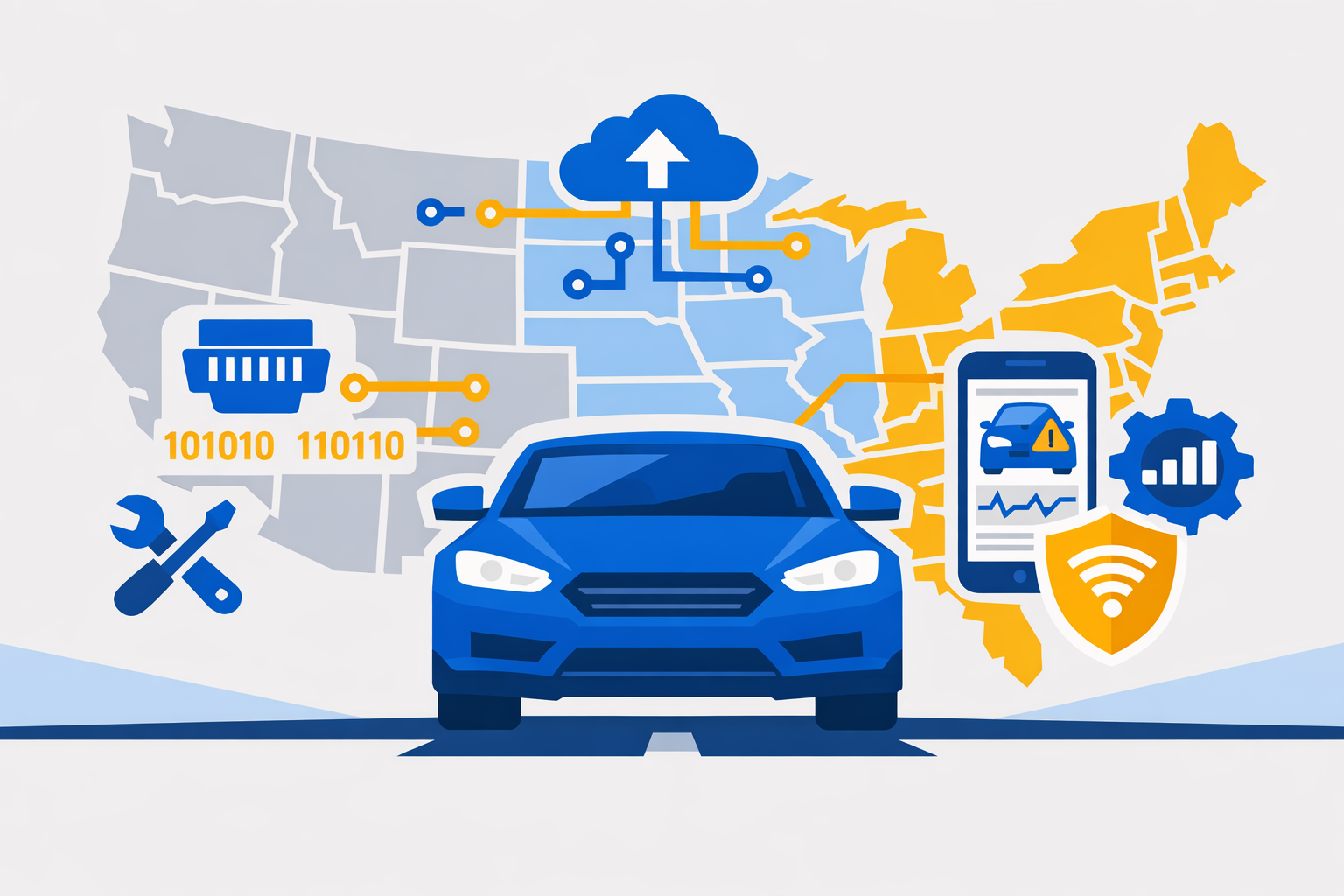
A growing patchwork of state laws governing vehicle diagnostics data access is creating regulatory uncertainty for automakers, independent repair shops, and fleet operators as over-the-air (OTA) software updates accelerate the digital transformation of connected vehicles. With competing federal bills advancing through Congress and a landmark court case approaching a critical ruling, 2026 is shaping up as a pivotal year for how vehicle-generated data is owned, accessed, and monetized.
Background
The friction between automakers and independent repair networks over data access is not new, but the proliferation of OTA-enabled vehicles has sharpened the dispute. Many newer cars allow owners to download software updates that fix problems, improve performance, and even address some safety recalls-all without leaving the driveway, much like updating a phone or laptop. As these updates increasingly touch powertrain, ADAS, and battery management systems, the diagnostic data vehicles generate has become commercially contested territory.
Vehicles produce vast quantities of data, including repair and maintenance information, which is automatically transmitted to manufacturers-giving OEMs full access to diagnostic information that independent shops often cannot obtain. Automakers continue to control vehicle data architecture through subscription-based OEM repair portals and proprietary scan-tool ecosystems. Access to diagnostics, repair procedures, and programming typically requires subscription portals such as Toyota's Technical Information System, Honda's Service Information System, and GM's ACDelco Technical Delivery System.
Research by Hanover Research and Babcox indicates that over 60% of independent repair facilities experience difficulties with routine repairs due to OEM barriers, and more than 50% must send up to five cars per month back to the dealer.
State and Federal Legislative Landscape
Massachusetts remains the furthest along in mandating independent data access. In February 2025, a Massachusetts federal district court rejected a long-running challenge by the Alliance for Automotive Innovation to a 2020 ballot initiative amending the state's right-to-repair law, known as the Data Access Law.[1] With Auto Innovators expected to file its reply brief in November 2025, the First Circuit could hear argument in the first half of 2026 and issue a decision before year's end.[2]
Maine's path has been more turbulent. The state's right-to-repair law took effect January 5, 2025, but full implementation has stalled amid legal and regulatory disputes. The law requires creation of an independent entity to administer the data-access platform, but that entity has not yet been established. The legislature reconvened in January 2026 to finalize amendments to its telematics access law, and until a standardized data-access system and governing entity are created, independent repair access to telematics data remains uncertain. Wisconsin is also considering similar legislation during its 2025-2026 session.[3]
At the federal level, two competing frameworks are vying for adoption. The Right to Equitable and Professional Auto Industry Repair (REPAIR) Act was reintroduced in the House in February 2025 and in the Senate in April 2025. The bill would require automakers to provide independent repair facilities with access to diagnostic codes, calibration tools, and essential repair information. Since its introduction, more than 60 members of Congress have co-sponsored the measure.
An OEM-backed alternative has also taken shape. The Safety as First Emphasis (SAFE) Repair Act has gathered significant support from automakers. According to the Alliance for Automotive Innovation and the Society of Collision Repair Specialists, it provides diagnostic and repair parity while safeguarding data and protecting manufacturers' intellectual property. A third vehicle data measure, the DRIVER Act, introduced in December 2025, strengthens privacy protections and establishes that vehicle owners have full access to and control over data generated by their cars at no additional cost and without restrictive terms.
Industry and Fleet Implications
The regulatory fragmentation carries direct operational consequences. As fleets become increasingly connected, independent repair shops have an opportunity to differentiate by leveraging vehicle data for predictive maintenance-but 60% of shops still struggle to access and apply connected vehicle data effectively, with integration and usability challenges remaining persistent pain points.
Fleet operators have grown vocal on ownership rights. NAFA Fleet Management Association government affairs representative Michael Parr said, "OEMs are looking somewhat enviously at the hotel and airline industries and all the different ways they found to monetize their offerings-to charge you for things that had not been charged for previously," describing data as an easy monetization lever.
OTA reliability has also entered the regulatory frame. In May 2025, a Volvo XC90 driver crashed after an OTA update affected braking functionality; in October 2025, some Jeep owners found their vehicles had suddenly lost power while driving after a failed OTA update. In both cases, automakers issued further OTA updates to correct the problem. Consumer Reports policy fellow Stacey Higginbotham noted that "it's up to industry regulators and lawmakers to set security standards that automakers must abide by."
The cybersecurity dimension remains a core point of contention. The REPAIR Act includes language that does not preclude a vehicle manufacturer from employing cryptographic or technological protections necessary to secure vehicle-generated data and safety-critical vehicle systems.
Outlook
With 2026 poised to be the year a long-running challenge to the Massachusetts Data Access Law is finally decided[4], the First Circuit ruling could set a national template-or intensify pressure on Congress to act. Massachusetts' repair law relating to vehicle telemetry data has already produced four years of federal litigation, and legal experts expect such litigation to increase, especially where state laws provide a private right of action against OEMs. Automakers, aftermarket suppliers, fleet operators, and insurers should expect further divergence in state rules over the next 12-18 months absent a uniform federal framework-a reality that will demand agile compliance strategies and increased investment in standardized diagnostics infrastructure.