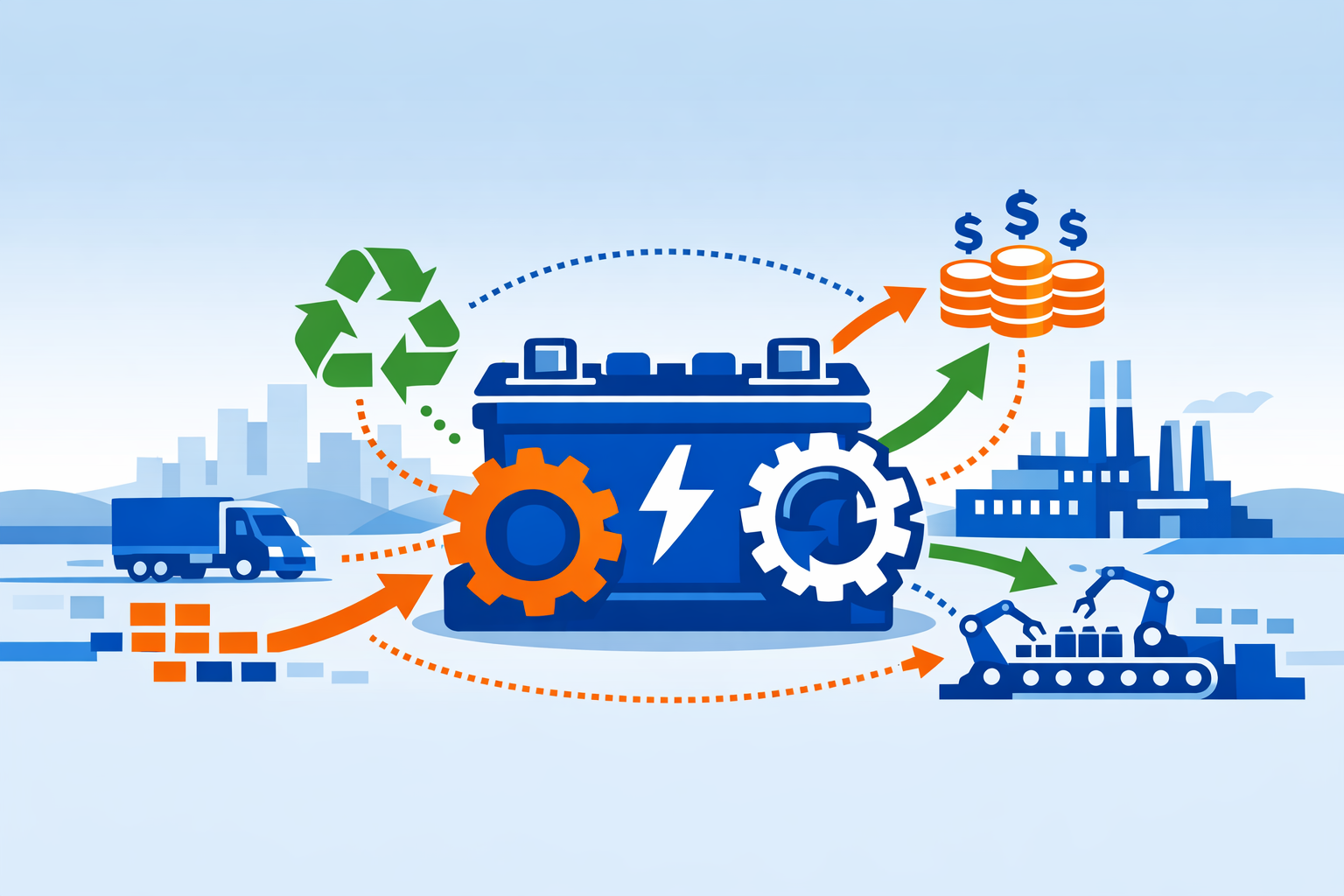
Federal funding programs and tightening Inflation Reduction Act thresholds are converging to push battery recycling to the top of the automotive supply chain agenda for 2027 and 2028, creating compliance obligations-and contract opportunities-for auto parts producers, logistics providers, and third-party recyclers.
Background
The legislative foundation for this push is the Bipartisan Infrastructure Law (BIL), which allocated nearly $7 billion to strengthen the domestic battery supply chain. Within that envelope, the U.S. Department of Energy (DOE) launched a $125 million Consumer Electronics Battery Recycling, Reprocessing, and Battery Collection Funding Opportunity (DE-FOA-0002897) to increase consumer participation in battery recycling programs, improve the economics of recycling, and help establish state and local collection programs.
The IRA adds a parallel regulatory layer. To qualify for the clean vehicle tax credit, automakers must meet escalating domestic-sourcing thresholds for battery critical minerals. The applicable percentage reaches 80 percent in 2027 and 90 percent in 2028, before hitting 100 percent beginning in 2029, requiring that critical minerals be extracted, processed, or recycled in the United States, a free-trade-agreement partner, or in North America. Simultaneously, a temporary FEOC (Foreign Entity of Concern) transition rule that excluded certain low-value, difficult-to-trace battery materials from full due-diligence requirements expires on January 1, 2027, tightening traceability demands across the supply chain.
More recently, the DOE announced a Notice of Funding Opportunity worth up to $500 million to expand U.S. capabilities in mineral processing, battery materials manufacturing, and recycling, signaling continued federal intent to scale domestic capacity ahead of the 2027-28 thresholds.
Details
The convergence of expiring transition rules and rising sourcing percentages concentrates compliance risk on 2027-28. Under Treasury final rules, manufacturers must conduct detailed supply chain tracing to determine the actual value-added percentage for extraction, processing, and recycling-a "traced qualifying value add" test, with the previous simplified allocation approach phased out. For auto parts makers, procurement data systems, supplier audits, and logistics records must be audit-ready before the 2027 model year.
On the infrastructure side, DOE awarded $54.5 million across 11 projects in March 2024 for the first two areas of the BIL recycling funding opportunity, with two additional projects receiving $14 million in July 2024 for retailer battery collection and transport programs. These grants are designed to build the collection and reprocessing backbone the automotive sector will depend on as end-of-life EV pack volumes rise. The global automotive battery recycling market is projected to grow from $26.21 billion in 2025 to $43.42 billion by 2030, according to MarketsandMarkets, with the incoming wave of retired packs from EVs sold between 2019 and 2022 beginning to enter recycling streams.
Supply chain capacity remains a structural constraint. North America announced 450,000 tonnes of annual recycling capacity versus only 180,000 tonnes of available feedstock in 2025, pushing utilization below 40 percent. That feedstock gap is expected to narrow sharply as first-generation mass-market EVs reach end of life after 2028. For auto parts producers, the interim period demands upfront investment without guaranteed volume-a tension analysts have flagged as a key risk factor.
Compliance costs carry a direct line-item burden. Environmental compliance adds roughly 5 to 10 percent to the per-kilogram expense of battery recycling processing, while per-kilogram recycling costs range from $1 to $15 depending on method and scale, according to IEA and McKinsey data. Logistics add further cost: end-of-life lithium-ion batteries are classified as hazardous materials, requiring specialized packaging, labeling, and documentation under U.S. Department of Transportation regulations-all of which must be factored into reverse-logistics planning.
FEOC restrictions layer geopolitical complexity onto these cost considerations. The IRA's FEOC framework effectively requires auto parts suppliers to verify that battery materials were not extracted, processed, or recycled by entities linked to China, Russia, Iran, or North Korea. IRA and IIJA domestic content requirements, along with FEOC designations, could create near-term supply bottlenecks or stranded asset risks for U.S. manufacturers currently sourcing less than 30 percent of cell value domestically, according to analysis by the Oxford Institute for Energy Studies.
Outlook
Calendar year 2027 will serve as an inflection point. FEOC transition rules expire, the critical minerals threshold steps up to 80 percent, and DOE-funded recycling projects are expected to be operational or near-operational, increasing available processing capacity for auto-sector feedstock. Parts producers and recycling partners that have not yet mapped procurement chains to the "traced qualifying value add" standard face the most acute near-term exposure. Large-scale end-of-life EV battery returns are expected to peak after 2028, meaning collection and processing infrastructure contracted in 2025-26 will determine who captures that feedstock. Companies that align grant-funded collection networks with manufacturer take-back programs stand to gain both compliance certainty and favorable material recovery economics.