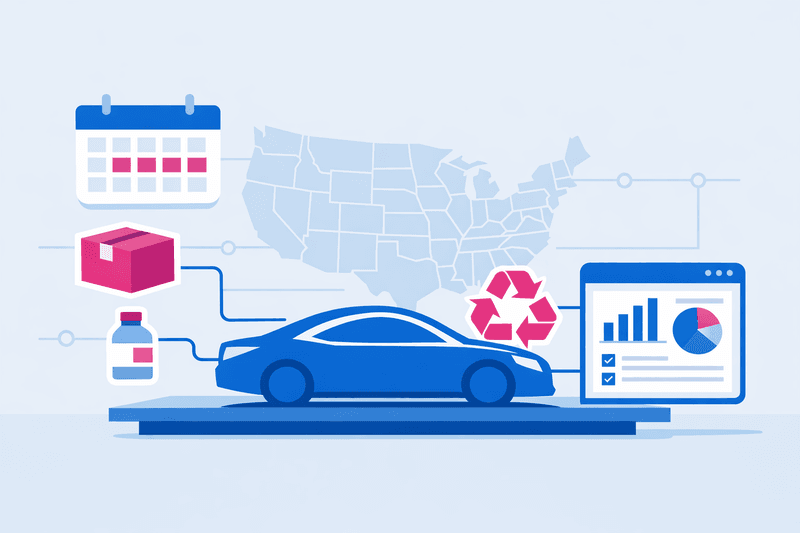
U.S. automakers are preparing to comply with state-level Extended Producer Responsibility (EPR) packaging mandates set for 2026. States including Maine, Maryland, Washington, and Oregon will require producers to register with or join Producer Responsibility Organizations (PROs), report packaging material data, and pay stewardship program fees. Automakers are updating supplier contracts, design protocols, and recycling processes to address these regulatory changes.
Background
While the European Union enforces a unified Packaging and Packaging Waste Regulation across member states, the U.S. lacks federal EPR legislation for packaging. Instead, states are enacting mandates individually. By early 2026, EPR laws will be active or in development in Maine, Maryland, Washington, Oregon, California, Colorado, and Minnesota1Packaging EPR Laws in the U.S.. These laws require producers, including automotive OEMs, to register with PROs, report packaging data, and begin phased fee payments during 2026 and beyond2Extended Producer Responsibility for Packaging in the US in 2026.
Details
In Maine, producers must register and report 2025 packaging data by May 2026, followed by initial fee payments in September 20262Extended Producer Responsibility for Packaging in the US in 2026. Maryland requires producer registration by July 1, 2026, with complete stewardship plans due by July 1, 20282Extended Producer Responsibility for Packaging in the US in 2026. In Washington, producers must join a PRO by July 1, 2026; non-compliance will bar producers from introducing packaging into the state from early 20292Extended Producer Responsibility for Packaging in the US in 2026. Oregon's program began in mid-2025, with reporting and fee schedules due by mid-20263What to Know About Extended Producer Responsibility (EPR) | EcoEnclose.
OEMs are required to collect audit-ready data on packaging composition, weight by material type, recyclability, and post-consumer recycled content. Suppliers are being asked to submit detailed material data through online portals or structured formats to support compliance4Extended Producer Responsibility Around Packaging.
California's broader SB 54 packaging EPR law is delayed, with rule consultations resuming in early 2025. Final provisions are anticipated to take effect in 20275EPR Packaging Laws Moving from Concept to Compliance.
Outlook
Automakers are expected to finalize supplier data processes and update contracts by mid-2026 to comply with state EPR requirements. Packaging suppliers that provide lightweight, recyclable, and high post-consumer recycled content materials may see increased demand. OEMs may invest in end-of-life recycling infrastructure and systems to track recyclability and recycled-content data across vehicle lines.
Developing these capabilities will be necessary for automotive manufacturers to meet the diverse requirements of emerging state-level EPR frameworks by 2026 and beyond.