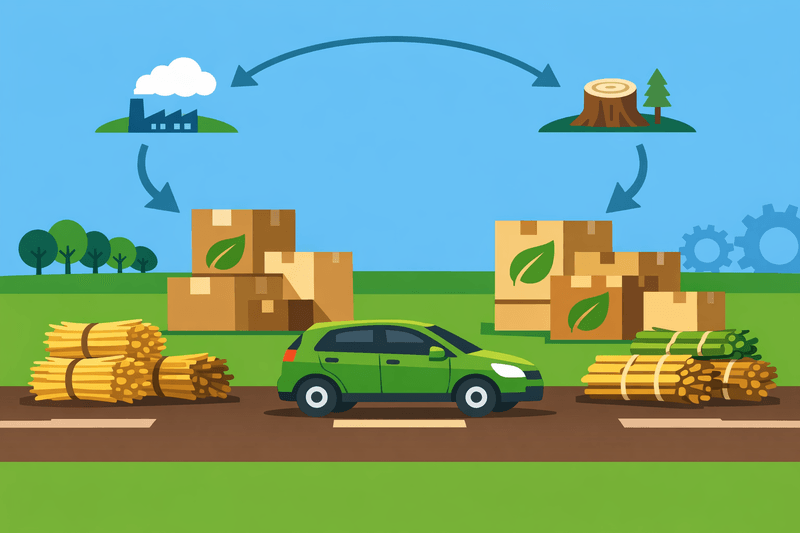
The World Economic Forum's 2026 initiative to invest US$2 billion in next-generation packaging signals a major shift in fiber sourcing and decarbonization. This analysis explores how agricultural-residue pulp could reshape automotive packaging supply chains, the implications for deforestation risk and ESG compliance, and practical considerations for OEMs, Tier 1 suppliers, and packaging converters.
Executive Summary
At Davos in January 2026, non-profit Canopy launched a US$2 billion blended finance program to scale low-carbon pulp made from agricultural residues, starting in India.1World Economic Forum 2026: Collaboration launches US$2B next-gen packaging initiative The initiative targets approximately 1.5 million tons of next-generation pulp capacity in its initial phase and intends to create a replicable blueprint for other regions.
Automotive supply chains face broad impacts, intersecting with Scope 3 decarbonization, the EU Deforestation Regulation (EUDR), and stricter due-diligence standards. Companies that assess the technical viability of agricultural-residue fibers, revise specifications, and enhance sourcing traceability can reduce deforestation risk while positioning packaging as a credible decarbonization lever.
A US$2 Billion Bet on Next-Generation Fiber
Scope and Design of the WEF 2026 Initiative
The Davos announcement outlines a dedicated finance model rather than a single project.
Key design features:
- Blended finance: Philanthropic, concessional, and commercial capital combine to de-risk initial pulp assets.
- Launch in India: Leverages abundant crop residues and strong pulp and paper engineering expertise.
- Feedstock focus: Utilizes agricultural residues such as wheat straw and sugarcane bagasse as alternatives to wood.1World Economic Forum 2026: Collaboration launches US$2B next-gen packaging initiative
The program is expected to support around 1.5 million metric tons of pulp mill capacity through new builds and retrofits, aiming to catalyze over 10 million tons within a decade.1World Economic Forum 2026: Collaboration launches US$2B next-gen packaging initiative
Why Agricultural Residues?
Agricultural residues are under-utilized in many regions, frequently burned or left to decompose.
- About 500 million metric tons of crop residue are generated annually in India; of this, approximately 100 million tons are burned in open fields.This burning is linked to an estimated 68,000 premature deaths per year from air-pollution exposure.2Air quality impacts of crop residue burning in India and mitigation alternatives | Nature Communications
- UNEP and other sources note that stubble burning is a significant source of methane and particulate emissions.3UN Report: India Emerges as Methane Hotspot Due to Crop Burning
Redirecting a portion of this biomass to pulp production can help reduce both agricultural burning and demand for wood fiber.
From Forests to Fenders: Packaging's Role in Automotive Decarbonization
Packaging as a Scope 3 Category 1 Lever
Automotive climate strategies have typically focused on tailpipe emissions, metals, batteries, and plant energy use. However, Scope 3 Category 1-purchased goods and services, including packaging-has become a primary emissions hotspot.
In some manufacturing companies, Category 1 accounts for over half of Scope 3 emissions; BORG Automotive Group reports purchased goods and services at 56% of its Scope 3 footprint.4BORG Automotive Group has completed their first Scope 3 climate accounting results
Packaging is significant in this category because it is:
- High-profile in ESG reporting and often an early focus for decarbonization.
- Directly specifiable by OEM purchasers, unlike many upstream materials.
- Heavily regulated, with requirements around recyclability, EPR, and now deforestation.
Packaging and Deforestation Risk
The pulp and paper sector is a major consumer of forest resources.
- WWF estimates pulp and paper use 33-40% of all global industrial wood.5Pulp & Paper: Forest Impacts and Consumer Power | World Wildlife Fund
- Analyses suggest around 3 billion trees are felled annually for paper packaging, often impacting high-carbon or biodiverse forests.6Paper Packaging Uses Three Billion Trees a Year | Canopy
Automotive supply chains rely on corrugated boxes, molded fiber, and paper dunnage. As volumes grow-particularly for EV and aftersales parts-the sector's indirect dependence on wood-based packaging increases, heightening exposure to deforestation risks.
The WEF/Canopy initiative provides a relevant pathway for automotive firms to address land-use emissions, NGO scrutiny, and tightening deforestation-free requirements in Europe and elsewhere.
Agricultural Residues as Fiber: Technical and Supply Considerations
Feedstock Options and Pulping Technologies
Suitable agricultural residues include straw (wheat, rice, barley), sugarcane bagasse, and other cereal or oilseed stalks.7The production of paper packaging from agricultural residues, such as straw, husks, stalks, or other farming by-products, is gaining attention as an innovative and sustainable alternative to conventional wood-based paper. | EU CAP Network Processing methods include:
- Mechanical/chemi-mechanical pulping (e.g., steam refining of wheat straw with sodium carbonate).8Reinforcement Fiber Production from Wheat Straw for Wastepaper-Based Packaging Using Steam Refining with Sodium Carbonate
- Chemical pulping adapted for non-wood fibers.
- Biorefinery approaches fractionating residues into fibers, lignin, and other products.9Valorization of agricultural residues in the development of biodegradable active packaging films - ScienceDirect
Pilot and demonstration plants in Europe and Asia have shown:
- Straw and bagasse pulp compatibility with conventional papermaking equipment.
- Feasibility for liners, molded fiber, and some specialty packaging grades.10Agricultural residues as a sustainable alternative in paper production
Environmental Performance vs. Conventional Wood Pulp
Life-cycle assessment (LCA) studies indicate that agricultural residues can yield significant reductions in energy, water, and emissions compared to imported virgin wood pulp.
A German LCA comparing sulfate (kraft) wood pulp, recycled pulp, and grass-based pulp for paper found:11Life Cycle Assessment Grass Paper | Hochschule Bonn-Rhein-Sieg (H-BRS)
| Parameter | Sulfate wood pulp | Recycled pulp | Grass-based pulp |
|---|---|---|---|
| Relative energy demand | 1.0× | ~0.5-0.6× | ~0.17× |
| Relative GHG emissions | 1.0× | <1.0× | ~0.26× |
| Water use (liters) | ~32,000 L | ~9,000 L | ~2 L |
| Relative acidification potential | 1.0× | <1.0× | ~1/18 of sulfate pulp |
*Ranges based on study summary; actual values vary by plant.
The study concluded grass-based pulp was six times more energy efficient than sulfate pulp, emitted only 26% of the emissions, used ~16,000 times less water, and had 18 times lower acidification potential.11Life Cycle Assessment Grass Paper | Hochschule Bonn-Rhein-Sieg (H-BRS)
These results are not universal but illustrate the environmental gains possible when residues replace imported wood pulp.
Scale, Variability, and Quality Constraints
Non-wood fibers make up a small share of global pulp supply.
A 2020 industry report estimated global non-wood pulp capacity at 7.8 million metric tons, with about 3.3 million tons of new capacity planned from 2020 to 2025-still a minor share of total pulp production.12https://sustainablepackaging.org/wp-content/uploads/2024/08/SPC_Non-Wood-Fiber-Packaging_Landscape.pdf
Key bottlenecks:7The production of paper packaging from agricultural residues, such as straw, husks, stalks, or other farming by-products, is gaining attention as an innovative and sustainable alternative to conventional wood-based paper. | EU CAP Network
- Residue variability, complicating consistent mill supply.
- Logistics and collection costs in regions with fragmented farms.
- Contaminants and ash content, impacting pulping yields and equipment.
- Fiber properties, which may limit use in high-strength transport grades unless blended.
For automotive uses, where packaging must withstand long, multi-modal supply chains, non-wood fibers will likely be blended with recycled or virgin wood pulp in the near term.
Deforestation, EUDR, and ESG: Heightened Compliance on Automotive Packaging
EU Regulation on Deforestation-Free Products (EUDR)
The EUDR fundamentally alters risk management for companies placing wood-related products in the EU.
From December 30, 2025, medium and large companies must submit due-diligence statements for wood, pulp, paper, and many derived products placed on the EU market, confirming deforestation-free and legal origin. Micro and small enterprises follow from June 30, 2026.13European Union Deforestation Regulation effective as of 30 December 2025 | Maersk
European Commission guidance clarifies:
- Wood-based materials are in scope if used as packaging, provided they are imported as standalone goods (e.g., kraft paper, corrugated board).14EUR-Lex - 52025XC04524 - EN - EUR-Lex
- Due diligence must document geolocation of plots, legality, and deforestation risk.
The German VDA industry association supports EUDR's objectives, but notes challenges from unclear packaging treatment and short implementation timelines.15German automotive industry criticises EU regulation against deforestation and calls for practical adjustments | VDA
Corporate Sustainability Due Diligence and ESG Reporting
Beyond EUDR, the EU Corporate Sustainability Due Diligence Directive (CSDDD) requires large firms to identify, prevent, and mitigate adverse impacts across their value chains.Obligations include embedding due diligence in policy, supplier engagement, and monitoring, with potential civil liability for non-compliance.16Corporate Sustainability Due Diligence Directive
Automotive OEMs subject to the Corporate Sustainability Reporting Directive (CSRD) must:
- Quantify Scope 3 emissions, covering packaging under purchased goods and upstream logistics.
- Disclose transition plans and KPIs for land-use impacts, including deforestation.
These frameworks elevate packaging fiber sourcing to a key ESG and risk-management issue for automotive manufacturers.
Operational Implications for OEMs, Tier 1s, and Packaging Converters
OEMs: Strategy, Specification, and Portfolio Guidance
For automotive OEMs, the WEF 2026 initiative signals future scaling of non-wood fibers. Key steps:
- Integrate agricultural-residue packaging within Scope 3 decarbonization roadmaps, alongside returnable systems and lightweighting.
- Update packaging specifications to allow qualified non-wood fibers, especially in secondary and tertiary packaging.
- Prioritize non-wood/recycled fibers for packaging linked to high-risk forest geographies under EUDR.
- Develop robust ESG data: ensure BoMs and supplier declarations can support deforestation-free claims.
Tier 1 Suppliers: Climate and Compliance Alignment
Tier 1 suppliers often design and select packaging for OEMs. They should:
- Align packaging with OEM sustainability targets, documenting fiber types and recycled content.
- Collaborate on agricultural-residue trials for specific product families.
- Prepare EUDR-ready documentation for all wood-based packaging into the EU, including traceable converter and mill data.
Packaging Converters: Technology, Traceability, and Scale
Converters supplying automotive customers should expect early demand for agricultural-residue fibers in:
- Corrugated and molded components for trays, separators, and dunnage.
- Aftersales and e-commerce packaging, where sustainability messaging often aligns with OEM requirements.
Necessary capabilities include:10Agricultural residues as a sustainable alternative in paper production
- Multi-fiber blending and process control.
- Batch-level chain-of-custody for wood, recycled, and agricultural-residue fibers.
- Partnerships with residue aggregators for consistent feedstock.
What Success Could Look Like by 2026 and Beyond
By end-2026, the WEF program will likely remain in early deployment, but automotive stakeholders can benchmark success with:
1. Lower Packaging Carbon Intensity
- Defined reductions in kg CO₂e per packaging unit for select flows, through fiber substitution and design.
- Inclusion of agricultural-residue packaging in OEM Scope 3 tracking.
2. Demonstrable Deforestation Risk Mitigation
- EUDR-compliant due diligence and origin data for all EU-bound wood packaging.
- Greater packaging volumes from recycled and non-wood fibers, especially for high-volume SKUs.
3. Enhanced Traceability and ESG Reporting
- Standardized supplier questionnaires and digital passports listing fiber type, origin, and recycled content.
- Audit-ready evidence linking sourcing to deforestation and climate targets.
4. Sectoral Collaboration and Adoption
- Industry guidelines and cross-OEM working groups referencing agricultural-residue fibers for select packaging uses.15German automotive industry criticises EU regulation against deforestation and calls for practical adjustments | VDA
Actionable Next Steps for Automotive Packaging Leaders
To accelerate implementation, packaging and supply-chain teams can:
- Quantify fiber use in all packaging flows, differentiating virgin wood, recycled, and alternative fibers.
- Identify pilot lanes (e.g., regional aftersales) suitable for agricultural-residue packaging trials.
- Engage converters and mills experienced with straw, bagasse, or grass-based pulps, requesting technical data on performance and recyclability.
- Incorporate EUDR and CSDDD requirements in sourcing contracts, specifying necessary data, geolocation, and due diligence.
- Align KPIs to include carbon intensity and deforestation-risk metrics alongside cost and damage rates.
Frequently Asked Questions
How does agricultural-residue packaging affect recyclability in paper streams?
Most industrial trials formulate agricultural-residue pulps for compatibility with standard paper recycling, especially when blended with wood or recycled fibers.7The production of paper packaging from agricultural residues, such as straw, husks, stalks, or other farming by-products, is gaining attention as an innovative and sustainable alternative to conventional wood-based paper. | EU CAP Network Mills and recyclers may adjust process parameters for high non-wood shares, but moderate substitution levels used in transport packaging show no systemic issues.
Will agricultural-residue fibers be strong enough for automotive logistics?
Mechanical properties depend on residue type, pulping method, and blend ratio. Wheat-straw pulps, when optimized and combined with recycled fibers, exhibit burst, tensile, and compressive strengths suitable for packaging.8Reinforcement Fiber Production from Wheat Straw for Wastepaper-Based Packaging Using Steam Refining with Sodium Carbonate For heavy loads or long routes, converters may use hybrid structures-residue-based inners with higher-strength liners-until large-scale performance is validated.
Does switching to agricultural-residue pulp eliminate EUDR obligations?
Not entirely. EUDR covers specific commodities (including wood), while non-forest crop residues may fall outside its strict scope. Still, companies must maintain robust ESG due diligence under CSDDD and CSRD. Sourcing agricultural residues can reduce deforestation risk, but documentation of land use and indirect impacts is required.17EU Regulation on Deforestation-free products
Which regions are likely initial suppliers of agricultural-residue pulp for automotive packaging?
India is a primary focus for the WEF US$2 billion program due to abundant residues and existing infrastructure.The blueprint is designed for adoption by other regions with surplus agricultural residues, such as parts of Asia and Latin America, once proven.1World Economic Forum 2026: Collaboration launches US$2B next-gen packaging initiative Europe is seeing early capacity in straw- and grass-based pulps for food and consumer packaging, with potential for industrial uses.
How should automotive firms reflect these changes in ESG reporting?
Companies should classify packaging materials within Scope 3 Category 1, disclosing shares of virgin wood, recycled, and alternative fibers, and link these to deforestation and land-use metrics. Over time, firms may set numerical targets (e.g., packaging sourced from non-wood fibers) and report progress annually in CSRD-compliant sustainability reports, supported by third-party assurance when relevant.