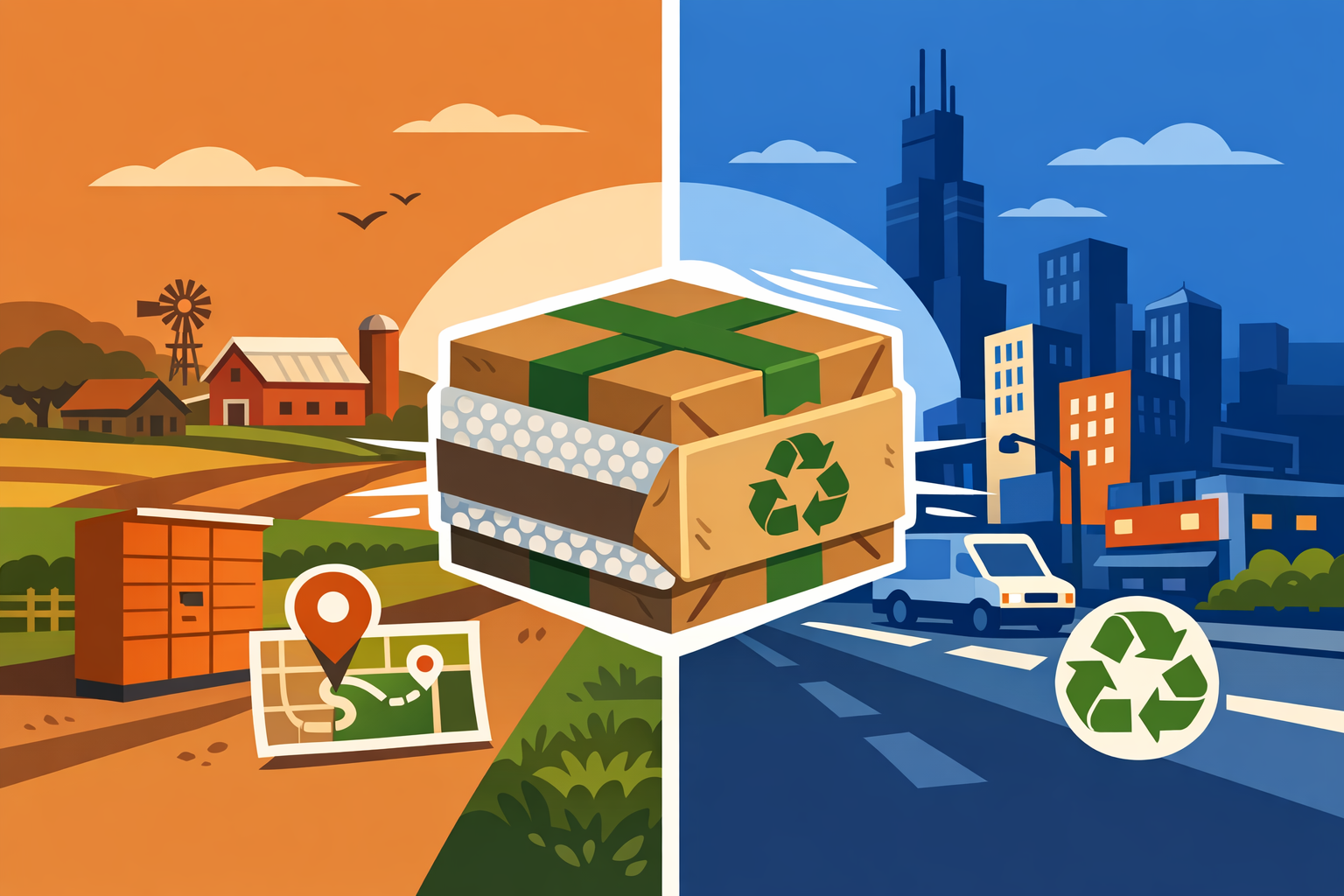
A package shipped to a rural address in Mississippi costs roughly five times more to deliver than the same parcel bound for a dense urban neighborhood in Chicago. That disparity - approximately $50 per rural delivery versus $10 in urban areas - is not merely a logistics accounting problem. It is a structural inequality quietly reshaping how brands design packaging, manage returns, and meet an escalating stack of regulatory obligations.
As last-mile delivery faces growing scrutiny for its environmental footprint, a second, under-examined dimension is emerging: access. Who gets reliable, affordable delivery - and what packaging consequences follow when they don't?
The Urban-Rural Delivery Divide, by the Numbers
The global last-mile delivery market is valued at $197 billion in 2025 and is projected to reach $352.7 billion by 2035, according to Future Market Insights[1]. Yet this growth is unevenly distributed. Urban logistics networks are maturing rapidly - with route optimization tools reducing delivery times and operational costs in 2025 - while rural last-mile delivery faces persistent structural bottlenecks: poor infrastructure, dispersed populations, limited carrier competition, and unreliable addressing data.
Urban routes can achieve 30 or more delivery stops per trip; rural routes may cover the same distance for just two to three stops, making cost-per-shipment economics deeply unfavorable. The result: reduced carrier incentives to serve underserved markets, longer transit times, and greater exposure to package damage.
| Metric | Urban | Rural |
|---|---|---|
| Average cost per package | ~$10 | ~$50 |
| Typical stops per route | 30+ | 2-3 |
| Failed delivery risk | Lower | Higher |
| Package damage exposure | Moderate | Higher |
| Smart locker infrastructure | Growing rapidly | Limited |
| Carrier competition | Multiple options | Often USPS-dependent |
This divide carries direct packaging implications. Longer transit chains, rougher handling during transfers, and the greater likelihood of packages sitting unattended or being rerouted all demand more robust protective packaging - precisely the material-intensive kind that conflicts with sustainability reduction targets.
Packaging Under Pressure: Protection vs. Material Footprint
When packages travel longer distances or pass through more handling touchpoints, the probability of damage rises. An estimated 85 million parcels arrived damaged in the U.S. in 2024 - approximately 3-4% of all shipments, according to logistics research cited by Opensend[2]. In 2025, U.S. retailers and carriers are expected to lose over $4 billion due to damaged goods, replacements, and processing returns.
For rural and underserved delivery corridors, damage risk is compounded. Packages may be left in unsecured locations, exposed to weather, or mishandled at understaffed transfer points. Brands serving these markets face a fundamental tension:
- Under-protect the product, and damage rates climb - triggering returns, replacements, and the packaging waste associated with both.
- Over-protect with heavy-duty materials, and the material footprint increases - potentially inflating EPR fees and raising per-unit emissions.
A 2024 study found that packages delivered via ultra-fast services had a 27% higher chance of arriving damaged compared to standard courier services, illustrating how speed-focused, underprepared supply chains erode packaging effectiveness regardless of geography.
The answer is not simply "more packaging." It lies in right-sizing protective design to actual transit conditions - an approach requiring granular, location-specific logistics data that most brands do not yet routinely collect or act on.
The Returns-Waste Compounding Effect
Damaged goods do not just disappear - they generate returns, and returns generate waste. Online shopping produces approximately 4.8 times more packaging waste per item than brick-and-mortar retail, with returned products requiring additional materials for reprocessing and reshipment, according to CleanHub research[3].
The scale is significant. E-commerce returns are estimated to emit up to 24 million metric tonnes of CO₂ annually. The return rate for online purchases sits at approximately 16.9% in 2024 per NRF data, with some estimates for 2025 reaching 24.5%, compared to around 9% for in-store purchases.
For brands with customers in high-fail-rate delivery zones, the math is stark: a missed or damaged delivery triggers a return loop that consumes additional transport fuel, generates secondary packaging waste, and - in many cases - ends with the product in a landfill rather than back in circulation. One failed delivery can cost a retailer an average of $17.20 per order, adding up to nearly $200,000 per year for mid-scale operations.
Durable, repair-friendly packaging that reduces breakage in transit, combined with clearer product imagery that cuts fit-and-expectation returns, addresses both the equity gap and the waste compounding problem.
Regulatory Pressure: The EPR Landscape Tightens
The packaging decisions brands make in response to delivery geography do not exist in a regulatory vacuum. A fast-expanding web of state-level Extended Producer Responsibility (EPR) laws is changing who pays for end-of-life packaging management - and incentivizing lighter, more recyclable material choices.
EPR Compliance: Seven States and Counting
As of 2025, seven U.S. states - California, Colorado, Maine, Maryland, Minnesota, Oregon, and Washington - have enacted comprehensive packaging EPR laws, per legal analysis from Proskauer Rose[4]. Oregon's program reached full implementation on July 1, 2025, with fee invoices already issued to producers. Penalties for non-compliance can reach $25,000 per day in Oregon, and up to $50,000 per day in certain other jurisdictions.
Several additional states - including Wisconsin and New Hampshire - introduced EPR bills in late 2025 and early 2026, signaling the wave is far from cresting.
EPR fee structures in most states apply eco-modulation: packaging that is harder to recycle or uses more material incurs higher fees. This creates a direct financial incentive to reduce protective packaging weight - putting it in tension with the durability demands of long-haul, rural last-mile delivery.
For packaging engineers and procurement leads, the implication is clear: packaging design must now account for both the physical demands of the route and the regulatory cost of the material. A heavy-duty multilayer corrugated solution that protects a product through a difficult rural transit may save money on returns only to recoup it in EPR compliance fees.
Smart Infrastructure as a Packaging Design Input
Emerging delivery infrastructure is beginning to close part of the equity gap - and creating new inputs for packaging strategy in the process.
Smart parcel lockers are one example. The smart parcel locker market was valued at $1.71 billion in 2024 and is projected to reach $4.24 billion by 2032 at a CAGR of 12.12%, according to SNS Insider[5]. Lockers reduce missed deliveries, eliminate porch-exposure damage risk, and consolidate routes - cutting the number of vehicle trips required per area. Research from Frontiers in Future Transportation notes that parcel lockers are increasingly viewed as infrastructure for social sustainability, designed to "ensure equitable access, inclusive service design, and improved service availability for underserved or vulnerable populations."
Modular, solar-ready locker systems are now being deployed by start-ups targeting suburban and rural communities that previously lacked reliable collection infrastructure. Where lockers are in place, brands can adopt lighter secondary packaging - reducing material use without increasing damage risk, since the locker itself provides a protective enclosure.
Carriers and retailers are also experimenting with location-specific packaging specifications. Data from route diagnostics, delivery success rates by ZIP code, and carrier performance profiles can theoretically feed back into packaging line decisions - allowing a brand to automatically apply a reinforced outer liner for shipments flagged for difficult-terrain delivery zones while defaulting to lighter materials for dense urban routes served by same-day carriers.
Amazon reported cutting its single-use plastic delivery packaging by 16.4% globally in 2024, in part through "ship-in-product" programs that eliminate secondary boxes for qualifying products. Such programs, however, depend on reliable, consistent handling - conditions more readily available in urban fulfillment corridors.
What This Means for Packaging Strategy
The intersection of delivery equity, protective packaging demands, returns-driven waste, and accelerating EPR compliance creates a genuinely complex set of trade-offs for packaging professionals. Several strategic priorities emerge:
- Invest in transit-profile data. Packaging specifications should reflect last-mile delivery conditions - carrier type, route density, average handling touchpoints - not just product fragility ratings.
- Design for durability and circularity together. Packaging that withstands a difficult rural transit and remains recyclable or compostable at end-of-life represents the highest-value outcome under EPR eco-modulation frameworks.
- Reduce return triggers upstream. Better product representation, accurate sizing guides, and AR-assisted try-on tools can cut fit-based returns, directly reducing the secondary packaging waste that returns generate.
- Track EPR obligations by ship-to state. With seven states now active and more entering the pipeline, producers shipping nationally need component-level visibility into packaging materials and volumes by state to meet reporting deadlines and minimize fee exposure.
- Monitor smart infrastructure deployment. As parcel locker networks expand into underserved markets, packaging specs for those routes can be safely lightened - a material savings opportunity aligned with both sustainability goals and EPR cost structures.
The last-mile delivery divide will not close overnight. But the packaging decisions made today - around material choice, protective design, and route-aware specification - will determine whether brands contribute to closing it or quietly entrench it further.