More than ten U.S. states have enacted or updated battery stewardship laws in the past three years-and for Tier-1 and Tier-2 auto parts suppliers, the compliance clock is running. With key deadlines clustering between 2027 and 2028, divergent requirements across state lines are creating a regulatory mosaic that threatens to reshape procurement strategies, labeling operations, and supply chain traceability programs throughout the automotive sector.
Unlike earlier battery regulations that set broad prohibitions on landfilling, the current wave introduces detailed producer responsibility obligations: mandatory Battery Stewardship Organization (BSO) membership, state-specific fees, take-back program participation, battery chemistry labeling, and annual reporting requirements. For manufacturers supplying components into multi-state vehicle assembly lines, these obligations do not stack neatly.
The State-by-State Picture: Who Has Set the Deadlines
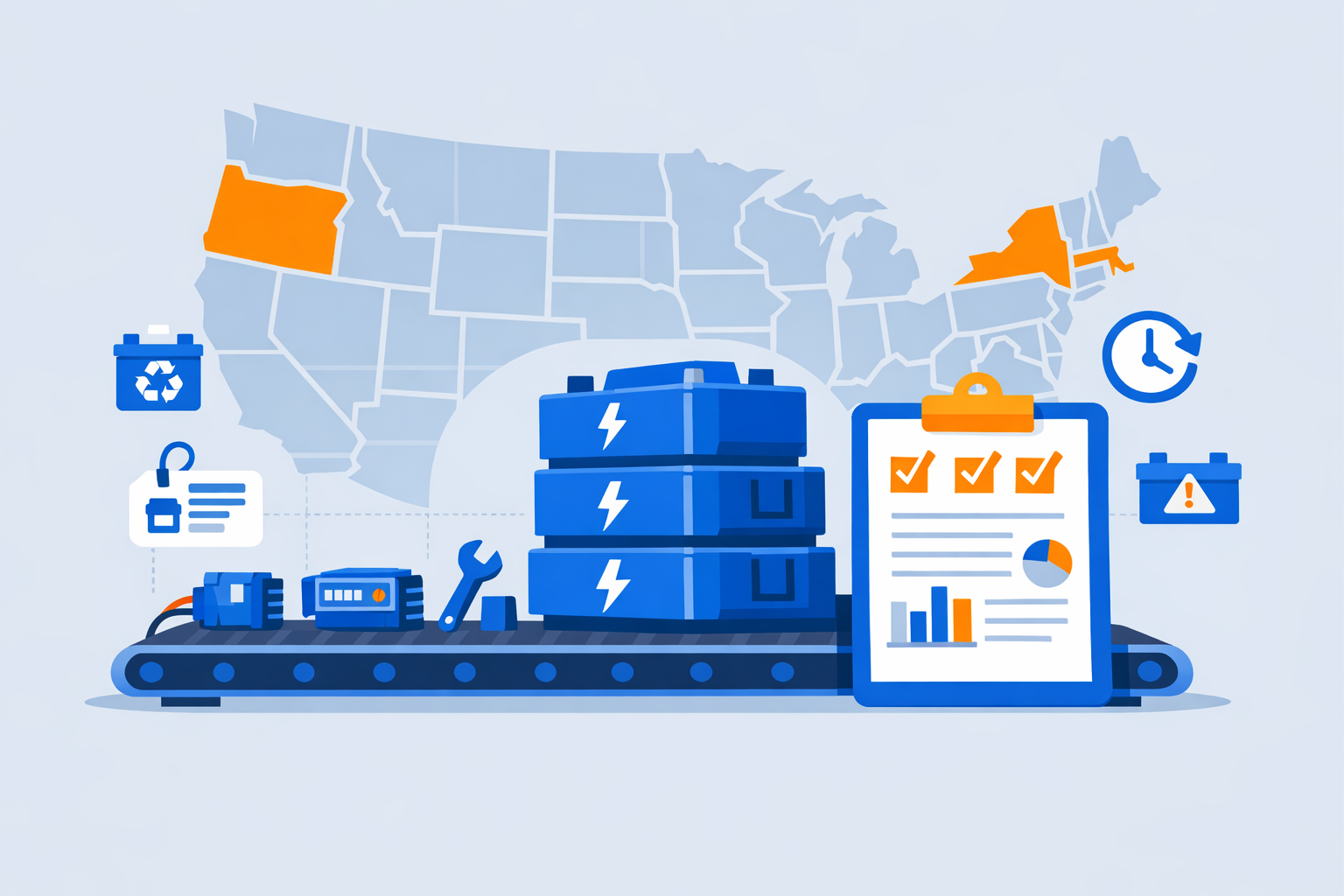
Legislative activity over 2024-2025 has produced a concentrated set of hard compliance dates. Several states will begin enforcing BSO membership requirements and retail sale restrictions in 2027, with disposal bans and labeling mandates following in 2028.
Washington moved earliest among the current cohort. In 2023, Washington passed SB 5144, establishing a battery stewardship program requiring producers to operate a statewide collection and recycling system. Collection sites will begin accepting portable batteries July 1, 2027, and medium-format batteries Jan. 1, 2029. Washington's labeling requirements add further complexity for the auto sector: the law outlines marking requirements for covered products, stipulating that markings must be "permanent, clearly visible, and legible," and by January 1, 2028, must include the producer's brand.
Critically for vehicle suppliers, while portable battery collection begins in 2027, large-format vehicle battery collection is not mandated until 2029. Until then, hybrid/EV batteries in Washington remain under Universal Waste Rules, meaning the dismantler is still financially responsible for downstream recycling.
New Jersey occupies a different position-it is currently the only state with a comprehensive EV-specific recycling mandate. On January 8, 2024, New Jersey passed the Electric and Hybrid Vehicle Management Act, making it illegal to dispose of EV batteries in landfills and instead mandating their reuse and recycling. Beginning in January 2027, the Act will explicitly prohibit unauthorized persons from disposing of EV batteries and their subcomponents as solid waste. On the same date, "no solid waste facility" in New Jersey "shall knowingly accept for disposal" an EV battery unless authorized by the state.
California established its stewardship deadline for most producers at April 1, 2027, when the Recycled Battery Act requires "producers" of any "covered batteries" sold or offered for sale within the state to participate in a stewardship plan approved by CalRecycle. However, batteries contained in a motor vehicle-including cars and bicycles-are excluded from the definition of "covered batteries." Auto parts makers supplying components with removable batteries, such as aftermarket lighting, portable diagnostic tools, and auxiliary systems, will still fall within scope.
Colorado passed its Battery Stewardship Act of 2025. On and after August 1, 2027, a producer selling, making available for sale, or distributing certain batteries or battery-containing products in or into the state must participate in and finance a battery stewardship organization. On and after January 1, 2028, the act prohibits a producer or retailer from selling, offering for sale, or distributing certain batteries in or into the state unless they are marked with labels that include information to ensure proper collection and recycling.
Connecticut and Nebraska have added to the cluster. Under Connecticut's 2025 Act, producers of covered batteries and battery-containing products sold or offered for sale in Connecticut must be a member of a Battery Stewardship Organization by January 1, 2027.[1] Nebraska's Safe Battery Collection and Recycling Act of 2025 similarly requires producers to be members of a Battery Stewardship Organization, with disposal ban compliance required as of January 1, 2028.
Illinois was among the first to act in this legislative cycle. The Illinois Battery Stewardship Act requires producers who sell, offer for sale, or distribute covered batteries in the state to participate in an approved stewardship plan. By January 1, 2026, all obligated producers must participate in such a plan or face restrictions on selling batteries in the state. After January 1, 2028, a disposal ban takes effect for all portable and medium-format batteries.
| State | BSO / Registration Deadline | Disposal Ban | Labeling Deadline | EV Battery Coverage |
|---|---|---|---|---|
| Washington (SB 5144) | Jan 1, 2027 (portable) | Jan 1, 2027 (portable) | Jan 2028 (brand); Jan 2030 (chemistry) | Medium-format from Jan 2029; EV under Universal Waste until then |
| California (AB 2440) | Apr 1, 2027 | Not yet specified | Annual chemistry report to CalRecycle from Jul 2027 | Motor vehicle batteries excluded |
| Connecticut (2025 Act) | Jan 1, 2027 | Not yet specified | Under rulemaking | TBD |
| Colorado (SB25-163) | Aug 1, 2027 | Landfill ban after 2030 | Jan 1, 2028 | Large-format under separate assessment |
| Illinois (BSA) | Jan 1, 2026 (passed) | Jan 1, 2028 | Not specified | Large-format EV packs excluded |
| Nebraska (2025 Act) | Not yet specified | Jan 1, 2028 | Not specified | TBD |
| New Jersey (EHVMA) | Jan 2025 (registration) | Jan 2027 (EV batteries) | Consumer education materials required | First state with comprehensive EV mandate |
The Operational Challenge for Auto Parts Suppliers
Legislative divergence creates several compounding problems for Tier-1 and Tier-2 suppliers operating across multiple states.
Fee structures differ. Washington charges Battery Stewardship Organizations a plan review base fee, with an additional per-hour rate if review costs exceed the base-Ecology's plan review fee for 2026 is $63,066, and each BSO must pay a one-time plan review base fee when it submits its plan for review and approval. Colorado's structure differs: a battery stewardship organization must pay a one-time fee of $50,000 at plan submittal, and if the executive director approves the plan, an additional fee of $86,000. Multiplied across multiple state programs, administrative costs can become material.
Product scope definitions are inconsistent. In most states, large-format EV propulsion batteries remain outside current stewardship program scope and default to federal Universal Waste handling rules. However, 12-volt auxiliary batteries, hybrid battery modules, and packaged replacement parts with removable batteries can fall within covered battery definitions-making SKU-level classification a non-trivial exercise for parts distributors.
Reporting data requirements reach deep into the supply chain. The default tool for supplier data collection in automotive remains the questionnaire-a spreadsheet sent to Tier-1 suppliers asking them to self-report on material origins and composition. Several of these regulations require data from raw material sources, which typically sit at Tier 3, Tier 4, or deeper. Most companies can barely see past Tier 1. Battery chemistry, weight classifications, and producer brand identification-all required for labeling under Washington and Colorado rules-must be consistently documented across supplier tiers.
Traceability gap: Industry observations confirm that supply chain mapping remains the biggest challenge, as most companies lack visibility beyond Tier-2 suppliers. Auto parts manufacturers navigating state stewardship rules will need structured data collection programs that extend beyond their immediate supplier base.
Where EV Battery Regulations Diverge Most Sharply
The gap between state treatment of portable/small batteries and EV propulsion packs is the sector's most operationally significant fault line. New Jersey's mandate stands in contrast to nearly every other state program: no federal regulation currently addresses the collection or disposal of EV batteries directly, although some states have enacted various battery-related EPR policies. New Jersey, however, is the only state to create a comprehensive, industry-wide set of rules covering the full recycling process.
States like Washington are planning to address large-format batteries but have not yet brought them into stewardship program scope. Although not included in the battery EPR scheme yet, larger-format batteries-including lead-acid batteries greater than 11 pounds and batteries not easily removed by the customer-will be subject to labeling and marking requirements beginning in 2028, and the law paves the way for additional assessment of end-of-life management for these categories.
For automakers and Tier-1 suppliers managing both conventional 12V systems and high-voltage EV packs within the same facilities, this creates dual compliance tracks with different timelines, reporting formats, and fee structures running in parallel.
At the federal level, the EPA has announced plans to separate lithium batteries from current universal waste guidelines, establishing a distinct regulatory category tailored to lithium battery characteristics. This development recognizes the unique safety and processing challenges posed by large-format lithium-ion batteries. Federal rulemaking, if finalized, could eventually provide a baseline that harmonizes state requirements-but no such framework is expected before the 2027-28 state deadlines arrive.
Compliance Strategies Gaining Traction
Industry practitioners and supply chain consultants are converging on several approaches for managing multi-state battery stewardship obligations.
Centralized BSO participation. Joining or co-founding a Battery Stewardship Organization that submits a plan covering multiple states reduces per-state administrative overhead and can consolidate fee payments. Established programs such as Call2Recycle already operate multi-state plans, lowering entry costs for manufacturers new to stewardship obligations.
Standardized reporting templates deployed upstream. Expectations around traceability, data quality, and auditability have become more demanding and more structured. Battery producers are no longer questioning whether due diligence is necessary, but how deeply, consistently, and effectively it can be implemented. Suppliers that build standardized data request templates-covering battery chemistry, weight category, and producer brand-and distribute them to Tier-2 and Tier-3 partners now will be positioned to meet both labeling and annual reporting requirements on schedule.
Regional recycling hub mapping. With disposal bans taking effect in 2027 and 2028 across multiple states, parts distributors and assembly plants will need pre-arranged agreements with permitted recyclers in each state of operation. Retailer and facility responsibilities vary significantly by state but commonly include collection requirements, signage mandates, and consumer education obligations-making hub identification a logistical as well as a legal task.
Early engagement with BSO plan timelines. Several state programs require stewardship organizations to submit approved plans before producer membership obligations activate. Producers must submit an operating plan detailing how they will collect, process, transport, and fund the program-and in Washington, that plan was due by July 1, 2026. Colorado's plan submission deadline is July 1, 2027. Companies that delay BSO engagement risk missing plan submission windows, which can trigger market access restrictions.
The RFID-enabled reusable packaging for EV battery logistics that has gained traction among OEMs may also facilitate stewardship compliance, as embedded tracking supports the battery chemistry and chain-of-custody documentation that state programs increasingly require.
Harmonization Prospects: Limited in the Near Term
Policymakers in several states have acknowledged the compliance burden that fragmented rules impose on national producers, but active harmonization efforts remain limited. State battery recycling regulations vary significantly across jurisdictions, creating a complex patchwork that businesses must navigate carefully. Extended producer responsibility programs are becoming the dominant regulatory model, with states implementing comprehensive battery stewardship laws. The structure of those laws, however, reflects differing state priorities-some emphasizing EV end-of-life specifically (New Jersey), others focusing on portable battery streams first (Washington, California), and others building toward comprehensive disposal bans (Illinois, Colorado).
The existing U.S. auto industry EPR compliance frameworks that have emerged around packaging offer a partial roadmap-shared Producer Responsibility Organizations (PROs) and common reporting templates have reduced per-company compliance costs in packaging EPR programs and may apply analogously to battery stewardship.
Without federal legislation establishing a baseline framework, the risk of market fragmentation-where auto parts carrying different recycling certifications or stewardship program stickers are marketed differently by state-will increase as 2027 approaches.
Key Takeaways for Operations and Compliance Teams
- Immediate action required in Illinois: Producer membership in an approved stewardship plan has been mandatory since January 1, 2026. Companies not yet enrolled face potential sale restrictions.
- 2027 is the primary compliance horizon: Washington (portable batteries, July 1), California (April 1), Connecticut (January 1), and New Jersey's EV disposal ban (January) all activate within 2027.
- Labeling deadlines arrive in 2028: Colorado and Washington both require producer brand identification on covered batteries by January 2028; Washington will require full chemistry labeling by 2030.
- EV propulsion batteries remain in a separate regulatory lane in most states-but New Jersey's 2027 mandate establishes the template others are likely to follow.
- Data infrastructure gaps are the operational bottleneck: Suppliers must extend battery chemistry and weight data collection to Tier-2 and Tier-3 levels to meet reporting and labeling obligations.
Frequently Asked Questions
Which states have the most imminent battery stewardship deadlines for auto parts makers? Washington, California, and Connecticut require producer membership in a Battery Stewardship Organization by early 2027. New Jersey's EV-specific disposal ban also takes effect in January 2027. Illinois producers were required to join an approved stewardship plan by January 2026.
Are EV propulsion batteries covered under state battery stewardship programs? Coverage varies significantly. New Jersey is the only state with a comprehensive EV battery recycling mandate. Washington's program covers portable and medium-format batteries from 2027 and 2029 respectively, but EV propulsion batteries remain under Universal Waste rules until at least 2029. California and most other states explicitly exclude motor vehicle propulsion batteries from their covered battery definitions.
What are the labeling requirements under these state laws? Requirements differ by state. Washington mandates that covered batteries display the producer's brand by January 2028 and battery chemistry plus a crossed-out wheeled bin symbol by January 2030. Colorado requires label compliance by January 2028. Markings must generally be permanent, clearly visible, and legible, and must identify battery chemistry using standards recognized by ANSI, IEC, or SAE.
What are the penalties for non-compliance? In New Jersey, civil penalties can reach $5,000 per violation. Washington's law creates a right of action for Battery Stewardship Organizations to recover costs from non-compliant producers. In most states, non-participating producers are prohibited from selling covered batteries-a market-access consequence that can be more significant than financial penalties.
How can Tier-1 and Tier-2 auto suppliers best prepare? Three near-term actions are gaining industry support: (1) Join or co-found a multi-state Battery Stewardship Organization to consolidate fee and reporting obligations; (2) deploy standardized battery data collection templates upstream to Tier-2 and Tier-3 suppliers covering chemistry, weight category, and brand; and (3) pre-arrange recycling hub agreements in each state of operation ahead of 2027-28 disposal ban activations.