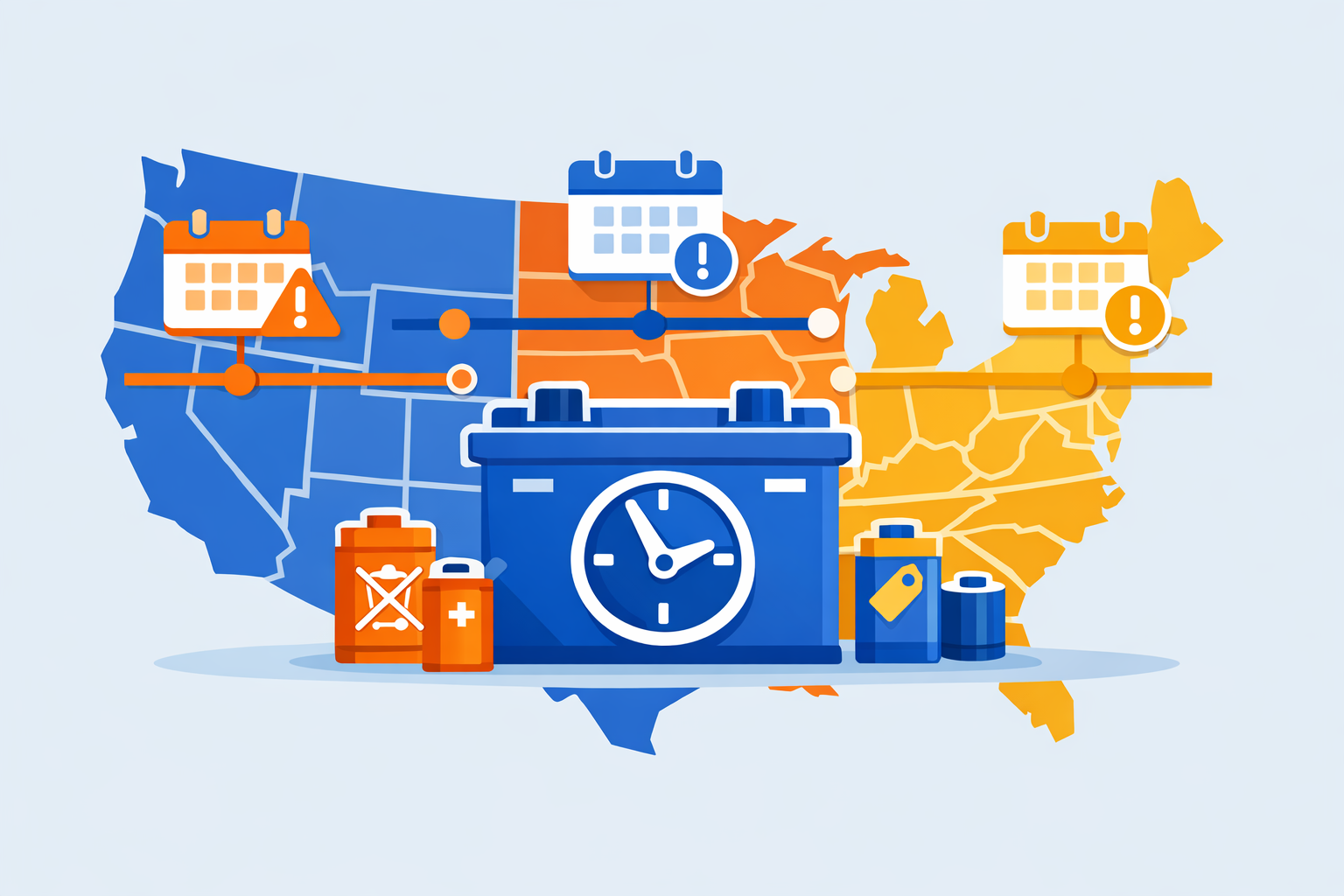
Auto parts suppliers operating across multiple U.S. states face an accelerating patchwork of battery stewardship compliance deadlines, with key take-back, recycling, and labeling mandates clustering around 2027 and 2028 under divergent state-level extended producer responsibility (EPR) frameworks. At least ten states have enacted or finalized battery EPR laws, each with distinct timelines, scope definitions, and reporting obligations-creating a fragmented compliance landscape for manufacturers and their supply chains.
Background
The Product Stewardship Institute (PSI) reports that EPR laws for batteries now exist across 34 states and the District of Columbia across multiple product categories, with battery-specific statutes accelerating sharply since 2021. The legislative push stems from fire safety concerns-lithium-ion battery fires at waste facilities have caused millions of dollars in damage, worker injuries, and fatalities, according to the Illinois Environmental Protection Agency-alongside growing demand for critical mineral recovery as EV adoption expands.
Until recently, federal coordination was absent. The U.S. EPA continues to develop a voluntary battery EPR framework, with the agency expecting to publish a high-level guidance document during summer 2026 and submitting a related report to Congress, according to Waste Dive. The framework is not a model statute but a design and reporting reference. EPA officials described California, Illinois, and New York as "early adopters" whose programs illustrate a wide range in how states collect batteries and enforce requirements. Divergence, not harmonization, currently defines the landscape.
Details
Compliance windows differ materially by state. In California, battery producers must participate in a CalRecycle-approved stewardship plan no later than April 1, 2027, under the state's Responsible Battery Act. Washington State's program, governed by WAC 173-905 effective January 16, 2026, bars retailers from selling covered portable batteries unless the producer participates in an approved plan beginning July 1, 2027; labeling must include the producer's brand by January 1, 2028.
Illinois' Battery Stewardship Act took effect January 1, 2026, and imposes a disposal ban on all portable and medium-format batteries beginning January 1, 2028. Connecticut's 2025 Act requires producers to join a Battery Stewardship Organization by January 1, 2027, while Nebraska's Safe Battery Collection and Recycling Act of 2025 sets a disposal ban effective January 1, 2028.
Colorado's SB 25-163 requires battery stewardship organizations to submit plans by July 1, 2027, producers to participate in and fund a stewardship organization from August 1, 2027, and mandates labeling on all batteries sold in-state from January 1, 2028. New Jersey's Electric and Hybrid Vehicle Battery Management Act-the first U.S. law to apply EPR principles specifically to EV propulsion batteries-required producer registration by January 8, 2025 and annual sales reporting beginning January 8, 2026, with a disposal ban taking effect January 8, 2027.
As of April 2026, governors in Wisconsin, Kentucky, and Oregon also signed battery stewardship laws, according to Waste Dive's state recycling tracker, bringing the total number of active or pending programs to more than a dozen.
Scope variations compound the burden for multi-state operators. California explicitly excludes batteries embedded in motor vehicles from its portable battery EPR program. Washington's program covers portable batteries from 2027 but defers medium-format batteries-those between 11 and 25 pounds or 300 to 2,000 watt-hours-until January 2029. Washington's administrative fee for battery stewardship organization oversight reached $357,634 for 2026, set annually by the Department of Ecology.
State divergence extends to labeling. Washington requires a producer brand mark by January 2028 and a crossed-out wheeled bin symbol plus battery chemistry information by January 2030. Colorado mandates its own labeling specification from January 2028. No two state labeling timelines align, forcing suppliers to manage multiple label versions or adopt a single label meeting the strictest combination of requirements.
| State | Producer Compliance Deadline | Disposal / Collection Ban | Labeling Deadline |
|---|---|---|---|
| California | April 1, 2027 | April 1, 2027 | TBD by CalRecycle |
| Washington | July 1, 2027 (portable) | July 1, 2027 (portable) | Jan. 1, 2028 (brand) |
| Illinois | Jan. 1, 2026 (active) | Jan. 1, 2028 | Not specified |
| Connecticut | Jan. 1, 2027 | TBD | TBD |
| Nebraska | TBD | Jan. 1, 2028 | TBD |
| Colorado | Aug. 1, 2027 | July 1, 2029 (retail ban) | Jan. 1, 2028 |
| New Jersey (EV) | Jan. 8, 2025 (registration) | Jan. 8, 2027 | Annual reporting |
Outlook
The EPA's voluntary framework, expected in summer 2026, is intended as a high-level reference covering design, collection, reporting, and regulatory considerations-not a binding federal standard-leaving states free to maintain their divergent programs. Industry groups and multi-state producers are pressing for greater harmonization of definitions, labeling specifications, and reporting formats to reduce the cost of simultaneous compliance across jurisdictions. Without federal preemption or a widely adopted model law, auto suppliers distributing battery-containing products nationally will need to align internal data systems, labeling operations, and take-back logistics to the most stringent combination of applicable state requirements before mid-2027 enforcement windows open.