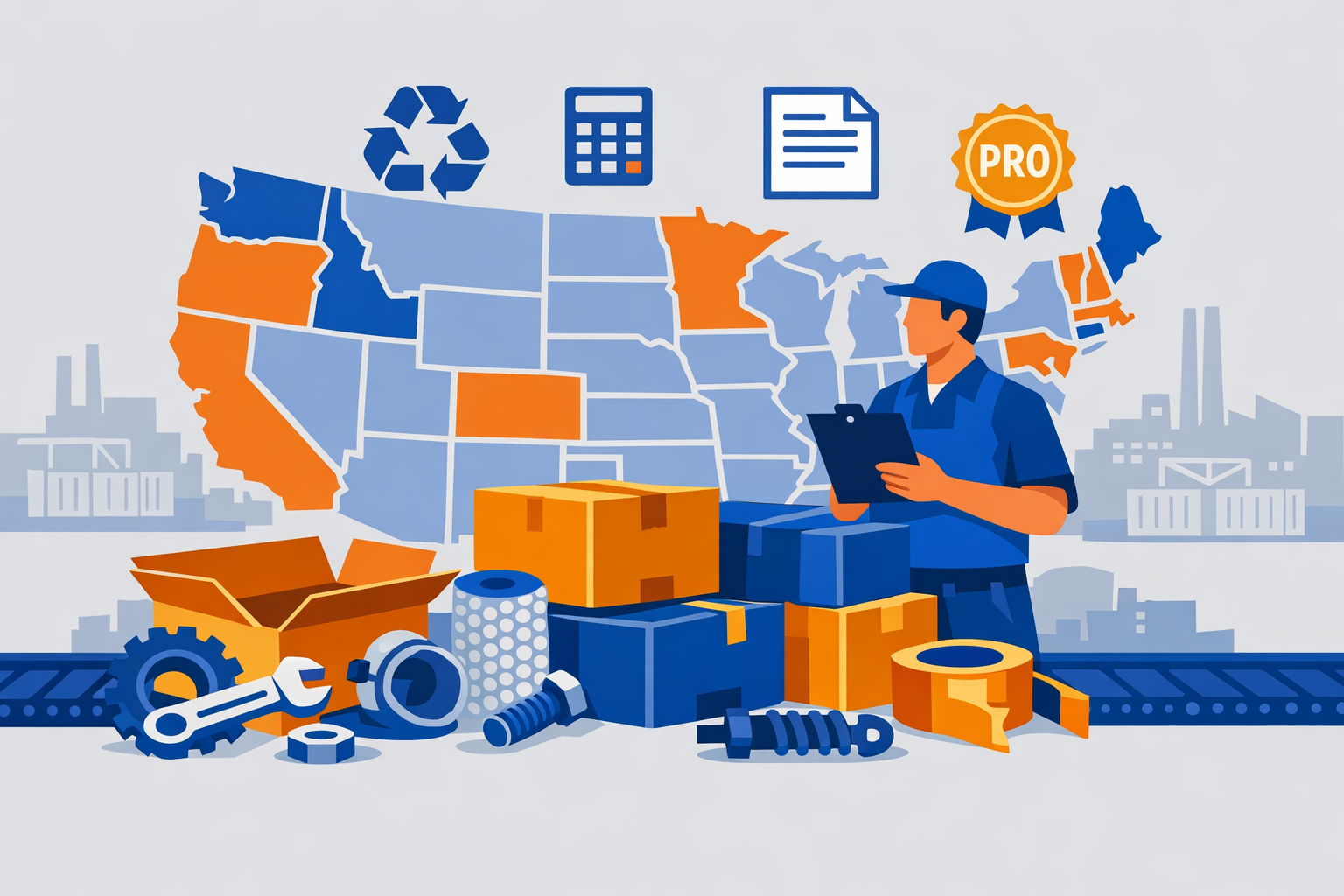
A wave of converging state-level Extended Producer Responsibility (EPR) deadlines will impose binding packaging compliance obligations on U.S. auto parts manufacturers, distributors, and retailers by early 2027-creating a de facto national compliance burden even without a federal law. Seven states-Maine, Oregon, Colorado, California, Minnesota, Maryland, and Washington-have now enacted comprehensive packaging EPR statutes, and multiple critical enforcement dates fall within the next 18 months. California's sales prohibition for non-compliant producers takes effect no later than January 1, 2027.
Background
No U.S. federal EPR law is in effect; legislation is introduced and passed at the state level.[1] Although the U.S. Senate has held hearings on EPR, no federal requirements exist, leaving producers to comply with differing laws across states. A federal labeling harmonization bill-the Pack Act-was introduced in the House in late 2025, as the Federal Trade Commission remains silent on potential Green Guides updates and businesses anticipate an October start date for California's SB 343 truth-in-labeling law. The Pack Act, backed by Ameripen and the Flexible Packaging Association, calls for standardized requirements governing recyclable and compostable packaging claims.
EPR laws fundamentally alter who pays for and manages packaging waste, shifting the financial and operational burden from local governments and taxpayers to manufacturers, importers, and distributors.[2] For automotive parts suppliers, this structural shift is significant: companies that manufacture, import, or brand packaged components-not just final-vehicle OEMs-fall squarely within the "producer" definition in most state statutes. These laws target plastics and single-use packaging and apply not only to manufacturers of plastics and containers but also to distributors, licensees, importers, retailers, and wholesalers, all of whom qualify as "producers."
Logistics and B2B sectors may often avoid producer status for transport-only packaging. Several states explicitly exclude packaging used solely in B2B transport or distribution, along with tertiary materials such as pallet wrap that are privately collected and recycled. Auto parts suppliers shipping exclusively to Tier 1 assemblers or OEM plants should verify this exemption carefully. Companies providing direct-to-consumer fulfillment or applying consumer-facing packaging under their own brand should scrutinize producer definitions and confirm responsibility allocations in contracts.
Details
The most immediate compliance milestone arrives in California. Producers must join a Producer Responsibility Organization (PRO) or obtain approval for individual compliance by January 1, 2027, with escalating recycling targets through 2032. California's SB 54, described by industry analysts as the most expansive packaging EPR law in the U.S., combines EPR with major requirements for recyclability, plastic reduction, and chemical compliance. Separately, California SB 343, finalized in April 2025, bans the chasing-arrows recycling symbol or terms like "recyclable" or "compostable" on packaging that does not meet California's recyclability or compostability criteria, with enforcement beginning in October 2026. Auto parts packaging carrying such claims-common on molded foam cushioning, multi-layer wraps, and protective films-must be reviewed for legal defensibility ahead of that date.
Cost projections are significant. Industry guidance from EcoEnclose advises producers to plan for a 15-40% uplift on packaging spend as fee cycles activate. The Circular Action Alliance's 2026 Oregon fee schedule ranges from $0 per pound for non-consumer corrugated cardboard and $0.05 per pound for paper to more than $1.30 per pound for certain plastic containers and foamed cushions, with most fees falling near the midpoint. Those higher bands directly affect auto parts suppliers, who routinely rely on foamed polyethylene, expanded polystyrene, and multi-layer stretch films to protect components in transit. Fiber-based materials tend to fall in lower fee bands, while flexible and multilayer plastics carry substantially higher fees due to limited recyclability and higher net system costs.
Eco-modulation-the mechanism by which fees are adjusted based on packaging recyclability-creates both risk and opportunity. These factors represent the most dynamic element of EPR fee structures, designed to incentivize packaging improvements. Multipliers can reduce fees by up to 50% for easily recyclable designs or increase them by 100% or more for problematic packaging. For bio-based plastics, the picture is mixed: bio-based, recycled-content, or readily recyclable materials often qualify for reduced rates, but materials must demonstrate an established real-world recovery pathway-not merely a bio-based origin-to qualify for fee incentives. Suppliers investing in bio-based films or coatings should verify material classification with the Circular Action Alliance before claiming lower fee tiers.
Labeling transparency requirements add a further layer of complexity. EPR is increasingly paired with broader recycling regulations, including stricter rules around recyclability claims, labeling standards, and material transparency. Together, these policies are reshaping how packaging is designed, sourced, and communicated. Producers must establish SKU- and component-level packaging data covering material, weight, post-consumer recycled content, and recyclability, and update contracts with suppliers, licensees, and private-label partners to allocate obligations and secure verifiable data.
Oregon's program, which became the first live U.S. EPR program on July 1, 2025, has served as a proving ground for the sector. More than 2,000 producers registered and received their first invoices, marking the first time U.S. packaging producers paid into a comprehensive EPR system. Oregon's transition exposed significant challenges around material classification and covered-materials scope. Separately, the National Association of Wholesaler-Distributors filed a lawsuit challenging the constitutionality of Oregon's program, alleging violations of the Dormant Commerce Clause and Due Process Clause. The suit argues the law unfairly targets out-of-state producers, burdens interstate commerce, and imposes opaque and unsustainable costs on distributors.
The following key deadlines directly affect auto parts producers shipping into regulated states:
| State | Critical 2026-2027 Milestone | Non-Compliance Consequence |
|---|---|---|
| Oregon | May 31, 2026: Annual supply report; fees due July 2026 | Up to $25,000/day |
| Colorado | January 2027: Fee payments due | Sales prohibition |
| California | January 1, 2027: PRO membership required; SB 343 labels by Oct 2026 | Prohibited from selling covered materials |
| Maine | May 2026: Registration & data; September 2026: Startup fees | Market access restrictions |
| Maryland | July 1, 2026: PRO registration deadline | $5,000-$20,000 per violation |
| Washington | July 1, 2026: Must join PRO | Prohibited from introducing covered materials |
| Minnesota | 2027-2028: PRO operations begin | Sales prohibition post-2028 |
Outlook
Companies should anticipate additional states passing packaging EPR within the next two to three legislative sessions, with initial obligations typically arriving 12 to 24 months after enactment. Northeast states-particularly New Jersey, New York, and Massachusetts-are among those advancing proposals, extending the compliance perimeter further into major auto parts distribution corridors. Packaging designed for recyclability, reduced material use, and higher recycled content helps lower EPR fees, minimize regulatory risk, and strengthen long-term sustainability performance-a calculus that suppliers with redesign windows of 18 months or less must begin modeling now. Proactively gathering and providing accurate, component-level data reduces future compliance risk and positions suppliers to respond to both current and emerging legislation.