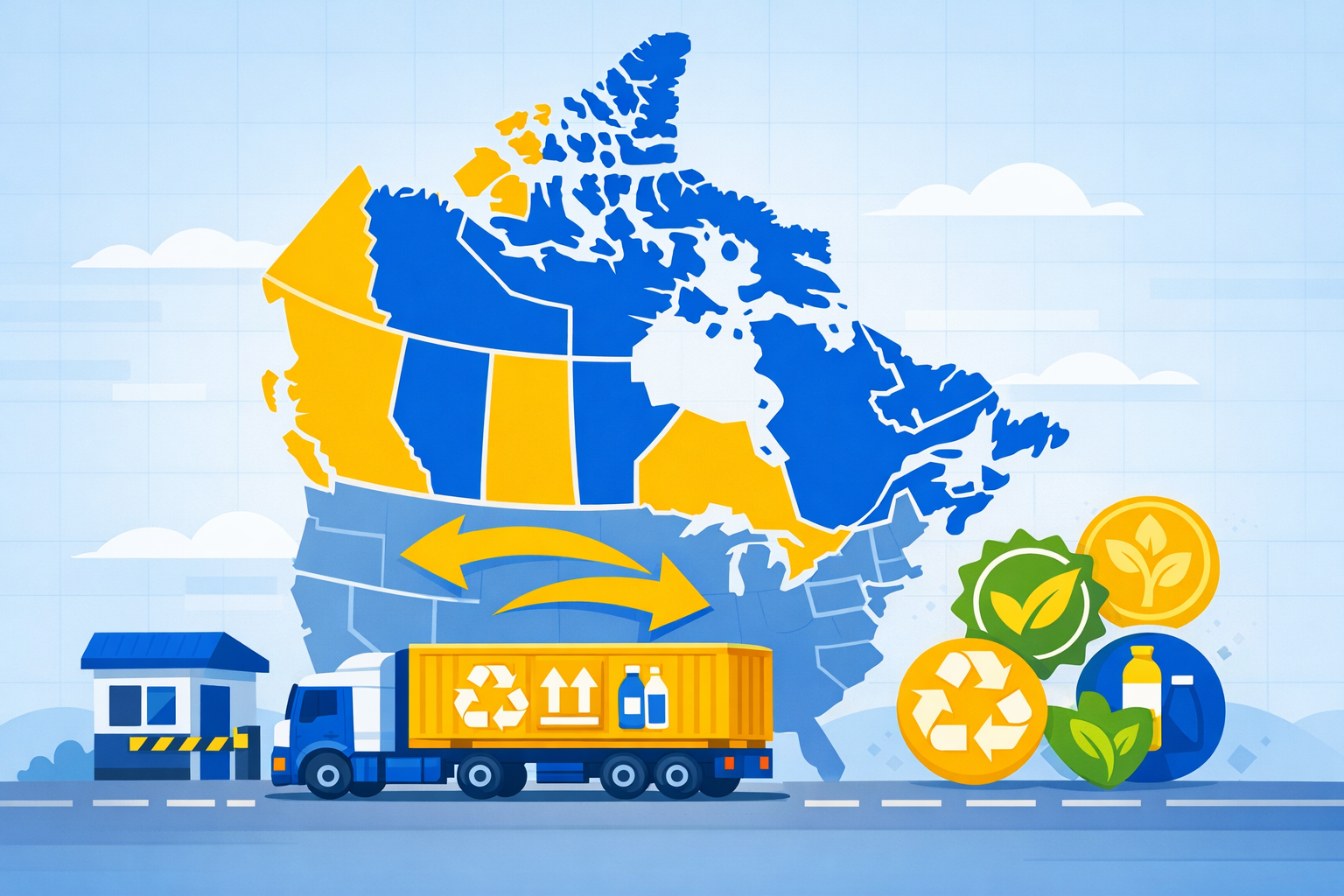
Auto parts suppliers operating across North America face a fast-changing compliance landscape. As of 2025, every Canadian province and territory except Nunavut has either enacted new extended producer responsibility (EPR) legislation or is actively transitioning to one - a sweeping policy shift with direct consequences for how automotive components are packaged, labeled, and recovered at end of life. For companies shipping parts across the Canada-U.S. border, emerging provincial rules add a new layer of complexity on top of already evolving U.S. state-level mandates.
The push toward harmonization is real, but so is the patchwork producers must navigate in the interim.
The Provincial Mosaic: Where Canada Stands Now
Packaging compliance in Canada is evolving rapidly, driven by a federal plastics reporting system and EPR regulations across provinces and territories. For auto parts producers, three major markets stand out as the highest-stakes regulatory environments.
Ontario completed its Blue Box transition to a full producer responsibility model effective January 1, 2026. Under the fully transitioned system, producers must submit annual packaging and paper supply data to the Resource Productivity & Recovery Authority (RPRA) and to a designated PRO by May 31 for the prior year's volumes.
Quebec has taken the broadest approach among Canadian provinces. Its new EPR framework covers all generators - not only those in the residential, public space, and educational sectors. Producers will begin reporting products intended for the industrial, commercial, and institutional (IC&I) sector in 2026 as the rule phases in. For auto parts, which largely move through IC&I channels, this is a consequential distinction.
British Columbia was the pioneer. British Columbia implemented packaging EPR in 2014, making it the first such program in North America, and has since served as a model for subsequent provincial rollouts. Recycle BC, a not-for-profit organization, administers residential packaging and paper product recycling throughout the province.
Alberta followed, with its EPR program for packaging, paper products, and single-use items officially launching on April 1, 2025. Administered by the Alberta Recycling Management Authority (ARMA) and managed by Circular Materials, the initiative aligns Alberta with other provinces and shifts financial and operational responsibility for recycling from municipalities to producers.
The Federal Overlay: Canada's Plastics Registry
Sitting above the provincial programs is the Federal Plastics Registry. The first reporting deadline under the Federal Plastics Registry was September 29, 2025, requiring producers of plastic packaging, electronic and electrical equipment, and single-use or disposable products to report data for the 2024 calendar year.
For the auto parts sector, the scope is set to expand. Phase 2 introduces reporting on all Phase 1 plastics regardless of their destined end-of-life waste stream, as well as plastic placed on the market in categories not covered in Phase 1 - including plastic resins, agriculture and horticulture, tires, transportation, construction, fishing and aquaculture, and textiles and apparel. The first annual reporting deadline for Federal Plastics Registry Phase 2 is September 29, 2026. Auto parts packaging is squarely in scope.
Harmonization Momentum: PROs Align on Ecodesign
A significant development in late 2025 pointed toward the consistency suppliers have long sought. For the first time in Canada, five producer responsibility organizations - Circular Materials, Éco Entreprises Québec, Multi-Material Stewardship Manitoba, SK Recycles, and Recycle BC - are collaborating on ecodesign guidelines to support greater recyclability of packaging and paper products. The initiative marks a major step toward a harmonized national framework offering clear guidance to the thousands of producers who market goods in more than one province or territory.
Five Canadian PROs are targeting completion of harmonized national ecodesign and recyclability guidelines for packaging by the end of 2026, with plastics guidance anchored in the APR Design Guide. The guidelines are structured around three strategies:
- Reduction: Optimizing packaging weight and volume to the minimum required for product function
- Procurement: Encouraging use of recycled, renewable, and certified materials through transparent supply chains
- Recyclability: Designing packaging for maximum compatibility with existing sorting and recycling infrastructure
Éco Entreprises Québec worked closely with the Association of Plastic Recyclers' technical team to align guidelines. The harmonization means PROs across Canada will use the APR Design Guide as the basis of their recommendations for designing plastic packaging for recyclability.
For auto parts suppliers, this convergence matters. Carton specifications, labeling, and recyclability claims that meet the harmonized guidelines should satisfy multiple provincial requirements simultaneously - reducing the design-cycle burden of maintaining separate packaging formats per jurisdiction.
The Cross-Border Challenge: Canada Meets U.S. EPR
Compliance pressure does not stop at the Canadian border. Seven U.S. states - Maine, Oregon, Colorado, California, Minnesota, Maryland, and Washington - have enacted packaging EPR laws, with 2026 marking the first major fee payment cycles in several of those programs. Suppliers operating in both markets effectively face two parallel compliance frameworks with divergent timelines, fee structures, and data requirements.
The contrast between the two systems is instructive.
| Compliance Dimension | Canada (Provincial EPR) | United States (State EPR) |
|---|---|---|
| Regulatory Level | Provincial/territorial + Federal Plastics Registry | State-level; no federal framework |
| IC&I Sector Coverage | Quebec leads; others phasing in | Generally residential focus |
| Harmonization Progress | 5 PROs aligning on national ecodesign (target: end of 2026) | Fragmented; state-by-state rules |
| Auto Parts / Transportation | FPR Phase 2 reporting includes transportation (Sept 2026) | Emerging - varies by state |
| Producer Registration | Must register per province with designated PRO | Must register per state with approved PRO |
| Eco-modulated Fees | Emerging in Quebec and BC; expanding | Active in Oregon, Colorado, California |
| Annual Reporting Deadline | May 31 (most provinces) | Varies; 2026 first fee cycles |
With nine of its 13 provinces and territories at varying stages of EPR implementation, Canada's experience could offer lessons to U.S. states moving rapidly toward their own laws. Nearly 90% of Canadian residents live within about 100 miles of the U.S. border, and numerous companies operate facilities on both sides.
The geographic overlap makes a coordinated North American approach strategically attractive - but difficult to execute without policy alignment that does not yet exist.
Cross-Border Compliance Alert: Auto parts producers shipping between Canada and the United States must now manage EPR obligations in both jurisdictions simultaneously. Canada's Federal Plastics Registry Phase 2 will include the transportation sector with a first reporting deadline of September 29, 2026. Concurrently, seven U.S. states have activated packaging EPR laws with first fee cycles in 2026. Suppliers without a dual-jurisdiction compliance strategy risk penalties on both sides of the border.
Key Provincial Compliance Timelines
The table below summarizes current EPR status across Canadian provinces most relevant to auto parts packaging flows.
| Province / Territory | EPR Status | Key Milestone | IC&I Sector Included? |
|---|---|---|---|
| British Columbia | Fully operational (since 2014) | Revised plan approved Aug 2025 | Under consideration |
| Ontario | Full EPR as of Jan 1, 2026 | Blue Box transition completed | Residential focus; ICI under review |
| Quebec | Full EPR operational from 2025 | IC&I reporting begins 2026 | Yes - all generators |
| Alberta | Fully operational (Apr 1, 2025) | Phase 2 extends Oct 1, 2026 | Phased inclusion |
| Saskatchewan | Full EPR from Dec 1, 2024 | Full transition by end of 2027 | No |
| Manitoba | Transitioning to full EPR | Plan finalization targeted 2026 | No |
| New Brunswick | EPR effective Jan 1, 2026 | Expanded designated materials list | No |
| Nova Scotia | Launched Dec 1, 2025 | Producers register with Divert NS | No |
| Yukon Territory | EPR effective Nov 1, 2025 | Circular Materials approved as PRO | No |
Practical Compliance Implications for Auto Parts Suppliers
The regulatory direction is clear, but the near-term operational burden remains substantial. The primary challenge is the lack of a fully harmonized national EPR framework. Businesses operating across multiple provinces and territories must navigate distinct regulations, reporting requirements, fee structures, and PRO options - requiring dedicated resources or expert guidance.
Accurate, granular data collection on product volumes, material types, weights, and end-of-life pathways is essential. Many businesses will need to invest in new internal systems or engage external expertise to meet these diverse reporting demands, especially with the Federal Plastics Registry adding another layer of data requirements and verification procedures.
For auto parts manufacturers, several operational actions are now baseline requirements:
- Map cross-border packaging flows at the SKU level, identifying which provincial and U.S. state programs apply to each product line
- Register with applicable PROs in each operating province - registration obligations are live, and penalties for non-compliance have already been issued in Ontario and BC
- Audit packaging materials against emerging ecodesign guidelines, particularly the APR Design Guide now anchoring Canadian PRO recommendations
- Monitor IC&I inclusion timelines in provinces like Quebec and Alberta, where components shipped to repair shops and dealerships fall within scope
- Prepare for Phase 2 FPR reporting on transportation-category plastics, due September 29, 2026
For auto parts companies already managing U.S. state EPR obligations under programs in Oregon, California, and Colorado, aligning data collection and packaging design with Canadian requirements in parallel is both an efficiency opportunity and a compliance necessity. The existing posts US Auto Industry Faces New Packaging EPR Rules and North America and Australia Align on Automotive Packaging Standards provide context on how suppliers are addressing the U.S. side of this equation.
Outlook: Convergence on the Horizon, Complexity in the Present
Industry sentiment is cautiously optimistic that a converged framework will ultimately reduce compliance burdens for cross-border auto parts supply chains. As EPR regulations for packaging and paper roll out across provinces and territories, ecodesign emerges as a key tool for improving recycling system performance and cost efficiency. By better matching product packaging with current and developing sorting and recycling infrastructure, ecodesign can raise overall material recovery rates, meet EPR regulation requirements, and enable a circular economy across Canada.
The most immediate signal from Canadian policymakers is that the full transition is on track and accelerating. Some provinces are beginning to focus on eco-design and eco-modulation, which would tie a brand's financial liability directly to its packaging choices.
For auto parts producers, this carries two practical implications. First, packaging decisions made today - material selection, weight reduction, recyclability design - will directly affect fee obligations as eco-modulation expands. Second, the data infrastructure being built now for provincial reporting will become the foundation for Federal Plastics Registry Phase 2 compliance. Building those systems with cross-border interoperability in mind is no longer optional - it is baseline readiness.
Frequently Asked Questions
Q: Are auto parts packaging producers considered "producers" under Canadian provincial EPR laws? A: Yes. Under provincial EPR frameworks, a producer is broadly defined as any entity that manufactures, imports, distributes, or sells products with packaging into a provincial market. Auto parts suppliers - including OEM component manufacturers and aftermarket distributors - are captured under these definitions in all active EPR provinces.
Q: Does the Federal Plastics Registry apply to auto parts packaging? A: Phase 1 (reporting deadline September 29, 2025) covered plastic packaging destined for residential waste streams. Phase 2, with a first reporting deadline of September 29, 2026, expands scope to include the transportation sector, directly capturing auto parts and components packaging.
Q: What is the difference between registering with a PRO and reporting to the Federal Plastics Registry? A: These are parallel but distinct obligations. Provincial PRO registration fulfills obligations under each province's EPR regulation and involves fee payments. The Federal Plastics Registry is a federal data collection exercise under the Canadian Environmental Protection Act that does not replace provincial obligations but adds a separate reporting layer.
Q: How should cross-border suppliers prioritize their compliance steps? A: Immediate priorities are: (1) confirm PRO registrations in all active provinces where packaging is supplied; (2) audit packaging materials against PRO ecodesign guidelines and the APR Design Guide; (3) build data systems capable of capturing packaging supply volumes, material type, and weight at the SKU level; and (4) monitor Quebec's IC&I sector reporting launch in 2026, which will capture auto parts supply chains through commercial channels.
Q: Will Canadian and U.S. packaging EPR frameworks converge? A: Movement in that direction is visible. Canadian PROs are aligning on the APR Design Guide - the same standard informing U.S. state eco-modulated fee structures - and the Federal Plastics Registry is building data infrastructure that could support bilateral coordination. However, formal regulatory convergence remains a multi-year prospect, and suppliers must maintain jurisdiction-specific compliance strategies in the near term.