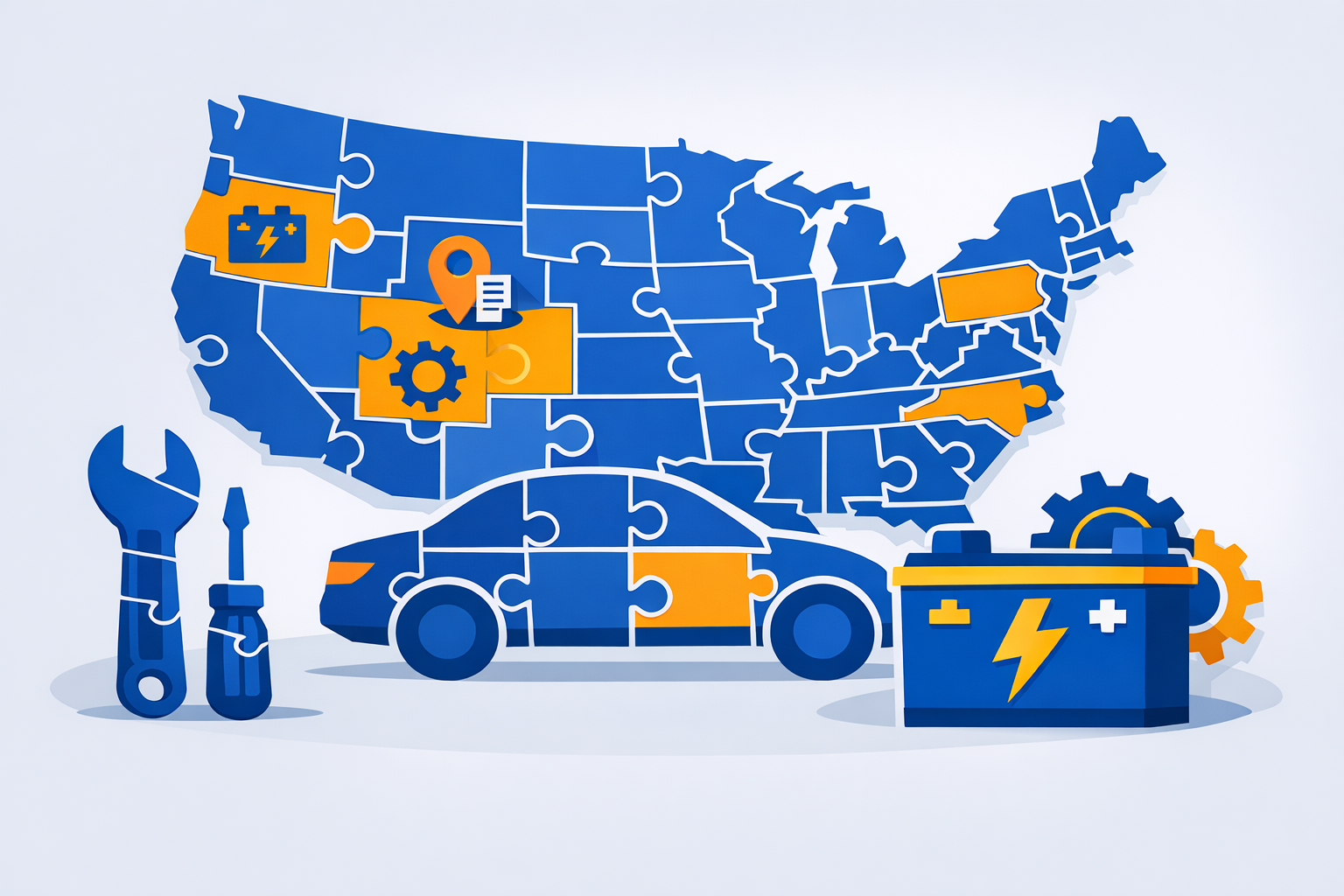
A wave of state-level battery extended producer responsibility (EPR) laws is creating a fragmented compliance landscape for U.S. auto parts suppliers and Tier 1 manufacturers, with key deadlines converging between 2026 and 2029. At least eight states have enacted or advanced battery stewardship legislation in the past three years, each establishing distinct registration portals, reporting formats, recycling targets, and labeling standards. For suppliers distributing battery-containing products across multiple states, the divergence demands parallel compliance tracks rather than a single national framework.
Background
Battery stewardship regulation in the United States is evolving rapidly as more states introduce extended producer responsibility frameworks. These laws place end-of-life management responsibility on manufacturers, brand owners, and importers-producing an increasingly complex and fragmented compliance landscape for companies selling standalone batteries or battery-powered products.
As of January 1, 2026, the regulatory landscape governing these batteries has fractured into a patchwork of 50 different standards. No federal battery stewardship statute exists to harmonize state programs, and the EPA has announced plans to separate lithium batteries from current universal waste guidelines, establishing a distinct regulatory category tailored to lithium battery characteristics, with proposed guidance expected in mid-2025.
The divergence contrasts sharply with the European Union's approach. The EU Battery Regulation (2023/1542) creates a single, harmonized framework that extends compliance beyond end-of-life management to cover the entire battery lifecycle, including mandatory sustainability requirements, carbon footprint declarations, and strict supply chain transparency.
Details
California leads with multiple complementary regulations: AB 2440 establishes stewardship programs for covered batteries, while SB 1215 expands electronic waste recycling fees to include battery-embedded products starting January 2026. Under California's AB 2440, battery producers must participate in a CalRecycle-approved stewardship plan no later than April 1, 2027. Washington State's SB 5144 requires portable battery collection programs to be operational by July 1, 2027, with medium-format batteries following on January 1, 2029, according to the Washington State Department of Ecology. A producer that does not participate in a battery stewardship plan may not sell covered batteries in Washington.
Illinois' Battery Stewardship Act requires producers to participate in an approved stewardship plan starting January 1, 2026, with civil fines of $7,000 per violation. Under Connecticut's 2025 Act, producers of covered batteries and battery-containing products sold or offered for sale in Connecticut must join a Battery Stewardship Organization by January 1, 2027. Nebraska's Safe Battery Collection and Recycling Act, enacted in May 2025, imposes a battery disposal ban effective January 1, 2028. Under Oregon's Act 4144, producers of batteries or battery-containing products must join a battery producer responsibility organization and implement a collection and recycling program by July 1, 2029.
The compliance burden extends well beyond calendar management. These laws introduce new challenges in data collection, reporting, and regulatory monitoring. In Colorado, compliance requires producers to register with CAA, sign a Producer Participant Agreement and Colorado State Addendum, and submit material supply data via the Producer Portal by July 31, 2025, with annual dues beginning in January 2026. Colorado's Department of Public Health & Environment has not issued guidance on navigating potential overlaps between competing stewardship plans, leaving open questions around possible duplication in reporting and fee obligations.
Labeling and material disclosure demands are also escalating. Consumer-facing requirements include mandatory labeling starting in 2026, with batteries carrying information on manufacture date, weight, and chemical composition. The regulations address supply chain due diligence through mandatory programs covering lithium, cobalt, nickel, and natural graphite sourcing. For auto parts suppliers sourcing globally, these disclosure obligations intersect with product pricing, warranty terms, and sourcing decisions.
Enforcement is tightening in parallel. As states independently develop rules, timelines, PRO structures, and fee formulas, EPR compliance is growing increasingly fragmented. What began as a push for improved material circularity and recycling incentives now carries the burden of complexity, regulatory uncertainty, opaque governance, and potentially substantial fees likely to be passed on to retailers and consumers. Legal challenges have also emerged: on July 30, 2025, the National Association of Wholesaler Distributors filed a constitutional challenge against Oregon's EPR law, arguing it places an undue burden on interstate commerce, creates a monopoly by requiring producers to join a single PRO, and lacks due process around fee setting.
Outlook
Extended producer responsibility programs are becoming the dominant regulatory model as states implement comprehensive battery stewardship laws. Industry stakeholders and legal analysts advise suppliers to map state-specific regulatory touchpoints now, align product sourcing with recognized recycler certifications, and invest in modular data systems capable of adapting to each jurisdiction's reporting format. With multiple states enforcing different laws-each carrying its own deadlines and criteria-establishing a compliance strategy now is critical to avoiding surprise costs or loss of market access. Colorado registration is already active, California's point-of-sale fee collection is under way, and Washington's disposal bans approach in 2027. The window for reactive compliance planning is narrowing rapidly for auto parts supply chains operating across state lines.