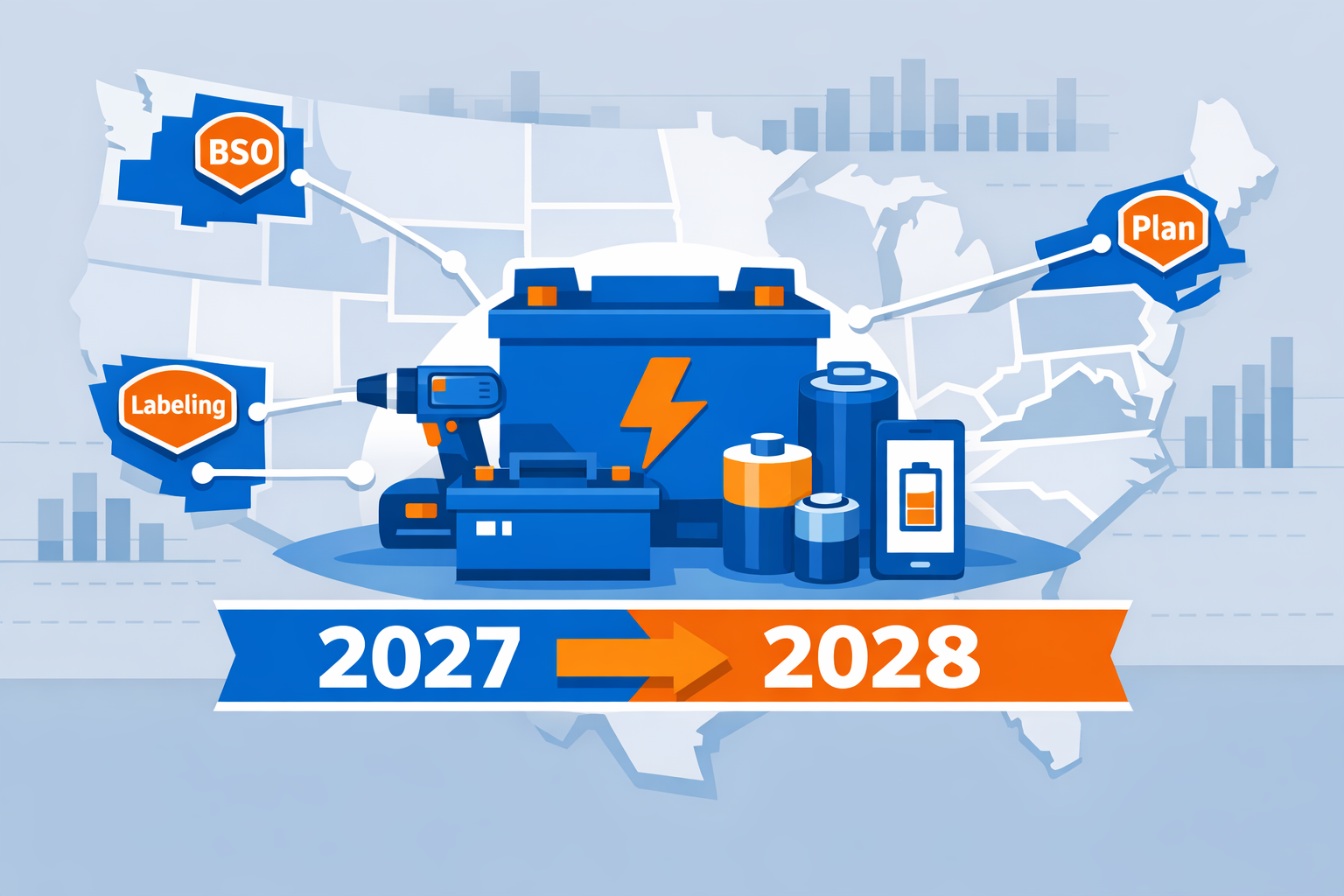
In the past five years, nine U.S. states and jurisdictions have enacted battery extended producer responsibility (EPR) laws - and the pipeline is still filling. For auto parts manufacturers and OEMs, the 2027-28 window represents a convergence of activation dates, fee obligations, labeling mandates, and disposal bans landing simultaneously across multiple states. Unlike packaging EPR, which has drawn the bulk of regulatory attention, battery stewardship programs carry distinct operational complexity: batteries are embedded in products, span multiple formats and chemistries, and sit within multi-tier supply chains where producer identity is not always straightforward.
The compliance challenge is not theoretical. It is structural - and it is arriving fast.
The State-by-State Map Is Expanding Rapidly
Battery EPR legislation has accelerated sharply since 2023. In the past five years, California, Colorado, Connecticut, Illinois, Nebraska, New Jersey, Vermont, Washington State, and Washington D.C. have all passed battery EPR laws, and several others have active legislation.
The pace intensified in 2025. Connecticut passed HB 5019, establishing producer responsibility for consumer batteries, while Nebraska enacted LB36, the Safe Battery Collection and Recycling Act. Colorado's SB25-163 requires a Battery Stewardship Organization to submit a stewardship plan no later than July 1, 2027, and from August 1, 2027 onward, producers selling covered batteries in the state must participate in and finance a compliant battery stewardship organization.
Washington State's program is one of the most detailed to date. Beginning July 1, 2027, the law prohibits retailers from selling covered portable batteries unless the producer participates in an approved plan; beginning January 1, 2028, the same restriction extends to large-format batteries.[1] Battery producers must join and fund a Battery Stewardship Organization (BSO), which will develop and implement an Ecology-approved stewardship plan. A producer that does not participate may not sell covered batteries in Washington.
California's approach is layered. A battery EPR scheme requires producers to create or fund stewardship programs for collecting and recycling most batteries sold in California, beginning no later than April 1, 2027. Separately, an expansion of California's Electronic Waste Recycling Act covers battery-embedded products, requiring consumers to pay a fee at the point of sale. The point-of-sale fee took effect January 1, 2026, while new reporting requirements take effect July 1, 2027.
One jurisdiction stands apart. In January 2024, New Jersey enacted the Electric and Hybrid Vehicle Battery Management Act, becoming the first state to include EV and hybrid vehicle propulsion batteries - those used to supply power to propel a vehicle - within its battery EPR law. This signals directly to auto OEMs and Tier 1 suppliers that the definitional scope of state battery laws is widening.
New Jersey's Precedent: As the first state to bring EV and hybrid propulsion batteries explicitly within EPR scope, New Jersey's law puts auto manufacturers on notice that the traditional carve-out for automotive batteries may not persist across all jurisdictions. Procurement and legal teams should assess exposure under existing and pending state programs now.
Key Compliance Milestones: State-by-State Overview
The table below consolidates critical activation dates for states with the most active 2027-28 compliance windows. Auto parts makers operating across multiple states will encounter overlapping - and not always consistent - obligations.
| State / Jurisdiction | Legislation | BSO Membership Deadline | Disposal Ban / Enforcement | Labeling Requirement | Auto Battery Scope |
|---|---|---|---|---|---|
| Washington State | SB 5144 (2023) | Jul 1, 2026 (plan submission) | Jan 1, 2027 (portable) | Jan 1, 2028 | Large-format: Jan 1, 2028 |
| California | AB 2440 / SB 1215 | Apr 1, 2027 | Apr 1, 2027 | Jul 1, 2027 (reporting) | Motor vehicle batteries excluded |
| Illinois | Battery Stewardship Act | Jan 1, 2026 | Jan 1, 2028 (disposal ban) | TBD | Automotive lead-acid excluded |
| Connecticut | HB 5019 (2025) | Jan 1, 2027 | Jan 1, 2027 | TBD | Under review |
| Nebraska | LB36 (2025) | Jan 1, 2028 | Jan 1, 2028 | Jan 1, 2028 | Under review |
| Colorado | SB25-163 (2025) | Aug 1, 2027 | Jul 1, 2029 (retail) | Jan 1, 2028 | Under review |
| New Jersey | EV & Hybrid Battery Mgmt Act (2024) | TBD | TBD | TBD | First state to include EV propulsion batteries |
| Washington D.C. | Zero Waste Omnibus Act (2020) | Active | Jan 2022 (active) | Active | Limited |
Fee Structures: What Producers Are Actually Paying
Battery stewardship fee structures vary by program, but a common architecture is emerging. Fees are typically assessed at the BSO level - meaning the BSO collects charges from member producers to fund program operations - rather than applied as direct per-unit or per-kWh levies on manufacturers.
Colorado's SB25-163 provides the clearest published fee structure. A battery stewardship organization must pay a one-time fee of $50,000 at plan submission; if the plan is approved, an additional $86,000 is due. Within 12 months of plan approval, and each July 1 thereafter, the BSO must also pay an annual fee covering the department's cost of implementing, administering, and enforcing the program - with the amount set by rule from the Solid and Hazardous Waste Commission.
Washington State's fee model is similarly structured at the BSO level. Ecology's plan review fee for 2026 is $63,066, paid as a one-time base fee when the BSO submits its plan. Ecology's annual administrative fee for 2026 is $357,634, paid by each BSO annually based on Ecology's prior-year costs.
For individual producers, financial exposure is filtered through BSO membership dues - but those costs are ultimately driven by the aggregate weight, volume, and format of batteries placed on each state's market. Producers with significant battery content in their BOMs (bill of materials) - including makers of battery management systems, hybrid vehicle modules, and electrified power tools - face proportionally higher assessments. Battery EPR regulations vary by state and format, covering small, medium, or large format batteries, and in some cases by specific chemistries.
Supply Chain Implications: BOM Visibility and Data Systems
For auto parts manufacturers, the compliance burden extends well beyond writing a check to a BSO. The structural challenge is knowing what you make - specifically, understanding which batteries or battery-containing products fall within scope in each state, at what format threshold, and under which brand or producer identity.
Generally, a producer is the brand owner of a covered battery sold to consumers. In some cases, the producer may be the manufacturer, brand licensee, brand owner, importer of record, or the distributor or retailer. The producer of a battery-containing product can also carry obligations under the law. This definitional breadth means that Tier 1 and Tier 2 auto suppliers - not just OEMs - may carry direct registration and fee obligations in states where they hold product brand or import roles.
The data challenge is significant. Supply chain mapping remains the biggest hurdle, as most companies lack visibility beyond tier-two suppliers. For battery compliance, that visibility gap translates directly into regulatory exposure: producers must report battery chemistry, volume sold, and brand data to state agencies.
Beginning July 1, 2027, California manufacturers must submit annual reports to CalRecycle noting the estimated number of covered devices sold in the state, the chemistry of batteries contained in those devices, a baseline estimate of recycled materials, and a list of all retailers to whom the producer provided notices. Records supporting these reports must be maintained for at least three years.
Labeling adds another layer. Battery markings must be permanent, clearly visible, and legible; by January 1, 2028, Washington State requires markings to include the producer's brand. Multiple states - including Nebraska and Colorado - share the same January 1, 2028 labeling activation date, but precise marking specifications may diverge. Managing parallel labeling revisions across product lines is a non-trivial engineering and procurement task.
For manufacturers supplying global markets simultaneously, the U.S. state patchwork sits alongside European obligations. The EU's Battery Passport - a digital record of a battery's entire lifecycle - becomes a requirement for all EV batteries starting February 18, 2027. Companies investing in battery traceability infrastructure to meet EU requirements are well positioned to extend that data architecture to U.S. state reporting obligations.
Harmonization Gaps and Governance Challenges
The absence of a federal battery EPR framework leaves manufacturers managing compliance state by state, with no standardized registration portal, no common fee basis, and no uniform definition of "covered battery" or "producer." The patchwork is not merely inconvenient - it creates genuine cost and risk asymmetries between competitors depending on where they sell, what formats they produce, and how their corporate structures assign brand ownership.
Several critical gaps remain unresolved:
- Automotive exemption inconsistency. California explicitly excludes batteries contained in motor vehicles. Illinois excludes automotive lead-acid batteries. New Jersey explicitly includes EV and hybrid propulsion batteries. Nebraska and Colorado are still working through scope definitions. Auto parts makers cannot assume uniform treatment.
- Medium- and large-format timelines diverge. Washington State's disposal ban for portable batteries activates January 1, 2027, but large-format batteries are not covered until January 1, 2028.[2] Manufacturers of battery systems straddling format thresholds need precise weight and watt-hour data to determine when each product line enters scope.
- Retail prohibition as a compliance lever. Most state programs use the threat of retail prohibition - not just fines - to enforce producer participation. A producer that does not participate in a battery stewardship plan may not sell covered batteries in Washington. In Illinois, non-compliance can result in a civil fine of $7,000 per violation, doubling if unpaid. Compliance failure risks market access, not just regulatory penalties.
Early-adopter programs offer a useful model. Vermont enacted the nation's first household battery EPR law in 2014. In its first year of implementation, Vermont increased collection of both single-use and rechargeable batteries by more than 180 percent - demonstrating that well-designed programs can achieve rapid operational results once producer participation is in place.
What Auto Parts Manufacturers Should Do Now
The 2027-28 compliance wave is not a distant horizon. Washington State's BSO plan submission deadline is July 1, 2026 - less than two months away. Illinois has been enforcing BSO membership since January 2026. Companies that have not yet mapped their battery-containing product portfolio against state program scope are already behind.
Practical priorities for procurement, supply chain, and compliance teams include:
- Conduct a battery-in-BOM audit. Identify all products containing batteries - whether portable, medium-format, or embedded - and determine whether each product's producer identity maps to the company or to a brand licensee or importer.
- Register with active BSOs. Illinois and Washington D.C. programs are already operational. Washington State's plan submission deadline is imminent. Participation gaps in active markets carry immediate retail prohibition risk.
- Standardize labeling data fields. Multiple states require producer brand marking by January 1, 2028. Engineering change orders for battery labeling should be initiated now to avoid compressed timelines at year-end 2027.
- Build chemistry and volume reporting infrastructure. California's July 2027 reporting requirement and Washington State's ongoing plan obligations require annual data on battery chemistry and units sold. Spreadsheet-based tracking is not sustainable at scale across multiple state programs.
- Monitor New Jersey closely. As the first state to include EV propulsion batteries in EPR scope, New Jersey's program sets a precedent that other states may follow. OEMs and Tier 1 suppliers should track rulemaking progress and assess exposure early.
The broader context for this compliance wave is also worth noting. For companies already aligning their supply chain compliance strategies with packaging EPR rules, battery stewardship programs represent the next layer in a deepening producer responsibility framework - one that spans materials, formats, and end-of-life systems simultaneously.
Producer Responsibility Organizations and advocates argue that EPR laws level the playing field by requiring all battery producers to financially support recycling programs, relieving local governments and taxpayers from managing disconnected systems. For the auto parts sector, the task now is not to debate the policy rationale - it is to build the data systems, organizational structures, and supplier relationships that make multi-state compliance operationally achievable before the 2027-28 activation dates arrive.
FAQ: US Battery Stewardship Compliance for Auto Parts Manufacturers
Q: Are automotive batteries exempt from state battery EPR laws? Most current state programs exclude batteries physically embedded in motor vehicles - California, for example, explicitly excludes batteries contained in cars. However, New Jersey has broken from this pattern by including EV and hybrid propulsion batteries within its EPR law. Exemptions vary by state and should be verified against each program's specific scope definitions.
Q: Who counts as a "producer" under state battery EPR programs? Definitions are broad. Producers typically include brand owners, manufacturers, importers of record, brand licensees, and - in some cases - distributors or retailers. For auto supply chains with complex brand and import structures, multiple entities within the same product flow may carry producer obligations.
Q: What happens if a manufacturer misses a BSO membership deadline? State programs generally prohibit retailers from selling products from non-compliant producers, creating a direct market access risk. Financial penalties also apply - Illinois, for instance, imposes civil fines of $7,000 per violation, doubling if unpaid.
Q: Do state battery EPR fees apply directly to manufacturers, or to BSOs? Fees are primarily assessed at the BSO level. BSOs then collect charges from member producers to fund program operations. However, producers with high battery volumes or complex chemistries face proportionally higher assessments, which flow back as membership costs.
Q: Is there a federal battery EPR program that would simplify multi-state compliance? No federal battery EPR framework currently exists. The EPA is developing collection best practices and voluntary labeling guidelines, but these are non-binding. Multi-state compliance remains the primary obligation for manufacturers operating nationally.