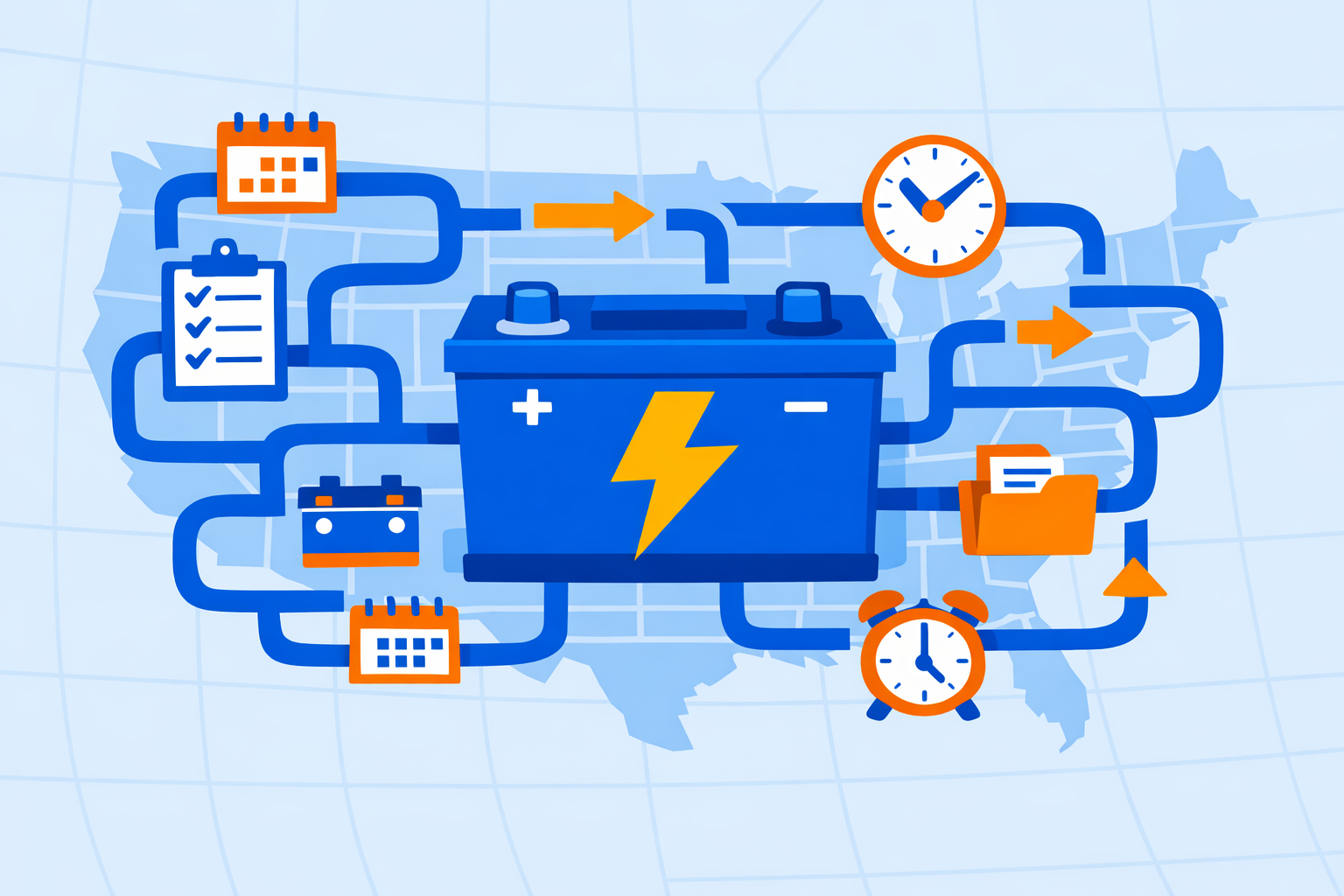
A wave of divergent state-level battery stewardship mandates is forcing auto parts manufacturers to navigate an increasingly fragmented compliance landscape, with registration, sales restriction, and disposal ban deadlines staggered across nine or more jurisdictions between 2025 and 2029.
Background
The proliferation of state battery Extended Producer Responsibility (EPR) laws accelerated sharply in 2024 and 2025, as legislatures from California to Nebraska moved to fill a vacuum left by the absence of federal stewardship standards for lithium-ion and other battery chemistries. Battery stewardship programs establish producer responsibility frameworks requiring manufacturers to finance and operate collection and recycling systems for their products. These laws aim to limit hazardous substances in batteries and mandate collection and recycling infrastructure, with programs like Call2Recycle playing a central role in managing compliance systems.
At the federal level, the regulatory picture remains incomplete. The EPA announced plans to separate lithium batteries from current universal waste guidelines, establishing a distinct regulatory category tailored to lithium battery characteristics, with proposed guidance expected in mid-2025. However, no comprehensive federal stewardship mandate has been enacted, leaving producers to track requirements state by state.
Details
Compliance timelines vary significantly by state, creating operational complexity for suppliers whose components cross state lines. California's Department of Resources Recycling and Recovery (CalRecycle) adopted regulations effective April 1, 2025, requiring battery producers to submit stewardship plans for battery collection and recycling. In Illinois, the Battery Stewardship Act required producers to participate in an approved stewardship plan by January 1, 2026, with plans due for submission by July 1, 2025, according to Source Intelligence. Non-compliance in Illinois can result in a civil fine of $7,000 per violation, doubling if unpaid.
Colorado enacted SB25-163 in June 2025, establishing its own regime with distinct milestones. The law requires a battery stewardship organization to submit a stewardship plan to the Colorado Department of Public Health and Environment by July 1, 2027. From August 1, 2027, any producer selling, distributing, or making available certain batteries or battery-containing products in the state must participate in and finance a stewardship organization that has submitted a plan. Colorado subsequently advanced SB26-003, extending stewardship obligations to EV propulsion batteries, with EV battery providers required to participate in an approved stewardship plan by August 1, 2028, or face penalties of up to $25,000 per day, according to legislative records.
Nebraska and Connecticut joined the trend in 2025. Under Nebraska's Safe Battery Collection and Recycling Act, producers must be members of a Battery Stewardship Organization, with a disposal ban taking effect January 1, 2028. Under Connecticut's 2025 Act, producers must join a Battery Stewardship Organization by January 1, 2027, with retailers prohibited from selling non-compliant products starting July 1, 2028. Washington and Oregon carry their own schedules: Washington's SB 5144 requires producer membership in a Battery Stewardship Organization, with a disposal ban for portable batteries effective January 1, 2027. Under Oregon's Act 4144, producers must join a battery producer responsibility organization and implement a collection and recycling program by July 1, 2029.[1]
This patchwork of requirements creates structural pressure on both tier-1 and tier-2 auto parts suppliers. As states continue adopting EPR legislation, companies must prepare to support a circular economy through compliance-but face new challenges in data collection, reporting, and regulatory monitoring. Retailer responsibilities vary by state but commonly include collection requirements, signage mandates, and consumer education obligations. For tier-2 suppliers with limited compliance infrastructure, navigating multiple regulatory regimes across different markets is daunting, and high testing and certification costs can be a barrier for smaller manufacturers.
Traceability requirements compound the challenge. Meeting battery compliance under overlapping federal and state regimes demands supply chain traceability and transparency, shifting pressure onto tier-1, tier-2, and tier-3 suppliers to provide accurate, accessible supply chain data. Producer responsibility planning requires early engagement with Battery Stewardship Organizations and compliance program development, as companies must join approved stewardship programs before regulatory deadlines while ensuring their collection and recycling systems meet technical and environmental standards.
The Suppliers Partnership for the Environment flagged readiness gaps early in 2025, engaging Call2Recycle on a project to research and recommend program options and OEM readiness practices for regulated and non-regulated EV battery take-back programs. The partnership's Q1 2025 final report covered EPR readiness regulations, take-back program types, and internal planning checklists.
Outlook
Extended producer responsibility programs are expanding beyond traditional battery categories, with multiple states implementing comprehensive stewardship laws covering primary and rechargeable batteries and disposal bans taking effect progressively through 2029. Without federal preemption or harmonization, auto parts suppliers operating across multiple states face mounting registration fees, parallel reporting obligations, and potential sales restrictions if any single jurisdiction's deadline is missed. Industry groups and compliance specialists are pressing for a unified national framework, but no such legislation has advanced in the current Congress. Suppliers with cross-border distribution networks should map their obligations against each state's unique deadlines well ahead of the 2027-2028 compliance cluster.