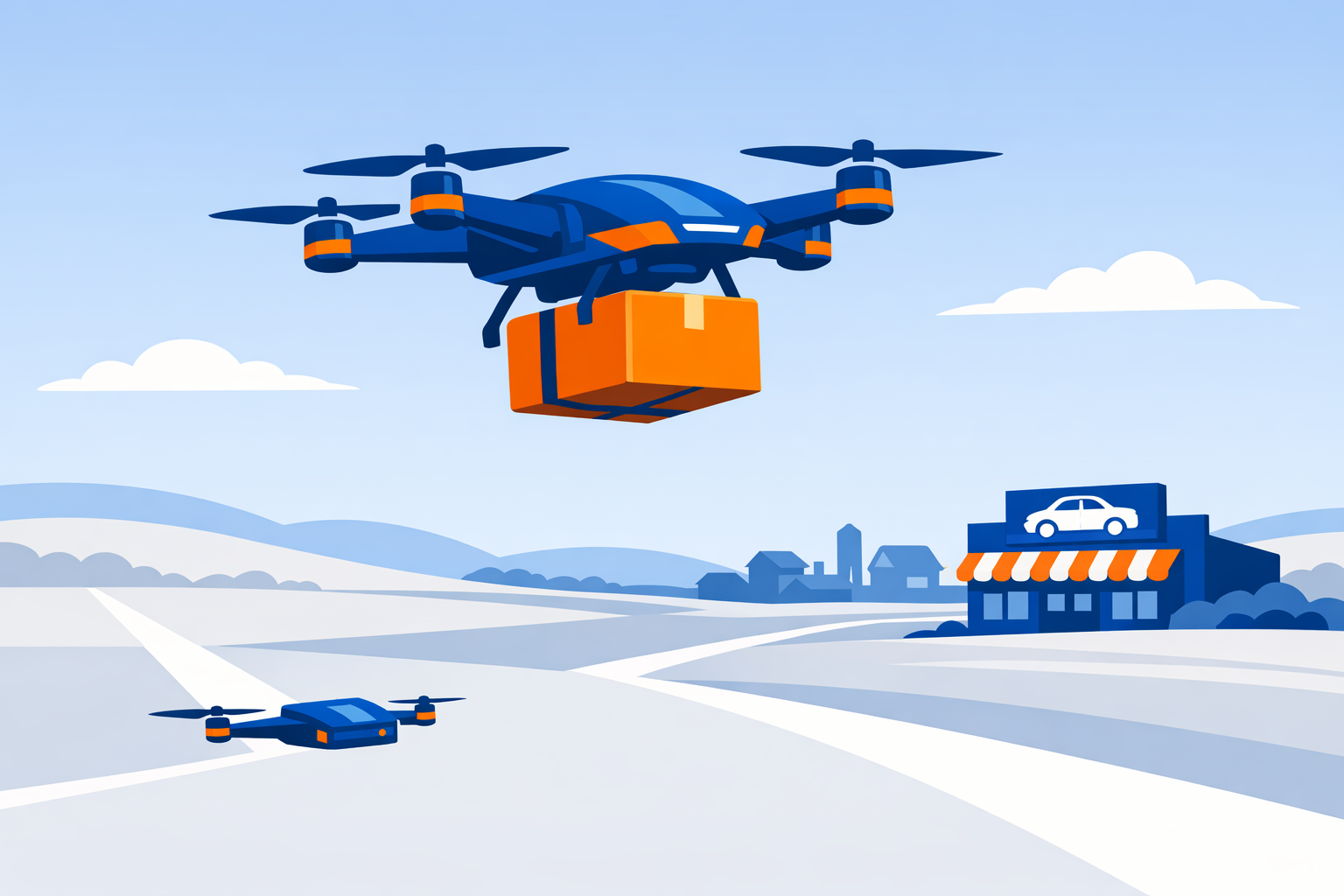
A landmark federal rulemaking effort and a series of industry-led pilot programs are converging to bring autonomous drone delivery of automotive spare parts to rural U.S. communities, reshaping last-mile logistics in regions where traditional van-based delivery is slow and costly.
Background
For years, commercial drone operators seeking to fly beyond visual line of sight (BVLOS) were required to obtain individual FAA waivers-a process that yielded just six approvals in 2020, rising to 190 cumulative waivers as of October 2024, according to agency data. The case-by-case approach limited scale and created lengthy permit backlogs, restricting the industry's ability to build viable drone logistics networks in rural areas.
That regulatory landscape shifted on August 7, 2025, when the FAA and the Transportation Security Administration jointly published a Notice of Proposed Rulemaking (NPRM), designated Part 108, proposing a standardized, performance-based framework for routine, low-altitude BVLOS operations. The action followed Executive Order 14307, signed June 6, 2025, which directed the FAA to publish a final BVLOS rule within 240 days-pointing to a target deadline in approximately the first quarter of 2026, according to legal analysis from Pillsbury Law.
The proposed rule replaces the waiver system with a scalable regulatory pathway covering package delivery, aerial surveying, agriculture, public safety, and flight testing, with operations primarily at or below 400 feet above ground level from pre-designated, access-controlled locations. It also introduces a new category of "Automated Data Service Providers" (ADSPs) to support UAS Traffic Management (UTM), enabling strategic deconfliction when multiple drones share airspace. "Normalizing BVLOS flights is key to realizing drones' societal and economic benefits," FAA Administrator Bryan Bedford said in the agency's announcement.
Details
On the commercial side, one of the most concrete auto-sector pilots to date launched in July 2025 in Southeast Michigan. Drone company blueflite, together with Jack Demmer Ford, Centrepolis Accelerator, Airspace Link, and DroneUp, announced a drone delivery program backed by a $740,000 grant from Michigan's Advanced Air Mobility (AAM) Activation Fund. The initiative tests autonomous drones for delivering high-demand car parts within a 12-mile radius of Jack Demmer Ford locations, flying over traffic rather than through it to reduce vehicle repair delays, according to the partners. The project operates along the expanding Ann Arbor-Detroit drone corridor and is described by participants as one of the first real-world drone delivery pilots in the automotive industry.
The economics supporting such pilots are compelling. Research modeled by the U.S. Department of Transportation found that depot-based drone delivery led to up to 60 percent cost savings per delivery compared to truck-only service when operating in small, low-demand delivery regions. Peer-reviewed research published in Scientific Reports found that electric drones are a more cost-effective option than road-bound diesel or electric trucks due to the high degree of automation, and also provide faster delivery times-an advantage especially pronounced in rural settings with dispersed demand.
The broader market context reinforces the strategic urgency. The U.S. drone logistics and transportation market is projected to grow at a compound annual growth rate of 38.7% from 2025 to 2035, according to Future Market Insights. For automotive supply chain professionals, where unplanned parts shortages can ground vehicles and stall service bays, faster and cheaper rural replenishment through drone corridors offers a tangible operational advantage.
Safety and airspace integration remain the primary engineering and regulatory challenges. The FAA's proposed Part 108 rule requires BVLOS-capable drones to carry Remote ID broadcasting, certified detect-and-avoid systems, and robust communication links not reliant on jammable frequencies. The proposed rule scales regulatory requirements to the risk profile of the operation-lower-risk missions would require an FAA permit, while higher-risk operations involving larger or faster aircraft require a full operating certificate, according to Pillsbury Law's review of the NPRM. All BVLOS-capable drones must also meet new airworthiness acceptance standards and support operational recordkeeping and reporting.
Community acceptance presents a parallel challenge. A June 2024 Vanderbilt University survey found that 66% of Americans did not support drones filming or capturing images of their homes, and nearly 70% expressed safety concerns about increased drone activity in their neighborhoods.
Outlook
The FAA's public comment period on the BVLOS NPRM closed October 6, 2025, with the agency and TSA reviewing stakeholder submissions before issuing a final rule targeted under the executive order timeline. If finalized on schedule, commercial operators could transition from individual waivers to the new standardized permit regime in early 2026, removing a central bottleneck to scaling rural drone logistics networks. For OEMs, parts distributors, and dealership groups in sparsely populated regions, the regulatory shift-combined with maturing UTM infrastructure and active state-level programs such as Michigan's-positions autonomous aerial delivery as a near-term operational option rather than a distant aspiration.