Automakers and tier-1 suppliers that have treated recycled-content packaging as a long-term ambition are running out of runway. With the EU's Packaging and Packaging Waste Regulation (PPWR) set to apply from August 12, 2026[1] and seven US states actively enforcing Extended Producer Responsibility (EPR) packaging programs, the window for phased preparation is closing fast-and OEM supplier contracts are the next frontier to feel the pressure.
The dual regulatory push is no coincidence. Regulators on both sides of the Atlantic have signaled a convergence in approach: mandatory recycled-content thresholds, stricter end-of-life labeling, harmonized testing methodologies for material compatibility, and lifecycle-based thinking that treats packaging as a compliance asset rather than a cost line. For automotive supply chains-already stretched across transatlantic sourcing hubs-the consequences are operational, contractual, and financial.
The Regulatory Picture: Two Frameworks, One Direction
EU: PPWR Enters Force with Phased Obligations
The EU's Packaging and Packaging Waste Regulation (Regulation (EU) 2025/40) entered into force on February 11, 2025, and will generally apply from August 12, 2026. The regulation replaces the 1994 Packaging and Packaging Waste Directive with a single, harmonized legal framework[2] that applies uniformly across all EU member states-a significant departure from the directive model that allowed national variation.
Key obligations taking effect from August 2026 include:
- Recyclability design criteria: All packaging placed on the EU market must be designed for recyclability, with performance-based grading enforced from 2030 onward
- Substance restrictions: A limit of 100 mg/kg for the combined concentration of lead, cadmium, mercury, and hexavalent chromium applies from August 12, 2026, alongside PFAS restrictions in food-contact packaging
- Declarations of conformity: Manufacturers must issue EU declarations of conformity and maintain technical documentation for five years, or ten years for reusable packaging
- EPR registration: Producers placing packaging on the EU market must register, report volumes, and finance waste management costs
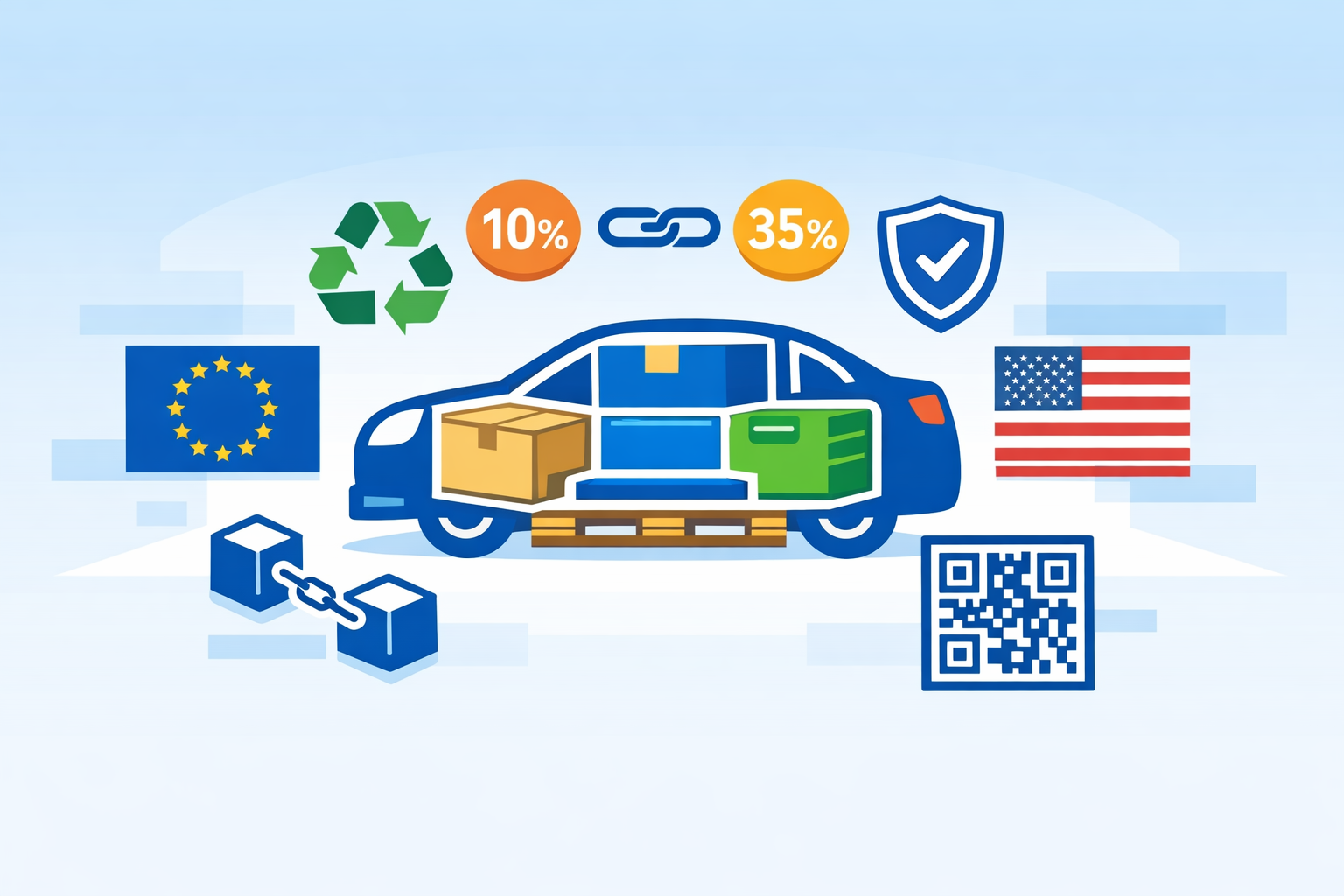
Plastic packaging must contain minimum recycled content recovered from post-consumer plastic waste, with the standardized calculation methodology due by December 31, 2026 and binding thresholds-ranging from 10% to 35% by packaging type-applying from January 1, 2030. Recyclability performance grades enter enforcement from 2028, giving companies a narrow window to redesign materials portfolios now.
For US companies exporting packaged automotive components into Europe, jurisdiction is based on market access, not location[2]. Selling into the EU through any channel-including distance sales-triggers PPWR obligations.
US: A State-by-State EPR Mosaic with 2026 Inflection Points
The United States lacks a unified federal packaging EPR framework, but seven states have enacted packaging-specific EPR laws-California, Colorado, Oregon, Maine, Maryland, Minnesota, and Washington-each with enforcement obligations escalating through 2026 and beyond.
The regulatory patchwork is reaching critical mass:
- Oregon: The first state to collect EPR fees. A second round of fee invoices is due in July 2026, with fees ranging from $0.05 per pound for paper to more than $1.30 per pound for certain plastic containers and foamed cushions.
- California: Producer invoices under SB 54 are expected in late 2026, with escalating performance standards-including recyclability and plastic-reduction targets-running through 2032
- Colorado: Producers were required to pay producer responsibility dues from January 1, 2026, with post-consumer recycled content targets for plastics, metal, glass, and paper due by 2030-2035
- Maryland and Washington: Producer registration or PRO membership deadlines fall on July 1, 2026, in both states
- Maine: Producers must register and report data by May 2026, with start-up fees due in September 2026
Eco-modulation is a defining feature across programs: packaging with higher recycled content and better recyclability attracts lower EPR dues[3], while multilayer films, hard-to-recycle resins, and non-recoverable formats face higher fees. For automotive tier-1 suppliers shipping components across multiple states, this creates a direct financial incentive to accelerate recycled-content packaging adoption well ahead of formal mandates.
The OEM Contract Cascade: What Changes and When
The convergence of EU and US standards is triggering a broad review of automotive supplier agreements. OEMs with transatlantic sourcing footprints-already managing the complexity of PPWR declarations and US state PRO registrations-are expected to push recycled-content requirements down into supplier contracts rather than absorb compliance risk internally.
The operational implications span several layers:
Bill of materials revisions: Packaging specifications embedded in supplier contracts must be updated to reflect recycled-content thresholds, recyclability grades, and approved material certifications (such as RecyClass or EuCertPlast). Suppliers unable to substantiate PCR content claims through documented supply chain evidence risk disqualification.
Supplier scorecard updates: Procurement teams are integrating packaging compliance metrics-recycled-content percentage, recyclability grade, EPR registration status-alongside traditional performance indicators such as on-time delivery and cost-per-unit.
Shared services for packaging design: To manage the cost of simultaneous redesigns across multiple packaging lines, some OEMs are establishing centralized packaging design functions or shared-service models that deploy common specifications across regional supplier networks.
Logistics simplification: Packaging standardization across the EU and US reduces the need for multiple regional configurations. Fewer SKU variants cut freight costs, simplify warehouse operations, and reduce material waste-a direct ROI case for compliance investment.
Early movers stand to benefit in procurement negotiations. Companies that demonstrate full lifecycle documentation, certified recycled content, and proactive EPR registration are likely to receive preferential treatment in supplier scorecards and potentially qualify for fee incentives built into eco-modulation structures. Laggards face compounding risk: penalty exposure, supply-chain disruptions tied to recycled-material shortages, and sudden price volatility in recyclate markets.
Compliance Milestones at a Glance
The table below summarizes the critical 2026 deadlines that automotive packaging professionals must track across both regulatory frameworks.
| Jurisdiction | Key 2026 Milestone | Packaging Requirement | Non-Compliance Risk |
|---|---|---|---|
| EU (PPWR) | Aug 12, 2026: General application | Recyclability design, conformity declarations, substance restrictions, EPR registration | Market access denial, EPR penalties, recall obligations |
| EU (PPWR) | Jan 1, 2030: Recycled content | 10-35% post-consumer recycled plastic by packaging type | Higher eco-modulated EPR fees; market exclusion |
| Oregon | Jul 2026: 2nd fee invoice | CAA PRO enrollment; eco-modulated fees | Fees up to $1.30/lb for hard-to-recycle plastics |
| California | Late 2026: Producer fee invoices | SB 54: recyclability, plastic reduction, eco-modulation | Escalating performance standards through 2032 |
| Colorado | Jan 2026: Producer dues paid | PCR content targets for plastics, metal, glass, paper by 2030-35 | Market sales prohibition without PRO participation |
| Maryland | Jul 1, 2026: Registration deadline | Join CAA PRO or file individual plan with MDE | Market access loss from Oct 2028 if unregistered |
| Washington | Jul 1, 2026: PRO membership | WRAP Act: uniform recycling list, eco-modulated fees | Sales prohibition from Mar 2029 without registration |
The Traceability Imperative: Digital Tools as Compliance Infrastructure
Meeting recycled-content mandates requires more than switching materials-it requires the ability to prove what those materials are and where they came from. Regulators in both the EU and US are explicit: companies must substantiate recycled-content claims through documented supply chain evidence[4], not marketing assertions.
For automotive supply chains, this is creating demand for purpose-built traceability infrastructure:
- RFID-enabled lot tracking: RFID tags integrated directly into packaging create a real-time audit trail from material source through end-of-life recovery. This supports conformity documentation requirements under the PPWR and lot-level reporting under US state EPR programs.
- Blockchain-backed packaging records: Distributed ledger technology offers tamper-proof documentation of component provenance[5], enabling OEMs and regulators to verify the recycled content of a packaging batch without relying on centralized-and potentially compromised-data systems.
- Digital Product Passports (DPPs): Already mandated for automotive batteries under EU law, DPPs are being evaluated for broader packaging categories. German automotive suppliers are already integrating blockchain into products for secure component histories[6] as required by the Battery Regulation and DPP mandates-a model transferable to packaging compliance.
- QR codes for labeling: The PPWR requires packaging to carry digital data carriers-QR codes or standardized open digital identifiers-that surface material composition, sorting instructions, and recyclability data. These directly support standardized declarations of recycled content and clearer end-of-life recovery pathways.
The intersection of IoT tracking and blockchain is expected to improve trust and transparency in global supply chain networks[7], particularly for compliance-sensitive sectors like automotive. Tier-1 suppliers that invest in this infrastructure now will be better positioned for audit readiness and preferential procurement treatment as OEM contracts are renegotiated.
This topic is closely related to coverage on our site examining the broader push toward harmonized recyclability standards across the automotive sector and the interim PCR benchmarks established between EU and North American regulators.
Six Steps to Position for 2026 and Beyond
The following framework provides a structured approach for packaging engineers, sustainability managers, and supply chain directors navigating the dual regulatory environment.
1. Conduct a transatlantic packaging audit Map every packaging component across EU and US automotive supply lanes by material, weight, and current recycled-content level. Identify which SKUs trigger PPWR obligations and which US state EPR programs apply based on geography of sale, not headquarters location.
2. Update bill of materials and supplier scorecards Integrate recycled-content thresholds and recyclability grades into supplier qualification criteria. Require third-party certifications-RecyClass, EuCertPlast, or equivalent-and PCR content verification as contractual conditions.
3. Revise OEM supplier contracts Incorporate explicit recycled-content milestones, phased targets, audit-right clauses, and corrective-action windows into contract templates. Define remediation obligations for non-conformance with EU declarations of conformity or US EPR reporting requirements.
4. Register with relevant PROs ahead of deadlines Complete enrollment with Circular Action Alliance (CAA) or the designated PRO in each applicable US state. Prepare EU declarations of conformity for all packaging entering the single market. Maryland, Washington, and Maine registration deadlines all fall in mid-2026.
5. Deploy digital traceability infrastructure Implement RFID-enabled lot tracking and blockchain-backed packaging records to document recycled-content claims end-to-end. Align with PPWR requirements for QR code-based labeling and prepare for Digital Product Passport expansion.
6. Optimize packaging design for eco-modulated fee savings Redesign packaging formats to reduce empty space, eliminate multilayer films, and maximize post-consumer recycled content. Higher recycled content reduces EPR dues on both sides of the Atlantic while improving audit outcomes and supplier scorecard performance.
Outlook: Formal Policy Updates Expected in Coming Months
The regulatory landscape will continue to evolve through the second half of 2026. The European Commission must adopt implementing acts-including standardized recycled-content calculation methodologies and labeling pictogram specifications-by August 2026. On the US side, California's rulemaking under SB 54 remains in active revision, and additional states are expected to introduce or advance EPR legislation through 2026.
Formal contract templates, implementation roadmaps, and potentially harmonized audit standards are expected to emerge from industry bodies and regulators as both frameworks mature. The companies best positioned to navigate this environment will be those that have already embedded recycled-content requirements into supplier agreements, invested in digital traceability infrastructure, and established cross-functional alignment between procurement, sustainability, and operations teams.
For auto OEMs and their supplier networks, the 2026 mandates are not a single compliance event-they are the opening phase of a decade-long structural shift in how packaging is designed, sourced, documented, and recovered. The time to build that capability is now.
FAQ
What is the EU PPWR and when does it apply to automotive packaging? The EU Packaging and Packaging Waste Regulation (Regulation (EU) 2025/40) is a directly applicable regulation replacing the 1994 packaging directive. It entered into force in February 2025 and generally applies from August 12, 2026. It covers all packaging-including industrial and transport packaging used in automotive supply chains-regardless of material or origin.
Do US companies exporting auto parts to Europe need to comply with PPWR? Yes. PPWR jurisdiction is based on market access: any company selling packaged goods into the EU-including through distance or cross-border sales-is subject to the regulation. US exporters must issue declarations of conformity, meet recyclability design criteria, and register for Extended Producer Responsibility (EPR) in the EU from August 2026.
When do US automotive packaging suppliers face their first hard EPR fee deadlines in 2026? Key 2026 fee and registration deadlines include: Oregon (fee invoices due July 2026), California (producer invoices expected late 2026), Maryland and Washington (PRO registration or membership by July 1, 2026), and Maine (registration and start-up fees in May-September 2026). Colorado producers were already required to pay EPR dues from January 1, 2026.
How can automotive suppliers prove their recycled-content claims? Suppliers must maintain documented supply chain evidence-not marketing assertions. Accepted approaches include third-party certifications (such as RecyClass or EuCertPlast), material traceability documentation, and RFID or blockchain-enabled lot tracking that links recycled feedstock to finished packaging units. The EU also requires digital data carriers (QR codes) on packaging to surface material composition data.
What happens if an automotive supplier is non-compliant? Consequences range from eco-modulated EPR fees (which increase significantly for hard-to-recycle or low-recycled-content packaging) to market access denial in the EU, civil penalties up to $25,000-$100,000 per day in some US states, and potential suspension of sales in states where PRO membership is a prerequisite. OEMs are also expected to push compliance risk down to suppliers through revised contract clauses and scorecard criteria.
Are recycled-content mandates for automotive packaging the same as for consumer packaging? No. The PPWR sets different thresholds by packaging type and category, with mandatory minimum recycled-content levels ranging from 10% to 35% for plastic packaging depending on application. Transport and industrial packaging-common in automotive logistics-have specific provisions, and some categories may qualify for exemptions. Companies should conduct a granular audit of each packaging type against the applicable regulatory schedules.