A single delayed electronic control unit can ground a vehicle for an entire workday. Multiply that across a dealership network managing hundreds of repair orders - and a fleet operator running just-in-time maintenance schedules - and the cost of parts scarcity becomes substantial. Now, a sweeping regulatory shift at the Federal Aviation Administration is positioning drone delivery as a practical answer to one of automotive supply chains' most persistent problems: getting the right part to the right place, fast.
The FAA's proposed Beyond Visual Line of Sight (BVLOS) rulemaking, published in August 2025 as a Notice of Proposed Rulemaking (NPRM) for a new Part 108 regulatory framework[1], marks the most significant structural advance in U.S. commercial drone regulation to date. For packaging engineers, logistics coordinators, and supply chain directors in the automotive sector, understanding what this rule enables - and what it still requires - is no longer optional.
What the BVLOS NPRM Actually Changes
For years, commercial drone operators faced a fragmented, case-by-case approval process. Since 2020, the FAA steadily increased the number of BVLOS waivers issued, from just 6 in 2020 to 122 in 2023, and reaching 190 as of October 2024 - a meaningful increase, but an approach that industry stakeholders argued[2] was too slow and too bespoke to support scalable commercial operations.
The August 2025 NPRM proposes replacing this waiver regime with a standardized two-tier authorization structure under a new Part 108:
- Operating Permits - valid for 24 months, covering lower-risk, limited-scale BVLOS operations with less FAA surveillance
- Operating Certificates - open-ended, covering higher-complexity or larger-scale operations with routine FAA compliance monitoring
The proposed rule would allow BVLOS drones weighing up to 110 pounds - an increase from the 55-pound limit under the current Part 107 framework, directly expanding the payload envelope relevant to automotive parts logistics. The NPRM also introduces a regulatory framework for Automated Data Service Providers (ADSPs) - entities managing strategic deconfliction, conformance monitoring, and UAS Traffic Management (UTM) - enabling scalable, multi-operator BVLOS corridors[2] that support commercial route networks rather than one-off flights.
The Trump Administration directed a final BVLOS rule to be published by February 1, 2026, reflecting bipartisan legislative pressure from the 2024 FAA Reauthorization Act, which mandated performance-based BVLOS regulations for the first time.
The Automotive Supply Chain Problem Drones Can Solve
The automotive aftermarket operates under conditions that make drone logistics particularly well-suited: high SKU diversity, unpredictable demand, geographically dispersed dealerships, and maintenance schedules that treat every hour of vehicle downtime as a direct cost.
The blueflite drone delivery pilot program in Southeast Michigan - backed by a $740,000 grant from Michigan's Advanced Air Mobility Activation Fund - is testing autonomous drones to move high-demand car parts within a 12-mile radius of Jack Demmer Ford dealership locations, operating within the growing Ann Arbor-Detroit drone corridor[3]. Partners include Airspace Link and DroneUp, and the program is designed to generate policy-informing operational data replicable across the automotive sector.
The challenge this pilot addresses is structural: dealerships cannot economically stock every part variant. A regional distribution center may hold thousands of SKUs, but the "last mile" from hub to service bay - whether urban or rural - is often served by a van that may take hours to arrive, particularly outside metro areas.
Urban vs. Rural Dynamics
The economics of drone delivery diverge by geography:
- Urban corridors benefit from drone delivery's traffic immunity. A brake caliper that takes three hours by courier in a congested city can arrive in under 30 minutes by air. However, dense airspace, limited landing infrastructure, and noise considerations require more complex UTM integration.
- Rural and semi-rural markets represent arguably the stronger near-term case. Road distances are longer, courier infrastructure is thinner, and same-day delivery is often unavailable. Drones excel at bridging regional supply gaps between urban distribution centers and remote service points[4], bypassing infrastructure limitations entirely.
This urban-rural asymmetry is not lost on regulators. BVLOS corridors already operating in Texas and Arizona[5] provide early commercial proof points for medium-range, business-to-business delivery - a model directly applicable to auto parts distribution.
Which Parts Are Prime Candidates?
Not every component in an automotive distribution center is a viable drone payload. The best candidates share three characteristics: low weight, high value, and high time-sensitivity. Components fitting this profile include:
- Electronic Control Units (ECUs) - typically under 5 lbs, often valued in the hundreds of dollars, and responsible for critical vehicle functions
- Oxygen and mass airflow sensors - lightweight diagnostic components with immediate vehicle operability impact
- Brake calipers and small hydraulic components - moderate weight, safety-critical, and often urgently needed
- Ignition coils and spark plugs - fast-moving, lightweight, standard replenishment candidates
- Diagnostic modules and telematics hardware - compact, high-value, often required for pre-delivery inspections
Heavy assemblies - transmissions, axles, full body panels - remain outside the practical envelope of near-term commercial drone payloads. Energy density limitations of current lithium-ion batteries cap economical drone payloads under approximately 5 lbs for most commercial delivery platforms, though the proposed Part 108 110-lb weight ceiling anticipates next-generation systems as battery technology matures.
The Technology Stack Behind Scalable Drone Parts Delivery
Deploying BVLOS drone logistics for automotive parts is not simply a matter of attaching a part to a drone. A production-grade operation requires an integrated technology stack:
- AI-driven route optimization - dynamically computing flight paths that account for weather, restricted airspace, battery range, and delivery priority sequencing
- Detect-and-Avoid (DAA) sensors - a BVLOS requirement enabling autonomous separation from manned aircraft and infrastructure
- UAS Traffic Management (UTM) integration - mandatory under the proposed Part 108 framework for commercial corridor operations; operators may serve as their own ADSP or contract with a certified third party[2]
- Weather resilience systems - wind compensation, precipitation tolerance, and thermal management for battery performance
- Precision payload release - secure load mechanisms for dealership pad drops without requiring human ground crew
- Fleet management and telemetry platforms - real-time monitoring, maintenance scheduling, and compliance recordkeeping for FAA certificate holders
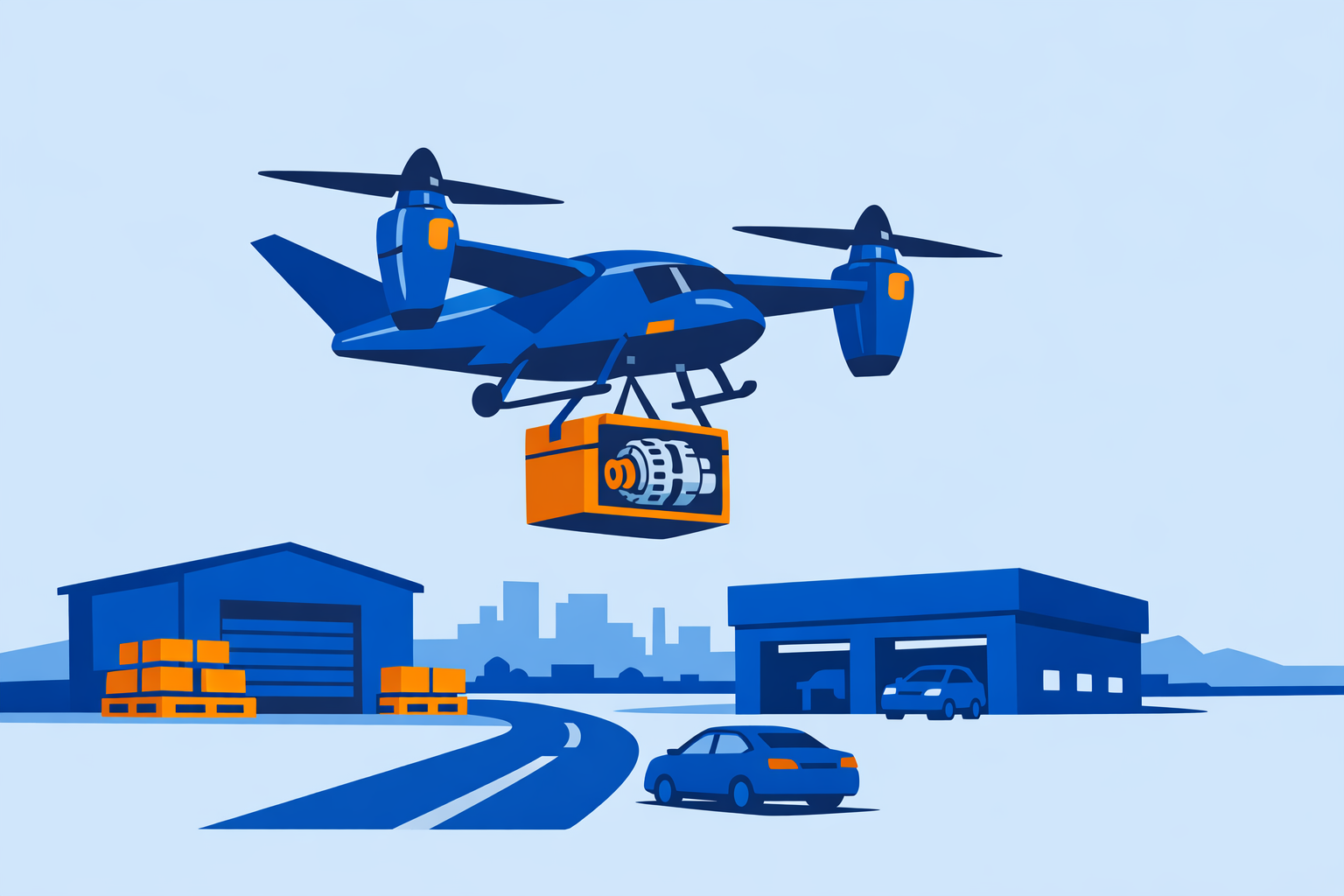
Blueflite's tiltrotor architecture - used in the Michigan Ford pilot - illustrates how hardware design choices directly affect logistics performance. Unlike traditional quadcopters, tiltrotor platforms combine vertical takeoff capability with fixed-wing flight efficiency, enabling longer range and more flexible payload configurations for B2B delivery routes.
For operations connecting trucking hubs to airport handoffs or urban depots to rural service centers, the technology must also accommodate intermodal handoff protocols - standardized packaging, labeling, and chain-of-custody documentation that integrates drone delivery into existing WMS and ERP systems.
Economics: Drone Delivery vs. Traditional Courier
The cost case for drone delivery of high-value, time-sensitive parts is strengthening as the regulatory pathway clarifies. Studies indicate drones can reduce last-mile delivery costs by as much as 70% compared to traditional courier methods[6] at scale - a figure that depends heavily on route density, fleet utilization, and regulatory compliance overhead.
For automotive supply chains, the relevant comparison is not drones vs. bulk freight, but drones vs. emergency courier and expedited same-day delivery - a segment carrying significant per-unit cost premiums precisely because of the urgency involved.
| Factor | Drone Delivery | Traditional Courier |
|---|---|---|
| Speed (urban, <15 mi) | 15-30 minutes | 1-4 hours |
| Speed (rural, >30 mi) | 30-60 minutes | Same-day to next-day |
| Traffic dependency | None - aerial route | High |
| Best-fit parts | ECUs, sensors, small electronics | All sizes |
| Cost per delivery (at scale) | Potentially 70% lower | Baseline |
| Rural reach | Strong | Limited by route |
| Regulatory status (U.S.) | BVLOS NPRM published Aug 2025 | Fully operational |
The economics improve further when vehicle downtime costs are factored in. A technician waiting on a $200 sensor for four hours represents a direct labor cost plus a lost service bay slot - a total that may significantly exceed the premium for expedited drone delivery.
The global drone package delivery market was valued at approximately $693 million in 2024 and is projected to grow to $4.66 billion by 2030 at a CAGR of 37.4%, with B2B industrial spare parts deliveries representing a growing segment as payload ceilings expand.
Pilot Programs and the Road to Scale
Michigan's blueflite-Ford program is not isolated. It represents an early iteration of what industry observers expect to become a multi-state network of automotive drone delivery corridors as Part 108 moves toward finalization.
Future pilots are likely to follow a hub-and-spoke model: regional auto parts distribution centers serving as drone launch points, with dealerships, fleet maintenance depots, and independent repair shops as drop zones. Airspace Link - a UTM software partner in the Michigan pilot - provides the digital infrastructure for safe corridor management, a capability that scales directly to multi-operator environments once Part 108 certification is in place.
For supply chain directors evaluating readiness, the relevant actions now are preparatory:
- Map high-frequency emergency parts orders to identify drone-eligible SKUs by weight and value
- Identify candidate launch points in existing distribution networks where drone pads could be integrated
- Engage with UTM and ADSP certification processes as Part 108 moves toward a final rule
- Monitor FAA airspace corridor authorizations - North Texas already hosts multi-operator BVLOS commercial corridors[7], with other geographies expected to follow
Packaging and labeling standards for drone-delivered auto parts also warrant early attention. Components must be secured against vibration and payload release dynamics, correctly labeled for chain-of-custody compliance, and sized to fit drone cargo compartments - an area where modular AI-driven packaging approaches being piloted in automotive warehouses may prove directly complementary.
Regulatory Timeline and Remaining Uncertainty
Despite significant momentum, the BVLOS framework is not yet finalized. Key outstanding variables include:
- Final rule publication - targeted for early 2026, pending public comment review
- Airworthiness acceptance standards - manufacturers must meet new certification criteria before fleets can be legally deployed under Part 108
- TSA security requirements - operators, supervisors, and flight coordinators face enhanced background checks and security threat assessments, a point of active industry pushback during the comment period
- UTM provider certification - the ADSP certification process is still being defined, creating a dependency for multi-corridor commercial operations
The FAA's own inspector general noted that BVLOS operational goals have been difficult for most lead participants to meet[7] under the existing BEYOND partnership program, and that comprehensive data collection to inform rulemaking remains a work in progress. These are calibration challenges, not structural barriers - but they underscore that commercial-scale automotive drone delivery remains a near-term prospect rather than an immediate operational reality.
FAQ
What is BVLOS and why does it matter for automotive parts logistics?
BVLOS - Beyond Visual Line of Sight - refers to drone operations extending beyond the remote pilot's direct view. Under current Part 107 rules, most commercial drones must remain visible to the operator, severely limiting delivery range. BVLOS authorization removes that constraint, enabling long-range automated routes between distribution hubs, dealerships, and maintenance depots at commercial scale.
Which automotive parts are most suitable for drone delivery?
The strongest candidates are lightweight, high-value, time-sensitive components: electronic control units (ECUs), oxygen sensors, brake calipers, ignition coils, and diagnostic modules. These typically weigh under 10 pounds, carry significant vehicle downtime costs if delayed, and are stocked regionally rather than locally - making rapid aerial delivery a practical alternative to emergency courier runs.
What is the proposed FAA Part 108 rule?
The FAA published its BVLOS NPRM in August 2025, proposing a new Part 108 framework to replace the existing waiver-by-waiver approval process. The rule would create standardized operating permits and certificates for BVLOS operators, establish airworthiness requirements for manufacturers, and define certification requirements for UAS Traffic Management service providers.
How does drone delivery fit into a just-in-time automotive supply chain?
JIT maintenance schedules demand that parts arrive precisely when needed to minimize vehicle downtime. Drone delivery can compress wait times from hours to minutes by bypassing road traffic entirely, making it a natural complement to JIT procurement strategies - particularly for emergency replenishment of small, fast-moving components.
What infrastructure does a dealership or depot need to receive drone deliveries?
At minimum: a designated landing pad (a marked, cleared surface), integration with the drone operator's UTM system for airspace coordination, and a revised receiving workflow for drone-delivered packages. More advanced implementations may include automated payload lockers, real-time delivery tracking integrated with DMS or WMS platforms, and standardized packaging specifications for drone-compatible parts.