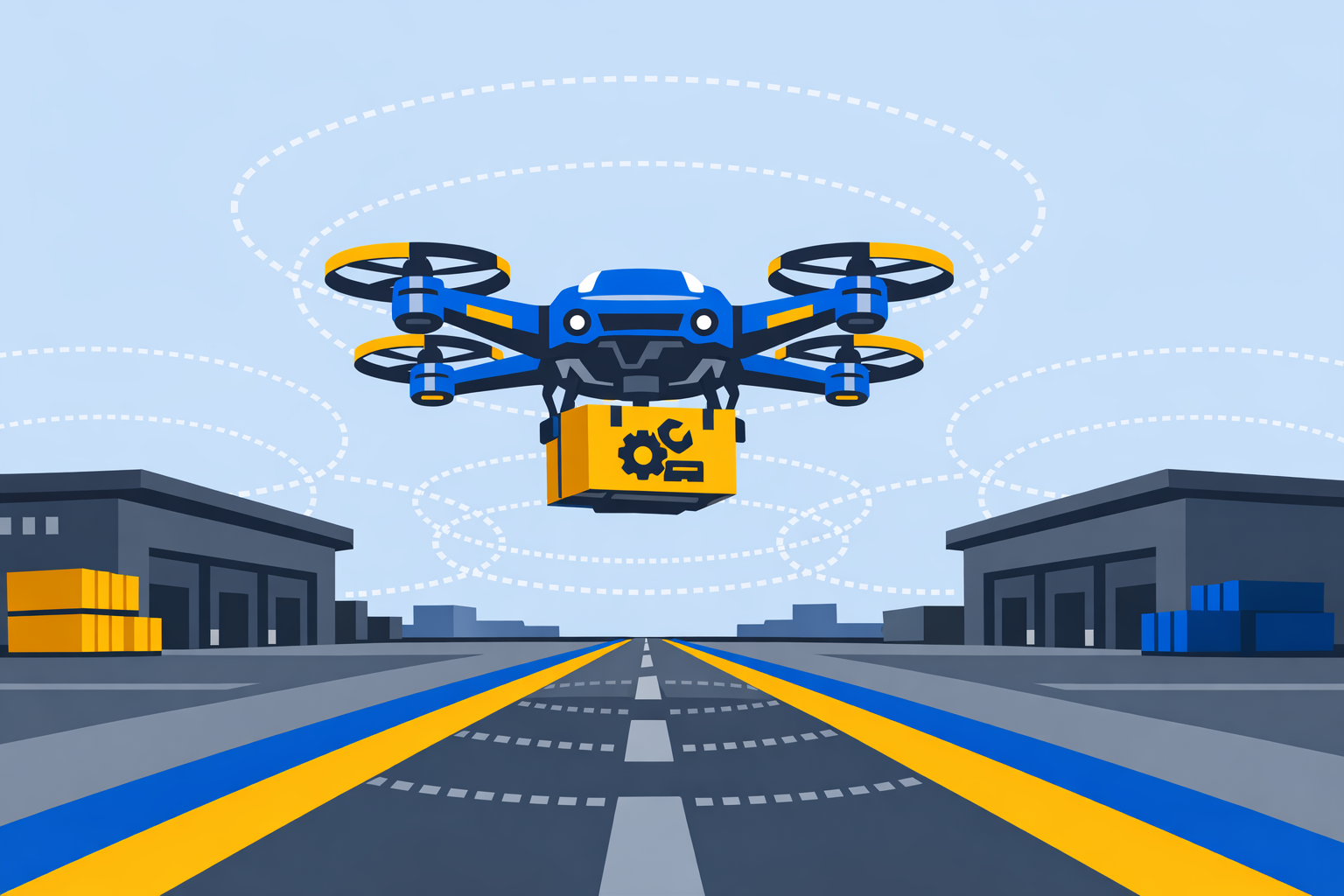
For years, the promise of routine drone delivery in industrial logistics remained locked behind one-off waivers, paperwork bottlenecks, and regulatory uncertainty. That wall is coming down. In August 2025, the FAA released its Notice of Proposed Rulemaking for Part 108 - a 700-plus-page proposal representing the most significant development in commercial drone regulation since Part 107 launched in 2016.[1] For carriers and suppliers moving automotive components to rural depots, dealerships, and industrial maintenance hubs, the timing demands immediate attention.
After years of drafting and delays, the proposed rule would create a standardized framework enabling commercial drone operators to fly beyond visual line of sight without applying for individual waivers - with the potential to unlock large-scale commercial drone operations, particularly in drone delivery.[2]
What Changed: From Waivers to a Scalable Framework
For years, drone deployment in U.S. airspace was constrained by regulations requiring operators to obtain individual waivers or exemptions for flights "beyond visual line of sight." The result was a fractured, resource-intensive system that made business planning difficult and favored large, well-capitalized players over smaller logistics operators.
On August 7, 2025, the FAA and TSA jointly released the NPRM for 14 CFR Part 108, creating a performance-based, scalable framework for BVLOS operations addressing both safety (FAA) and security (TSA) - shifting BVLOS from exception-based waivers to a standardized regulatory pathway.
The core mechanism: rather than propose a one-size-fits-all framework, the rule scales requirements and permissions to the type of operation. High-risk operations - determined by aircraft size, weight, speed, area of overflight, and operational parameters - require an operating certificate, while lower-risk operations require an FAA permit.
The rule also introduces a framework for "Automated Data Service Providers" (ADSPs) - entities that support scalable BVLOS operations by providing strategic deconfliction, conformance monitoring, and UAS Traffic Management (UTM). Operators may serve as their own ADSP or contract with another provider.
On the timeline: The FAA published the NPRM on August 7, 2025. The 60-day comment period closed on October 6, 2025, drawing over 3,000 responses. A final rule is expected by spring 2026, with implementation anticipated six to twelve months after publication.
Why Auto Parts Logistics Is a Natural Fit for BVLOS Expansion
The automotive aftermarket and industrial maintenance sectors face a structural problem drone logistics is well-positioned to solve: time-critical, low-weight component deliveries to locations underserved by ground infrastructure.
Significant opportunity exists in industrial logistics - including automated parts delivery between manufacturing buildings in large complexes, inventory transport within massive warehouses, and inspection or supply missions at sites where drones reduce downtime and enhance worker safety.
Industrial requisitions such as tools and spare parts grow as payload ceilings climb, offering high average selling prices but sporadic volume - a profile that maps directly to the unscheduled repair parts market across dealer networks and fleet maintenance centers.
For rural repair networks, the value proposition is particularly strong. Beyond urban delivery, growth is driven by industrial applications and drone logistics in remote and rural areas where traditional infrastructure is lacking, addressing critical supply chain gaps. A sensor module or brake assembly needed at a rural dealership two hours from the nearest distribution center is a problem a BVLOS corridor can solve in minutes.
The middle-mile opportunity is equally significant. BVLOS corridors enable point-to-point transport between regional distribution hubs and local dealer networks without requiring a driver, a truck, or road access - compressing lead times on emergency orders while reducing last-mile cost structures. BVLOS corridors in Texas and Arizona already provide commercial proof points for this model.
Part 108 in Practice: The Two-Tier Authorization Structure
Part 108 proposes two operational pathways. Automotive logistics operators must understand which applies to their use case:
| Feature | Operating Permit | Operating Certificate |
|---|---|---|
| Risk Level | Lower-risk, smaller scale | Higher-risk, large-scale or complex |
| Regulatory Analogy | Similar to Part 91 general aviation | Similar to Part 135 air carrier |
| TSA Personnel Vetting | Required for key personnel | Required for key personnel |
| Detect-and-Avoid (DAA) | Performance-based requirement | Mandatory, including non-cooperative aircraft |
| UTM/ADSP Integration | Required | Required |
| Flight Logs & Recordkeeping | Required | Expanded safety event reporting |
| Best Fit for Auto Logistics | Rural depot-to-dealer corridors | High-frequency industrial hub operations |
One of the most notable shifts under Part 108 is the move from individual pilot responsibility to organization-wide safety culture. Part 107 places most of the operational burden on the Remote Pilot in Command. Part 108 requires the entire organization to adopt a proactive safety system - a mindset closer to that of a commercial airline than a lone operator.
Airspace Coordination Requirements
Carriers entering BVLOS operations for auto parts delivery must address several airspace management obligations under the proposed rule.
Operations up to 400 feet above ground level are permitted in Class B, C, and D airspace, and within lateral boundaries at airports designated as Class E - except for specific areas requiring separate FAA airspace authorization.
Population density is a primary risk determinant under Part 108. Five population-density categories govern requirements for equipment, pilot qualifications, and operational approvals - a framework that directly affects route planning between urban distribution centers and suburban or rural delivery endpoints.
Some operators have criticized the NPRM's reliance on population density as the primary risk determinant, noting that many commercial operations occur at access-controlled sites - construction sites, mines, energy facilities - where mitigations such as geofencing, site access control, and parachute systems reduce risk regardless of surrounding population density. This concern applies to industrial campuses and manufacturing complexes where automotive logistics naturally concentrates.
What Suppliers Must Document to Participate
Documentation is where many carriers and suppliers will face the steepest operational changes. Part 108 significantly expands recordkeeping and reporting obligations.
The FAA is broadening its record and data reporting requirements. Recordkeeping and reporting of safety events and near-misses will be mandatory, enabling the FAA to monitor operator performance over time. As more operational data is collected - including potentially personally identifiable information of operators or third parties - the FAA is establishing mechanisms via a Privacy Impact Assessment to ensure data protection, transparency, and accountability.
For automotive parts specifically, suppliers participating in BVLOS delivery programs will need to maintain:
- Flight logs tied to each delivery event, including route data, weather conditions, and any deviations
- Part serialization records linking each shipped component to a specific flight manifest - critical for warranty traceability and recall compliance
- Chain-of-custody documentation from dispatch to delivery confirmation
- Payload and weight verification logs to ensure compliance with aircraft operational envelopes
- Personnel qualification records confirming TSA vetting status for all operations staff
On the security side, the proposed rule defines two key security-related roles for TSA: vetting key personnel through security threat assessments and establishing standard security programs for package delivery operations. Operations personnel must be cleared by TSA, with Operations Supervisors and Flight Coordinators specifically required to pass TSA Security Threat Assessments.
Six Steps Carriers Should Take Before the Final Rule
1. Audit existing waivers and map to Part 108 pathways. Agricultural, package delivery, and other operations currently handled via waivers or exemptions under Parts 107, 91, or 135 are expected to transition to Part 108 as existing exemptions expire. Begin that mapping now.
2. Establish a principal base of operations. The proposed rule requires each operator to maintain a verified U.S. base and physical FAA contact address before any BVLOS operations commence.
3. Upgrade aircraft to meet airworthiness acceptance standards. All BVLOS-capable drones must meet new airworthiness acceptance standards, provide required documentation and maintenance instructions, and support operational recordkeeping and reporting.
4. Begin TSA vetting for key personnel. Approved operators must fill required operations personnel roles, including Operations Supervisors, who bear responsibility for overall flight operation safety and logistics. Lead times for TSA processing mean this step cannot wait until the final rule.
5. Select or become an ADSP/UTM provider. Evaluate whether to build internal UTM capability or contract with an existing ADSP. Both paths require early planning and technical integration with supply chain management systems.
6. Build the documentation stack. Implement flight data logging, part serialization linking, and a Privacy Impact Assessment framework ahead of the rule's effective date.
Carrier Partnerships and the Middle-Mile Equation
The competitive dynamics of BVLOS auto parts delivery will increasingly favor carriers capable of offering end-to-end drone logistics services rather than point solutions. Market consolidation trends indicate that larger logistics companies are acquiring specialty drone service providers to diversify delivery portfolios and access specialized flight segments.
For mid-size carriers serving regional automotive dealer networks, the most viable near-term path likely involves partnerships with established drone operators already holding BVLOS approvals. Most commercial drone delivery has been the domain of vertically integrated companies operating both the technology and the service network - directly competing with traditional logistics providers. Emerging models now enable third-party logistics companies to deploy air delivery networks without proprietary in-house engineering.
Procurement leads and supply chain directors evaluating these partnerships should assess not only flight capability but also the operator's compliance infrastructure: ADSP integration status, TSA vetting completion, and readiness to support serialized part tracking within existing WMS and ERP environments.
Takeaways for Packaging and Supply Chain Professionals
The FAA's Part 108 NPRM is not a distant policy discussion. Under the Executive Order timeline, a final rule is expected by approximately March-April 2026. For automotive suppliers and carriers, the window for proactive preparation - upgrading aircraft, vetting personnel, selecting ADSP partners, and building documentation workflows - is open now.
Drone delivery of auto parts to rural and industrial hubs is moving from pilot program to scalable operation. Carriers and suppliers who treat compliance as a strategic capability rather than a regulatory burden will be positioned to lead when routine BVLOS corridors open across the national airspace.
Related reading: For more on how automation is reshaping automotive supply chains, see our coverage of modular AI packaging lines in automotive warehousing and AI-driven reusable packaging in automotive cold chain logistics.