The automotive industry generates billions of packaging units each year-foam dunnage, corrugated inserts, plastic containers-much of it ending up in landfill once a vehicle component reaches its destination. As US EPR regulations tighten and fee structures begin penalizing non-recyclable materials, pressure on OEMs and their suppliers to act is intensifying. Specialized Packaging Group (SPG) has responded by opening a dedicated Innovation Center in Silicon Valley, positioning the facility as both a prototyping hub and a vehicle for industry-wide standardization in sustainable automotive packaging.
What SPG Has Built - And Why It Matters
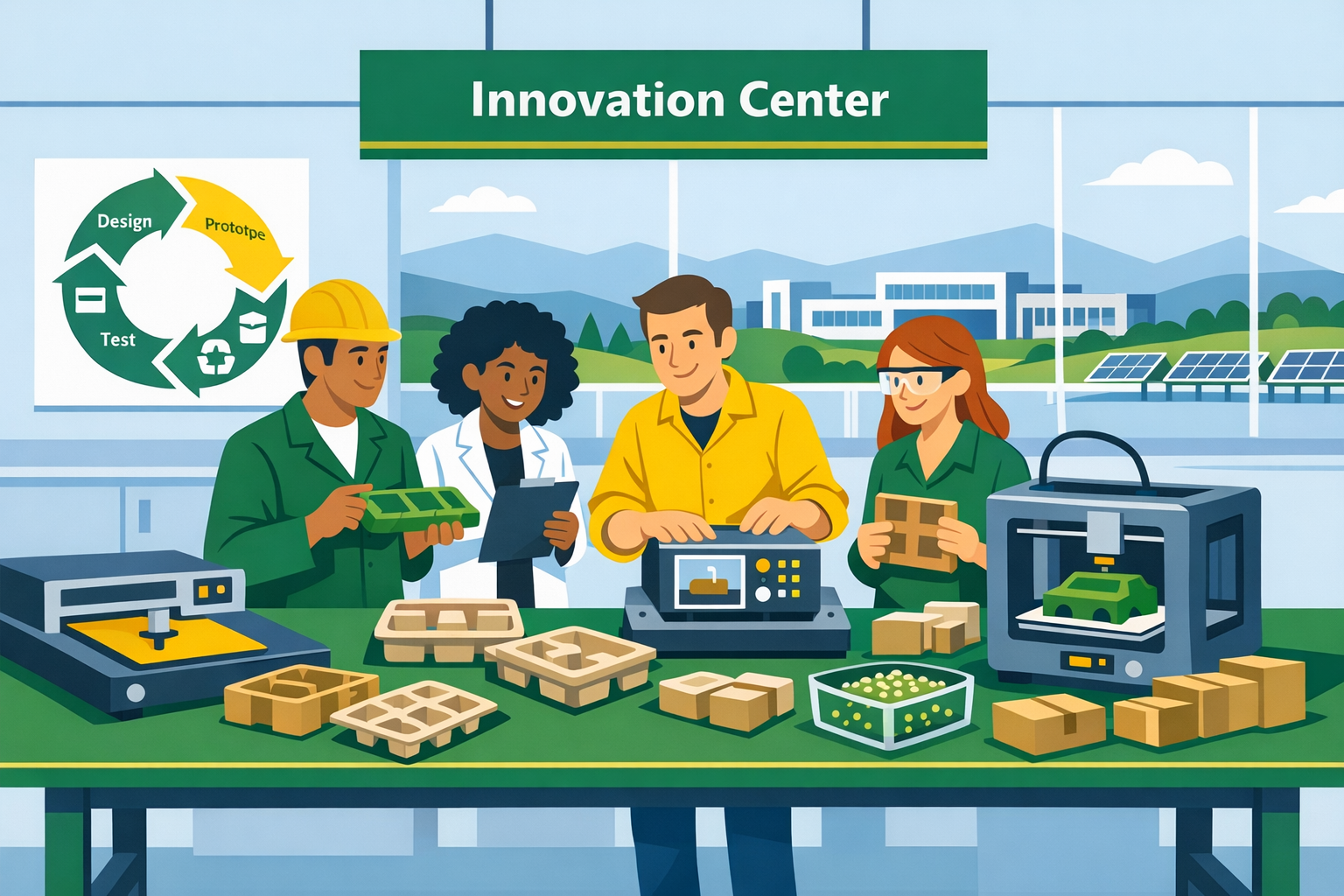
SPG has opened its Innovation Center in Silicon Valley, a collaborative facility designed to help customers accelerate sustainable packaging development. The center brings design, engineering, and validation under one roof to support growing demand for packaging that addresses product protection, efficiency, and sustainability goals.
Customers work directly with SPG design engineers from early concept through final validation. By combining rapid prototyping with on-site testing, partners can reduce material waste and significantly improve speed to market.
The physical infrastructure reflects that ambition. The facility features dedicated lab space, a showroom highlighting SPG's sustainable materials, and advanced prototyping equipment including a CNC cutting table and 3D printers for immediate fit testing. To ensure performance and compliance, the center includes ISTA-certified testing capabilities: a vibration table, free-fall drop tester, compression tester, incline impact tester, and environmental thermal chamber.
"The Innovation Center gives our customers direct access to the tools, expertise and testing capabilities needed to move packaging ideas from concept to launch faster," said Joe Gumbis, Chief Commercial Officer, SPG.
From Concept to Compliant: The Open-Innovation Model
The center's operating philosophy centers on collaborative, open innovation. SPG's approach brings automakers, Tier 1 and Tier 2 suppliers, and packaging recyclers into joint development programs-rather than developing solutions in isolation and selling them downstream. This model is designed to compress the timeline from design concept to compliant, scalable packaging, a process that has historically stretched across multiple product cycles in automotive supply chains.
Early partnerships announced at launch signal the breadth of that collaboration:
- EV bioplastics validation: A major electric vehicle program is working with the center to validate compostable and advanced bioplastic packaging components-addressing one of the most technically challenging substitution cases in automotive dunnage.
- Returnable packaging pilots: A logistics provider is co-developing returnable packaging loops on high-volume metropolitan routes, targeting measurable reductions in single-use packaging volume.
These are not isolated proof-of-concepts. The center's activities are structured to feed into regulatory discussions around sustainability disclosures and potential future requirements for packaging data transparency-creating a direct link between prototyping output and policy input.
A central aim is to foster shared metrics for recyclability, barrier performance, and life-cycle cost across the supply chain. Analysts suggest this could prove significant: by establishing common benchmarks through its OEM, supplier, and recycler networks, SPG's facility could catalyze the kind of standardization that has been difficult to achieve through industry bodies alone.
SPG's Sustainability Track Record
The Innovation Center does not emerge in a vacuum. SPG is one of North America's largest independent protective packaging providers, serving aerospace, electronics, automotive, healthcare, and technology markets. The company operates more than 30 manufacturing and design facilities in North America with a network of more than 200 manufacturing partners.
Its recently published Impact Report reveals the scale of sustainability progress already achieved. SPG cut greenhouse gas emissions intensity by more than 50% while doubling revenue and increased use of recycled or renewable materials in packaging by one-third, outpacing industry peers. The company reduced plastic packaging use by nearly half, replacing virgin plastics with sustainable alternatives, and converted more than 12 million pounds of scrap into new packaging products.
SPG integrates closed-loop systems by collecting used materials from customers, processing them, and turning them back into high-performance packaging-an approach that supports sustainability while delivering cost savings.
SPG's CEO notes that sustainability is no longer a separate initiative but a core driver of product development and business growth. "Customers are demanding solutions that both meet their performance needs and align with their sustainability goals, so innovation from our side must serve both functions," he stated.
The Regulatory Pressure Driving Urgency
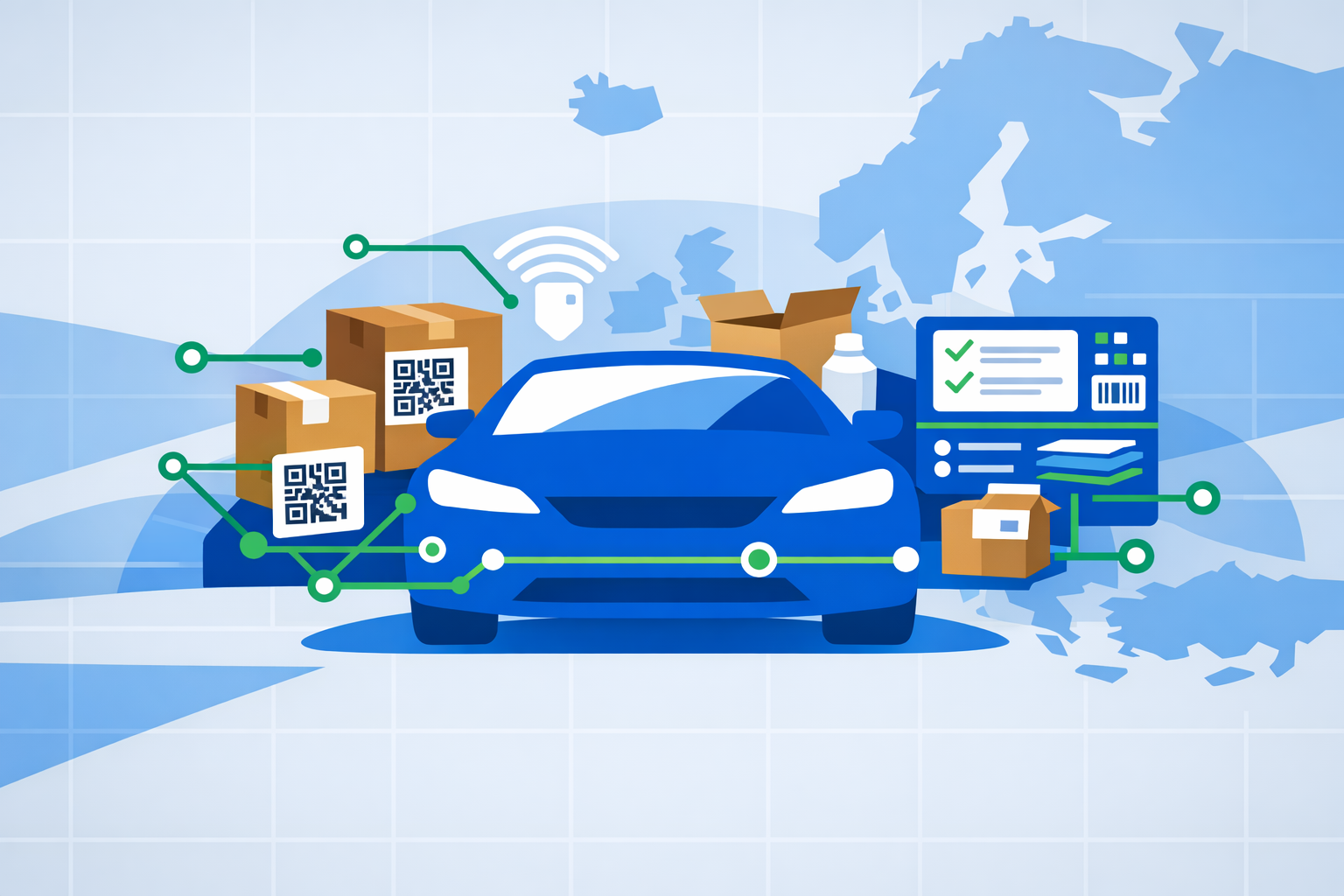
The center's launch aligns with a sharply evolving regulatory environment for packaging across the automotive sector. Smart packaging systems for automotive spare-parts logistics are already being deployed to meet traceability mandates, but materials compliance is an equally pressing dimension.
Returnable containers are a staple in the automotive industry for domestic shipments, but internal plastic dunnage-including foams, plastic films, and other low-weight plastics-can be more challenging to recover due to mixed material compositions and economic barriers in collecting and transporting these materials to recyclers. Given the scale and volume of materials moving through the automotive supply chain, recapturing a higher percentage of plastic dunnage materials presents a meaningful opportunity.
On the regulatory side, the pressure is becoming financial as well as operational. Recyclability is increasingly a financial signal, not just a sustainability goal. Many EPR programs use eco-modulated fees, meaning packaging that is widely recyclable and easier to process typically carries lower fees. Hard-to-recycle materials, by contrast, are becoming more expensive: multi-material formats, low-recovery plastics, and packaging that contaminates recycling streams often trigger higher EPR fees and increased scrutiny.
Reporting is expected to begin in 2025 for California, Colorado, and Oregon programs, with EPR fee payments expected to start between 2025 and 2027 depending on the state.
{{component:callout-epr}}
Key Focus Areas at a Glance
{{component:data-table-focus}}
{{widget:lifecycle-comparator}}
Standardization as a Strategic Outcome
Perhaps the most consequential long-term impact of the Silicon Valley Innovation Center is its potential contribution to standardization across the automotive packaging ecosystem. The Suppliers Partnership for the Environment's Sustainable Packaging Work Group is bringing together automakers, tiered suppliers, packaging suppliers, and recyclers to develop industry-supported guidance on sourcing more sustainable packaging designs and exploring viable cyclical material recovery processes for automotive dunnage.
SPG's center adds a physical testbed and commercial acceleration mechanism to what has largely been a policy- and guidance-driven conversation. By running real-world lifecycle analysis and prototyping against validated industry requirements-and feeding results into regulatory working groups-the facility is positioned to translate open innovation into measurable compliance standards.
Companies that embrace material innovation, such as mono-material packaging or bio-based materials, can reduce compliance risks while achieving sustainability targets. The Innovation Center is designed to give automotive supply chain partners a structured path to do exactly that.
Key Takeaways
- SPG's Silicon Valley Innovation Center offers automotive OEMs and suppliers direct access to co-development, rapid prototyping, and ISTA-certified testing under one roof.
- Early pilot programs cover bioplastic validation for an EV program and returnable packaging loops on metropolitan logistics routes-both high-priority areas for circular-design compliance.
- Regulatory timelines are accelerating: EPR reporting and fees are live in multiple U.S. states, making recyclability and material data transparency operational priorities, not aspirational ones.
- The standardization potential of shared lifecycle metrics across SPG's network could shape how recyclability, barrier performance, and life-cycle cost are measured across the broader automotive packaging supply chain.
- SPG's existing track record-over 50% GHG intensity reduction and 12 million-plus pounds of scrap converted annually-provides a validated foundation for the center's ambitions.
For packaging engineers, sustainability managers, and supply chain directors navigating the shift toward circular automotive packaging, the Innovation Center represents a practical, well-resourced collaboration point-arriving at precisely the moment the industry needs it.
{{component:faq}}