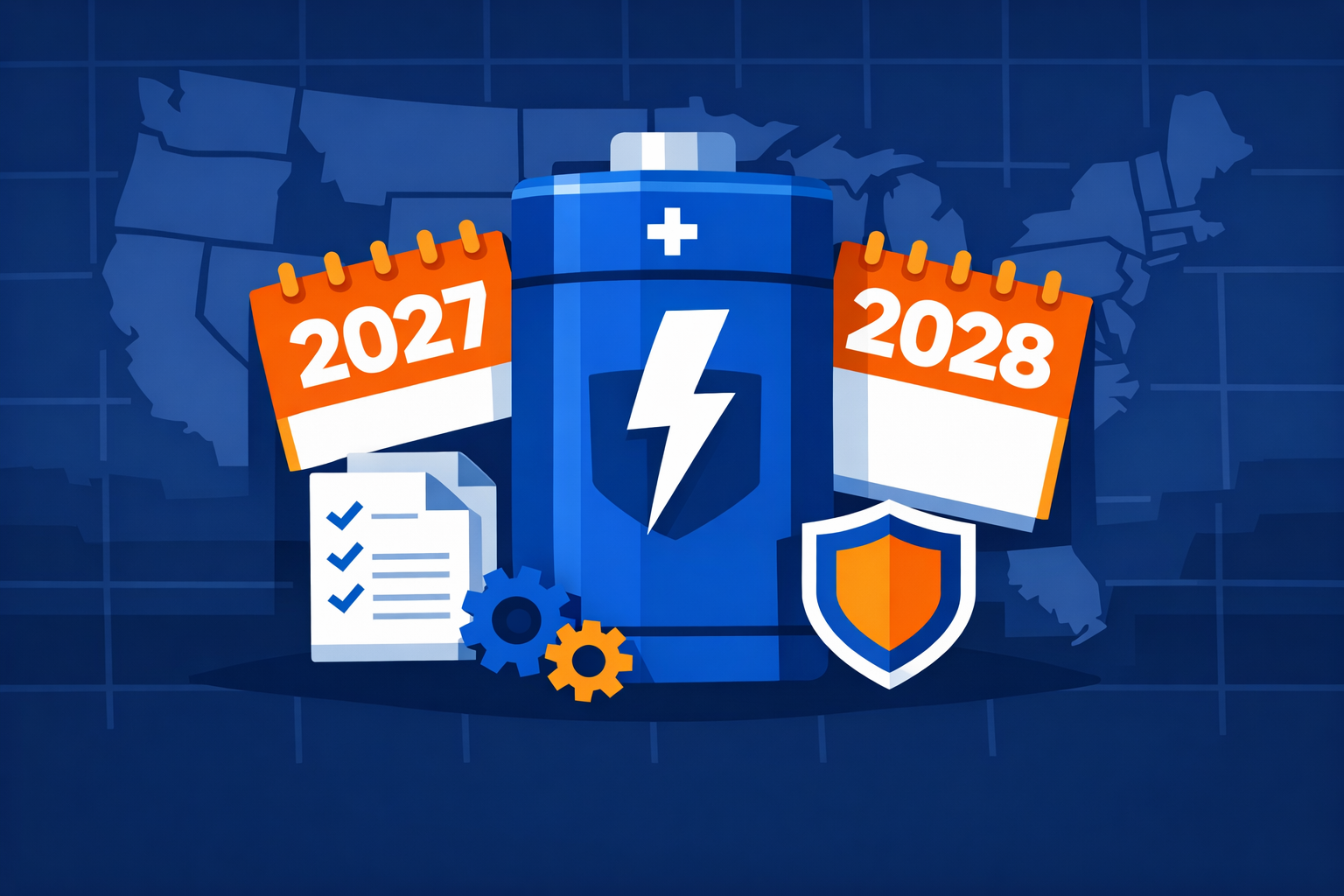
A wave of state battery extended producer responsibility (EPR) laws is converging on 2027-2028 compliance deadlines, forcing automakers, battery suppliers, and multistate manufacturers to navigate divergent fee schedules, reporting mandates, and stewardship plan requirements across key markets. With no federal standard in place, industry observers warn that the patchwork of obligations will add material costs and administrative complexity to supply chains already under pressure.
Background
Adoption of battery stewardship laws has gained significant momentum in recent years, partly to help prevent fires at waste and recycling facilities. The legislative surge spans both coasts and the Midwest. California's Responsible Battery Act requires all battery producers to participate in a CalRecycle-approved stewardship plan no later than April 1, 2027. Washington State's battery stewardship program, codified under Chapter 173-905 WAC and adopted by the Department of Ecology on December 16, 2025, prohibits retailers from selling portable batteries unless the producer participates in an approved plan beginning July 1, 2027, and extends that requirement to large-format batteries beginning January 1, 2028.
Colorado's Battery Stewardship Act (SB 25-163), signed by the governor on June 4, 2025, requires battery producers to join a stewardship organization and submit plans to the Colorado Department of Public Health and Environment by July 1, 2027. Oregon Governor Tina Kotek signed HB 4144 on April 7, 2026, establishing a producer responsibility program requiring producers to fund and operate a statewide battery collection and recycling program. Wisconsin's battery stewardship law takes effect in January 2027, while Nebraska's Safe Battery Collection and Recycling Act requires producers to join a Battery Stewardship Organisation by 2028.
Details
Fee structures embedded in state budgets vary significantly. Colorado's fiscal note estimates that battery stewardship organizations will owe an annual fee of $80,000 to the Colorado Department of Public Health and Environment beginning in FY 2028-29, with plan review and administrative fees accruing to state budgets in FY 2027-28. Washington's fees include a plan submission fee of $50,000, an approval fee of $86,000, and an annual administrative fee, with the amount of the annual fee set by the state's Solid and Hazardous Waste Commission. In Oregon, producers that fail to join a producer responsibility organization face civil penalties of up to $10,000 per day.
Coverage scope compounds compliance complexity for manufacturers. California's battery EPR law expressly excludes batteries contained in motor vehicles, while Washington's program covers large-format batteries-including electric vehicle battery packs-beginning January 1, 2028. Oregon's PRO membership fees may include eco-modulation elements that incentivize producers to design for reuse and recycling or include recycled content in batteries, and discourage the use of materials that increase system costs. These divergences mean a single OEM selling battery-containing products in multiple states may face different definitions of "covered battery," different fee methodologies, and different reporting cadences in each jurisdiction.
According to legal analysts, thresholds, exemptions, and fee calculations often differ between jurisdictions, requiring multistate producers to maintain detailed tracking systems and cross-functional compliance teams. The National Association of Wholesaler-Distributors has already challenged Oregon's separate packaging EPR law on constitutional grounds, with a federal district court issuing a preliminary injunction in February 2026-a case that legal observers say could set precedent affecting battery EPR enforcement in other states.
The U.S. Environmental Protection Agency and the Department of Energy are developing a national voluntary battery EPR framework pursuant to the Infrastructure Investment and Jobs Act, with the agency expected to publish guidance in summer 2026. The federal government has an interest in battery EPR to help recover more critical minerals from domestic sources, which the Trump administration sees as a way to reduce reliance on imports and create U.S.-based jobs.
Outlook
By October 2027, Washington State's Department of Ecology must complete and submit to the legislature an assessment of the opportunities and challenges associated with end-of-life battery management. Meanwhile, additional states are weighing action: Florida, Iowa, Indiana, Missouri, New Hampshire, and Wisconsin are among states examining similar battery EPR bills. For supply chain professionals, the near-term priority is establishing jurisdiction-specific compliance calendars and auditable data collection systems before the first wave of 2027 fee deadlines arrives-a task made more urgent by the absence of any harmonized reporting methodology across current state programs.