Automotive suppliers operating across multiple U.S. states face overlapping and inconsistent battery stewardship requirements, with compliance deadlines ranging from 2026 through 2029. This regulatory patchwork is intensifying data collection demands, take-back logistics, and per-unit cost pressures throughout the supply chain.
Background
State-level battery recycling regulations build on federal standards but often introduce variations to address local priorities, creating inconsistencies that challenge national compliance. The legislative wave began in earnest in 2022, when California passed an EPR law covering single-use and rechargeable batteries and established an advisory board requiring multi-stakeholder input.[1] In 2023, Washington State enacted a battery EPR law - the first in the nation to include e-mobility device batteries and to study the opportunities and challenges of managing large-format batteries.[2]
The pace of new legislation accelerated sharply thereafter. In January 2024, New Jersey enacted the Electric and Hybrid Vehicle Battery Management Act, becoming the first state to include electric and hybrid vehicle propulsion batteries within an EPR battery law. In August 2024, Illinois enacted the Portable and Medium-Format Battery Stewardship Act, requiring battery producers to fund and manage the collection, transportation, and recycling of portable primary, rechargeable, and medium-format batteries.[3] In 2025 alone, Connecticut, Colorado, and Nebraska each enacted new Battery Stewardship Acts, all requiring producers to join an approved Battery Stewardship Organization.
Details
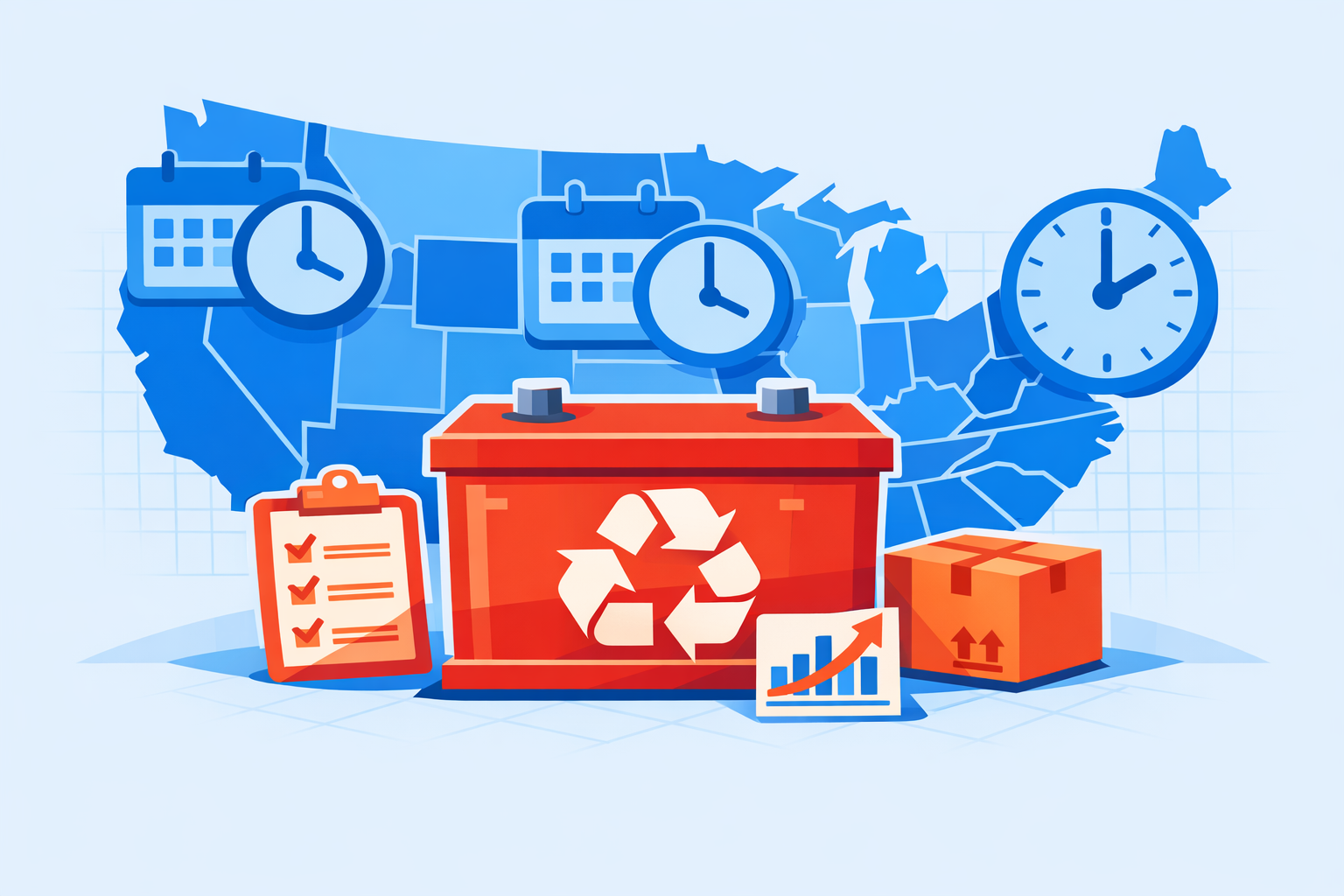
Compliance timelines now vary substantially by state, creating cross-border logistics challenges for Tier-1 and Tier-2 automotive suppliers. Vermont's expanded battery EPR program took effect January 1, 2026, adding portable and medium-format rechargeable batteries to its existing single-use framework. New Jersey's law requires producers of certain electric and hybrid vehicle propulsion batteries - including lithium-ion and nickel-metal hydride types - to register with the New Jersey Department of Environmental Protection by January 8, 2025. Beginning January 8, 2026, producers must annually report the number of covered batteries sold or distributed in the state to the NJ DEP. Battery collection and disposal restrictions under New Jersey's law, including a ban on unauthorized disposal as solid waste, take effect January 8, 2027.
In the West, Washington State's SB 5144 requires battery producers to join Battery Stewardship Organizations, with disposal bans taking effect January 2027 for portable batteries and January 2029 for medium-format batteries. California's battery EPR scheme requires producers to create or fund stewardship programs by April 1, 2027, covering most batteries sold in the state. In the Midwest, Colorado's Battery Stewardship Act of 2025 requires producers to join a Battery Stewardship Organization; as of August 1, 2027, no retailer may sell a covered battery or battery-containing product not participating in an approved plan. Nebraska's Safe Battery Collection and Recycling Act of 2025 similarly requires BSO membership, with a disposal ban effective January 1, 2028.
For automotive suppliers, EV propulsion batteries represent the most operationally complex segment. Under New Jersey's law, producers must create and submit management plans to the NJ DEP within 180 days of the department adopting program regulations. Plans may include a complete vehicle take-back program, a battery take-back program, or any other department-approved program. Producers must demonstrate how they will collect, process, and recycle EV batteries while ensuring materials recovery rather than simple disposal.
As of January 1, 2026, the regulatory landscape governing these batteries has fractured into a patchwork of 50 different standards, according to a compliance analysis by the Automotive Recyclers Association. No single federal law governs hybrid batteries; instead, three layers of regulation interact to determine liability, with the Federal Universal Waste Rule (40 CFR Part 273) serving as the baseline in 48 states.
At the federal level, progress toward harmonization remains preliminary. Throughout 2025, the EPA hosted focused conversations on developing a national EPR framework covering all batteries, addressing topics such as covered battery scope, producer responsibilities, and federal-state roles. On July 17, 2025, the EPA and DOE held a virtual session on small and mid-format battery recycling goals, performance measures, and reporting requirements to assess current performance targets and data collection efforts under state battery EPR legislation. The National Waste & Recycling Association has formally endorsed the federal approach, stating its support for discussions about a national framework for battery recovery as state-by-state programs continue to expand. The Trump administration included a proposed rule on lithium battery waste in its latest Regulatory Agenda and updated its related webpage in August 2025, though formal rulemaking had not been announced as of that date.
Outlook
The U.S. still lacks a unified national policy for EV battery recycling, leaving a fragmented regulatory landscape. Establishing a consistent federal, state, and local framework could reduce regulatory uncertainty, mitigate liability concerns, and lower investor risk. For automotive suppliers, the 2027-2028 window represents the period of highest concurrent compliance exposure, with major disposal bans in New Jersey, Washington, California, and Colorado all clustering in that range. The patchwork of state laws creates complexity for national manufacturers and retailers but also drives innovation in recycling technologies and business models. As more states adopt comprehensive legislation, pressure for federal standards may increase, potentially yielding more uniform requirements nationwide.