Seven states. Dozens of deadlines. Penalties of up to $25,000 per day for non-compliance. The US packaging EPR wave is no longer a future concern for automotive manufacturers and their suppliers - it is an active, operational compliance reality.
Seven states currently have packaging EPR programs in place at various stages of implementation, with key deadlines set for 2026 and beyond. For auto parts producers - whose packaging ranges from small hardware blister packs to heavy-duty specialty containers - understanding exactly which milestones land where on the calendar separates strategic preparation from costly, last-minute scrambles.
This article maps the regulatory road ahead, with particular attention to the 2025-2027 window that will define multi-state compliance obligations for procurement leads, packaging engineers, and sustainability teams across the automotive supply chain.
The EPR Landscape: How the US Got Here
A new era of corporate environmental regulation is emerging through EPR packaging legislation. While EPR laws have existed in the US for years covering specific products like paint, electronics, mattresses, and batteries, a new category has joined the list: consumer packaging.[1]
EPR laws fundamentally alter who pays for and manages packaging waste, shifting the financial and operational burden from local governments and taxpayers to manufacturers, importers, and distributors. Producers now bear responsibility for the entire lifecycle of packaging, from production to post-consumer disposal.[2]
For automotive manufacturers and their tier suppliers, the implications are growing. As states and countries adopt EPR laws targeting automotive packaging, batteries, tires, and electronics, vehicle suppliers face increasing exposure. Industry body MEMA is tracking and engaging on these policies to ensure compliance pathways remain clear.
EPR obligations typically apply to OEMs, tiered suppliers who place products or packaging on the market, and importers and brand owners of automotive components. Any company that sells, imports, or distributes auto parts, packaging, or applicable materials may have compliance obligations.
State-by-State Timeline: What Lands When
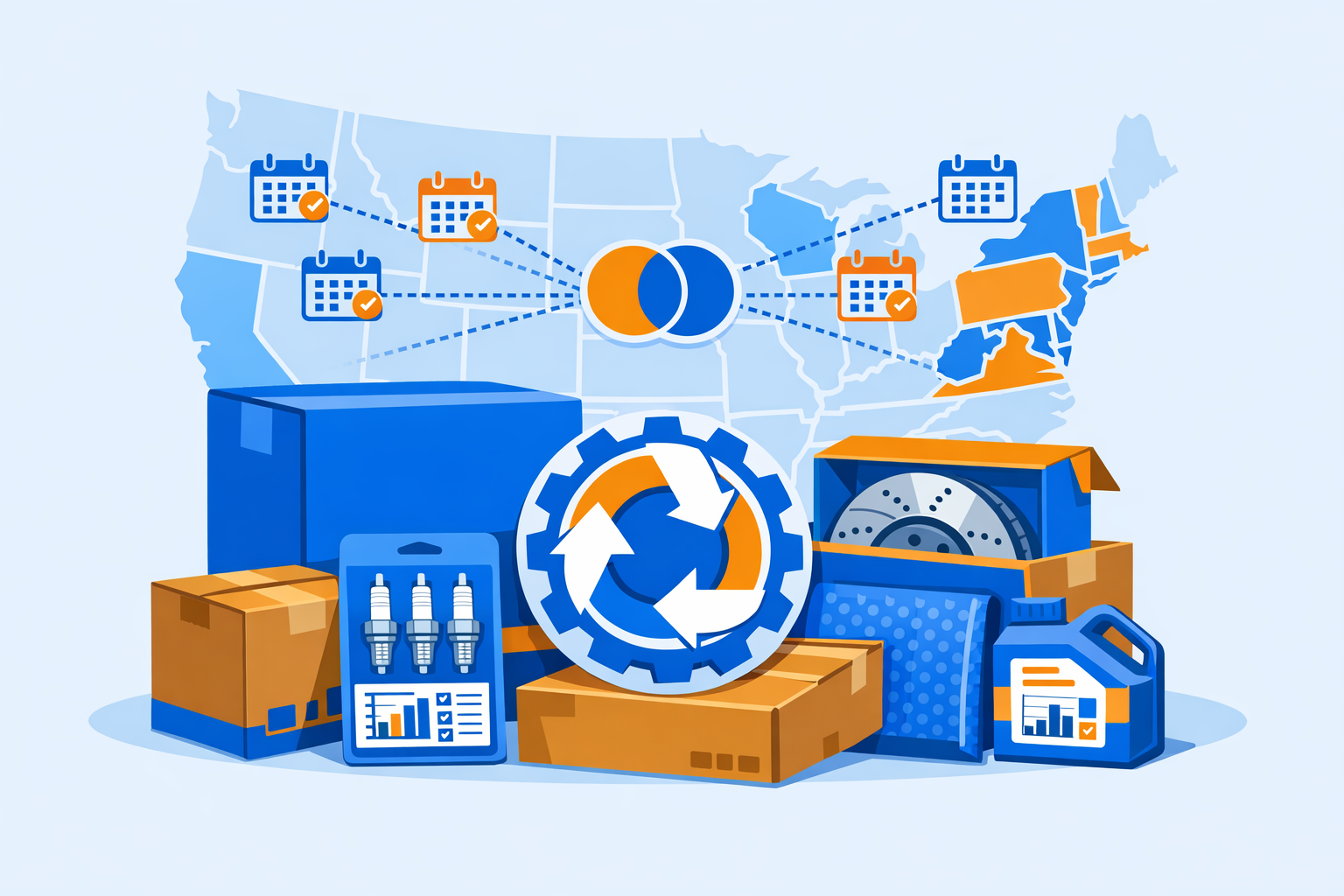
The seven enacted states each operate on distinct timelines, but a pattern is emerging: many now share a harmonized May 31 reporting deadline through the Circular Action Alliance. The administrative burden is becoming more streamlined, but the financial stakes are higher than ever.
Oregon and Colorado: Already Active
On July 1, 2025, Oregon became the first state to officially launch its program, requiring producers to join the Circular Action Alliance (the designated PRO) if they sell, offer for sale, or distribute packaging and related products into the state. Producer fee obligations also commenced from this date.
Colorado's EPR plan took effect January 1, 2026 - the first year Colorado producers began paying mandatory responsibility fees based on the volume and classification of packaging. To remain compliant, companies must register with the CAA and submit detailed material supply reports by May 31, 2026.
California: The 2027 Milestone Everyone Is Watching
California's EPR program begins January 1, 2027. However, 2026 remains a critical preparatory year - producers must submit their material data supply by May 31, 2026, which the state will use to calculate the first round of "early fees" due in August.
California has set aggressive recycling rate, recyclability/compostability, and source reduction targets likely to require significant changes to existing packaging materials and designs, particularly for plastics. Implementing these changes can be costly and time-consuming, often requiring alternative packaging formats.
Maine, Minnesota, Maryland, and Washington: Staggered Through 2028
In Maine, producers must register with the approved stewardship organization and report their estimated packaging data for 2025 by May 2026. The full program is expected to become operational in 2027.
Minnesota's Packaging Waste and Cost Reduction Act requires producers to join a registered PRO by July 1, 2025. PROs must then submit their first comprehensive stewardship plan to the Minnesota Pollution Control Agency by October 1, 2028.
Washington became the seventh state to enact a packaging EPR law in May 2025. Producers must join a PRO by July 1, 2026, although no PRO has yet been approved.
The table below consolidates key deadlines across all seven states for rapid reference.
| State | Enacted Law | PRO Registration | Key Reporting Deadline | Fees Begin | Full Launch |
|---|---|---|---|---|---|
| Oregon | SB 582 (Aug 2021) | Jul 2025 ✅ | May 31, 2026 | Jul 2025 ✅ | Operational |
| Colorado | HB 22-1355 (Jun 2022) | Oct 2024 ✅ | May 31, 2026 | Jan 2026 ✅ | 2026 |
| California | SB 54 (Jun 2022) | Nov 2025 (baseline) | May 31, 2026 | Aug 2026 (early) | Jan 1, 2027 |
| Maine | LD 1541 (Jul 2021) | May 2026 | May 31, 2026 | Sep 2026 | Oct 2027 |
| Minnesota | HF 3911 (May 2024) | Jul 2025 ✅ | Simplified 2026 | TBD - 2028+ | 2028+ |
| Maryland | SB 901 (May 2025) | TBD 2026 | Simplified 2026 | TBD 2027 | 2027+ |
| Washington | SB 5284 (May 2025) | Jul 1, 2026 | May 31, 2026 | TBD 2030+ | 2028+ |
Penalty exposure is active. Oregon's enforcement - including noncompliance penalties of up to $25,000 per day - went into effect on July 1, 2025. Depending on jurisdiction, companies that make or sell products face penalties of up to $50,000 per day for noncompliance.
Why Automotive Packaging Faces a Distinct Compliance Challenge
Most EPR frameworks were designed with fast-moving consumer goods in mind. Auto parts packaging presents a structurally different challenge:
- Range of formats: Packaging spans from small polybags for fasteners to multi-layer corrugated systems for body panels and corrosion-sensitive components, each with different recyclability profiles.
- Multi-material complexity: Protective coatings, foam inserts, vapor-corrosion inhibitor (VCI) films, and custom dunnage often combine materials that are difficult to separate, potentially triggering higher eco-modulation fees.
- SKU volume: A single OEM or Tier 1 supplier may manage thousands of packaging SKUs across multiple states, each requiring individual material classification and weight reporting.
- Indirect supply chain exposure: OEMs are expected to carry EPR obligations and will need packaging information from their suppliers to support compliance. Even if a company is not classified as a "producer" obligated to report directly to a PRO, it may be required to report packaging data to customers doing business in relevant EPR states.
Compliance demands significant time and resources. Collecting and analyzing supply data - the amounts and types of covered materials supplied into each state - and accurately categorizing packaging materials requires close coordination across multiple departments and suppliers.
Eco-Modulation: The Hidden Cost Lever in Auto Packaging Design
Beyond base fee obligations, eco-modulation is the mechanism that will shape packaging redesign decisions across the auto supply chain. Eco-modulation adjusts a producer's base fees up or down based on packaging design and performance. The goal is to reward packaging choices that reduce environmental impact and improve recycling outcomes while increasing costs for packaging that creates higher system burdens.
Eco-modulation multipliers can reduce fees by up to 50% for easily recyclable designs or increase them by 100% or more for problematic packaging. For automotive packaging engineers, this means:
- Mono-material formats (e.g., corrugated cardboard without plastic coatings) earn lower fees than multi-material assemblies.
- PCR content integration - one of eco-modulation's most significant effects is its ability to stimulate demand for post-consumer recycled content. By offering reduced EPR costs for packaging incorporating higher percentages of recycled materials, a compelling economic rationale emerges for businesses to prioritize PCR usage.
- Life Cycle Evaluations (LCEs) - conducting product-level life cycle analyses may provide further fee reductions for companies in Oregon.
Given the variability among states, producers and brand owners should standardize packaging to meet the most stringent eco-modulated fee requirements. Creating different packaging formats for every state would be cost-prohibitive.
A Six-Step Compliance Checklist for Auto Packaging Teams
The following sequence provides a practical framework for procurement, engineering, and sustainability teams working toward 2026-2027 deadlines. For additional background on how OEMs are approaching standardization across borders, see earlier coverage of how auto suppliers are seeking unified packaging standards ahead of EPR rules.
Step 1 - Determine producer status. Identify whether the organization qualifies as a producer under each state's definition. OEMs are almost universally classified as producers. Tier 1 and Tier 2 suppliers may also carry obligations depending on whether they hold the brand.
Step 2 - Build a Packaging Bill of Materials (BOM). Establish a BOM for specific packaging SKUs, with weights and material categorizations for each. This centralized dataset enables accurate tracking and reporting while providing clear visibility into eco-modulation improvement opportunities over time.
Step 3 - Register with the Circular Action Alliance (CAA). The CAA is the designated PRO for Oregon, Colorado, California, Minnesota, Maryland, and Washington. Registration is mandatory before selling covered packaging into active states.
Step 4 - Meet the May 31 reporting window. Producers must detail all covered materials sold into each state during the prior calendar year. With multiple states converging on this date, auto parts manufacturers with multi-state distribution must ensure data pipelines are ready well in advance.
Step 5 - Audit for eco-modulation gains. Evaluate packaging designs against each state's recyclability criteria and bonus/malus schedules. Reducing multi-material complexity and increasing PCR content are the highest-leverage moves.
Step 6 - Update supplier contracts. Ensure staff involved in reporting are trained and understand the importance of accurate data, as inaccurate or misleading submissions could result in state-issued fines and penalties. Supplier contracts should require packaging material disclosures including weight, material type, and recyclability certifications.
See also: how recycled-content packaging strategies are shifting across US automakers for more on supplier-level PCR sourcing trends.
Industry Wish List: What Would Make Multi-State Compliance Workable
The current patchwork creates disproportionate friction for auto parts manufacturers operating nationally. Several structural improvements would materially reduce compliance costs and accelerate design-cycle adaptation:
- Aligned recyclability definitions. States currently apply different standards for what constitutes "recyclable" packaging. A single, nationally recognized recyclability list - analogous to Oregon's Uniform Statewide Recyclable List - would reduce testing duplication across SKUs.
- Shared eco-modulation testing protocols. A Life Cycle Evaluation conducted for Oregon should be recognized by California and Colorado rather than requiring producers to fund separate assessments per state.
- A centralized, publicly accessible registry of compliant packaging formats. Auto parts packaging engineers need a searchable reference - organized by material type and format - to confirm compliance across multiple state programs simultaneously.
- Standardized supplier data templates. Industry initiatives providing regular updates and practical insights on enacted programs, proposed legislation, and implementation developments help members track emerging requirements. Standardized data templates, agreed at the industry level, would reduce the burden on smaller suppliers providing data to multiple OEM customers.
- Clearer B2B exemption guidance. Auto parts packaging is predominantly commercial and industrial, not residential consumer packaging. States should provide clearer guidance on the extent to which B2B auto parts packaging falls within scope and under what conditions industrial packaging may qualify for reduced obligations.
Forecast: How EPR Will Reshape Auto Packaging Through 2027
EPR is no longer a niche environmental policy concept in the United States. Over the past several years, EPR laws have accelerated rapidly at the state level, reshaping how producers approach packaging, product design, reporting, and end-of-life management. For companies placing goods on the US market, understanding EPR is now less a forward-thinking sustainability exercise than a strategic imperative.
For the automotive sector specifically, three structural shifts are likely by 2027:
Packaging design cycles will shorten. Eco-modulation incentives will compress the traditional 3-5 year packaging redesign cycle as financial penalties for non-recyclable formats accumulate. Engineering teams will need to integrate recyclability testing earlier in the concept phase.
Supplier data requirements will intensify. Nearly every function in a company is affected: product development, sourcing, quality, safety, distribution, sales, marketing, and finance. Suppliers that cannot provide component-level material data in a standardized format risk being deprioritized in sourcing decisions.
Cost structures will shift. Brands should budget 0.5-1% of annual sales for PRO fees, representing a 20-40% increase in packaging spend. For high-volume auto parts distribution, this is a material line item that must be modeled into procurement contracts now rather than absorbed as a surprise in 2027.
The window for proactive action is narrowing. With California's full program launching January 1, 2027, and Maine's program commencing fee collection in late 2026, the second half of this year is the last realistic opportunity to complete packaging audits, finalize supplier data agreements, and stress-test reporting systems before deadlines begin to compress.
For auto parts manufacturers that move now, EPR compliance also presents an opportunity: eco-modulation offers substantial fee reductions for designs that improve recyclability, reduce environmental impact, or support circular economy objectives. Understanding and leveraging these incentives can transform EPR from a compliance cost into a competitive advantage.