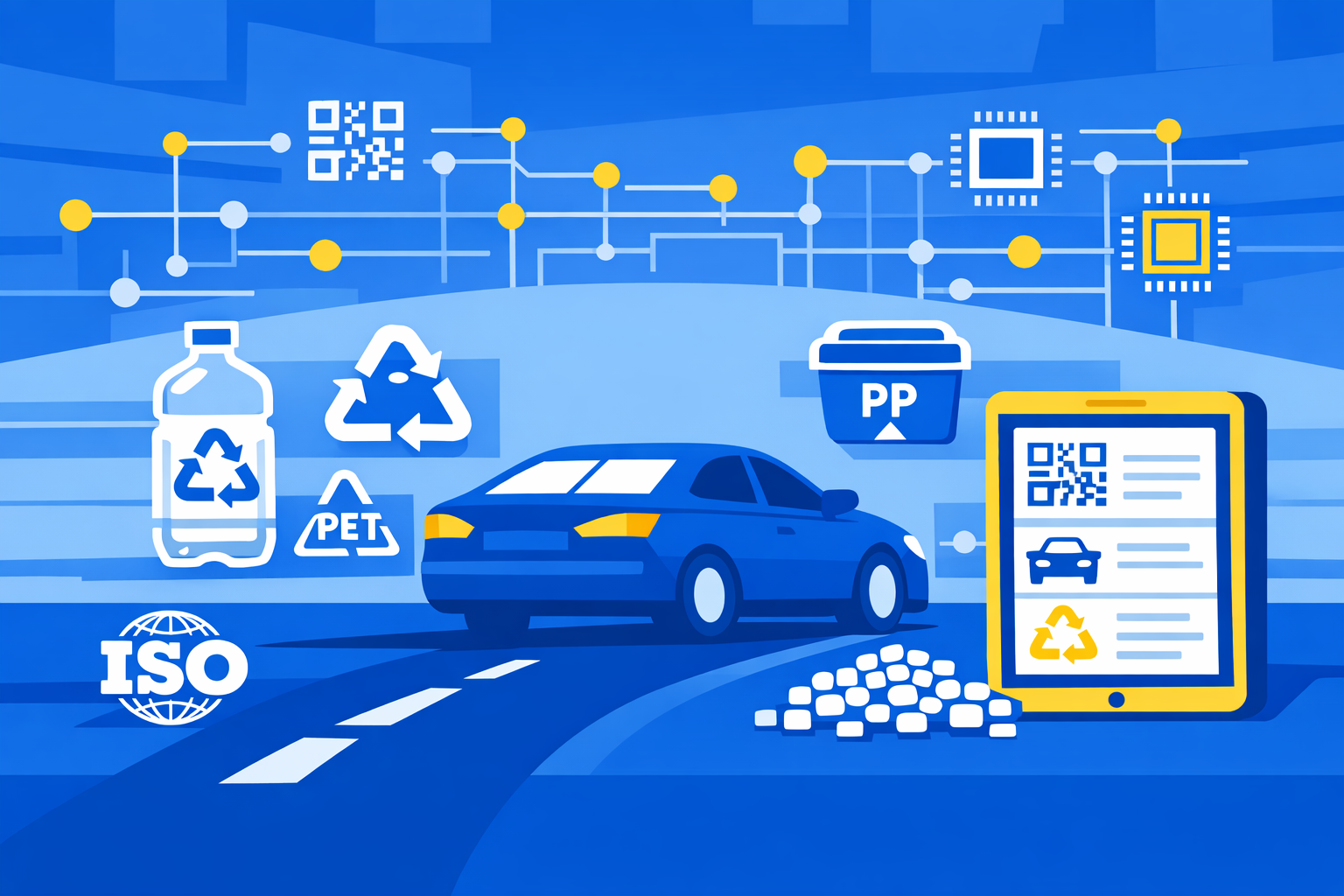
The EU's Digital Product Passport is no longer a distant regulatory concept - and for automotive packaging professionals, the deadline pressure is already tangible. The European Commission formally adopted its ESPR Working Plan 2025-2030 on 16 April 2025, setting a phased timetable that places battery, tyre, and steel packaging in the first enforcement wave. Plastic packaging for the broader automotive supply chain is expected to follow by 2028-2030.
The critical challenge is not simply that a DPP is required. It is that the DPP must contain verified, machine-readable data on recycled content, material composition, and recyclability - and for much of the automotive packaging sector, that data does not yet exist in auditable form.
What the DPP Framework Actually Requires From Packaging
The Digital Product Passport is anchored in Regulation (EU) 2024/1781, the Ecodesign for Sustainable Products Regulation (ESPR), which came into force in July 2024. Under this framework, every product subject to ecodesign measures will require a DPP - a structured digital record linked to a physical product via QR code, RFID, or NFC chip - containing data on materials, sustainability performance, recycled content, and end-of-life instructions.
For packaging specifically, the EU Packaging and Packaging Waste Regulation (PPWR) operates in parallel. Adopted in December 2024, the PPWR (EU) 2025/40 entered into force on 11 February 2025 and will generally apply from 12 August 2026. Businesses assessing PPWR compliance are advised to do so alongside DPP obligations - the recyclability grades, recycled content percentages, and material composition data required for PPWR conformity declarations are precisely the data fields that will populate DPPs.
The European Commission has described the DPP system[1] as creating "a common digital language for product information across value chains." For automotive packaging teams, that language must be spoken fluently - and verifiably - by every tier of the supplier network.
The Automotive Sector: A High-Stakes Test Case
The automotive industry sits at the intersection of multiple DPP obligations simultaneously. The European Commission has proposed a new End-of-Life Vehicles (ELV) regulation that introduces a mandatory Digital Product Passport for vehicles, designed to provide detailed data on vehicle components, materials, and recyclability to support efficient dismantling and material recovery.
Alongside this, the EU is proposing that at least 25% of plastics used in new vehicles must come from recycled sources. This recycled content target does not sit in isolation - it is inseparable from the data infrastructure required to prove it.
Starting in mid-2025, manufacturers in the automotive sector were required to begin embedding detailed material data into components via mandatory digital product passports, listing polymer types (following ISO 1043), additives, fillers, joining methods, and end-of-life instructions.
Leading OEMs are already moving. Stellantis has stated plans to use 40% recycled content in vehicle plastics by 2030[2], working with European recyclers to source post-consumer polypropylene and polyamide compounds with full traceability. BMW Group is testing interior panels made from recycled thermoplastics. Regulatory pressure is translating into commercial procurement decisions - and packaging partners unable to supply verified recycled-content data will face sourcing displacement.
The Recycled-Plastics Certification Problem
Here is where the compliance gap widens. Recycled content claims embedded in a DPP must be substantiated, not self-declared. Certification schemes such as RecyClass, REDcert², and mass-balance audit frameworks under ISO 14021 provide the chain-of-custody documentation that regulators and downstream auditors will require.
The problem is structural. Recycled material sourcing in automotive packaging commonly involves post-consumer polypropylene, ABS blends, and polyamide compounds from multiple recyclers across different member states. Supplier data collection for carbon footprint and recycled content typically requires a minimum of three to six months to establish with sufficient documentation for a DPP-compliant record.
For multi-tier automotive supply chains - where Tier-2 and Tier-3 suppliers often lack digital data systems entirely - this represents a significant lead-time risk. Smaller suppliers are expected to face particular challenges meeting new data requirements[1], while larger manufacturers are already investing in ERP and PLM integration to bridge the gap.
Equally important is technical interoperability. The DPP framework requires data to be structured in GS1 Digital Link and JSON-LD format, built on open, non-proprietary international standards. Most legacy enterprise systems in the packaging sector were not designed to produce outputs in these formats, making middleware integration projects a prerequisite for compliance readiness.
Compliance Timeline: Where Automotive Packaging Fits
The ESPR rollout is sequential. Automotive packaging professionals need to map their exposure across multiple product categories simultaneously.
{{component:TABLE_PLACEHOLDER}}
The battery passport deadline of February 2027 is the most immediate pressure point for automotive packaging. From 18 February 2027, all industrial and electric vehicle batteries above 2 kWh must carry a mandatory Battery Passport documenting recycled content, carbon footprint, performance, and durability. Packaging for these batteries - protective casings, transport unitisation, inner dunnage - will need to align with the data flows of the battery DPP itself.
The EU's push to standardise reusable packaging for automotive aftermarket parts adds a further parallel obligation, with 95% reusable transport packaging required from January 2030. DPP labelling and digital tracking requirements for packaging are expected by August 2028.
The Interoperability Gap: Where Data Gets Lost
Beyond individual product readiness, a systemic data interoperability challenge is emerging across the automotive packaging ecosystem. The DPP must work with other EU digital systems, including customs databases and platforms such as the European Chemicals Agency (ECHA) - meaning data produced by packaging manufacturers must be readable and verifiable across multiple downstream institutional systems.
The automotive industry has an advantage here. The Catena-X data ecosystem - a purpose-built automotive data space - is progressing ahead of schedule[3] as a platform for DPP-linked data exchange between automotive sector companies. Packaging suppliers that integrate with Catena-X early are likely to gain a compliance pathway that tier-one OEM customers will require of them.
For cross-border operations, companies outside the EU supplying regulated goods into the EU market are also required to comply with DPP documentation obligations. Non-EU packaging manufacturers shipping automotive packaging to European assembly plants must appoint an authorised EU representative and ensure DPP data standards are met before goods enter the single market.
Assess Your DPP Readiness
The following interactive tool helps automotive packaging professionals benchmark their organisation's current state across three critical dimensions of DPP compliance: data infrastructure, recycled content certification, and cross-border compliance mapping.
{{widget:WIDGET_PLACEHOLDER}}
Key Compliance Pressures to Address Now
{{component:CALLOUT_PLACEHOLDER}}
Outlook: Cost and Lead-Time Implications
DPP compliance is not cost-neutral. Organisations building data collection programmes from scratch should anticipate meaningful investment in supplier onboarding, PLM/ERP integration, and certification audits. Those that delay face steeper costs at enforcement - either through rushed system implementation or, more significantly, through loss of procurement positioning with OEMs that mandate DPP-compliant supply chains.
The smart packaging capabilities - RFID, QR-code tracking, sensor-enabled traceability - already adopted for spare parts logistics provide a partial foundation. However, the DPP requires not just a digital identifier on the packaging but a verified, structured data record behind it.
Packaging engineers, sustainability managers, and procurement leads should treat 2025-2026 as the window to build that foundation: establishing supplier certification requirements, piloting DPP-ready data flows on high-volume SKUs, and mapping exposure across the ESPR product category timeline. The certification and data infrastructure investments required now are substantially lower than the compliance remediation costs that will follow if action is deferred to 2027.